Bridging the Deployment Gap: Architectural Patterns for LLM-Based Agents in Production
The rapid evolution of Large Language Model (LLM) frameworks has democratized the creation of agentic AI. Today, a developer can build a script that enables an agent to loop through tools, perform web searches, and synthesize information in a matter of hours. However, a significant "deployment gap" persists between these functional prototypes and robust, production-grade applications.
Real-world agent workflows are fraught with challenges: complex multi-step reasoning, volatile API latencies, and critical dependencies that, if mismanaged, lead to system timeouts, memory leaks, and catastrophic user experience failures. To transition from a local notebook to a reliable service, architects must move beyond simple scripting and embrace formal distributed system paradigms. This article explores the two primary architectural pillars for agent execution—synchronous and asynchronous patterns—and provides a roadmap for choosing the right framework for your production environment.
The Anatomy of the Deployment Gap
The "deployment gap" in agentic AI is not merely a matter of code complexity; it is an issue of state management and infrastructure resilience. When an agent is designed to act as an autonomous entity, it ceases to be a simple function call. Instead, it becomes a long-running process that requires consistent state tracking, error handling, and resource orchestration.
In production environments, external factors—such as network jitter, LLM provider rate limits, and tool-use latency—introduce non-deterministic execution times. A synchronous model, while intuitive, assumes that the caller has infinite patience and the connection will remain stable throughout the agent’s entire reasoning chain. In reality, cloud infrastructure, such as AWS API Gateway, enforces strict timeouts (often 29 seconds), meaning any agentic workflow exceeding this window will result in a dropped request, wasted compute tokens, and a frustrated user.
Synchronous Execution: The "Wait and See" Paradigm
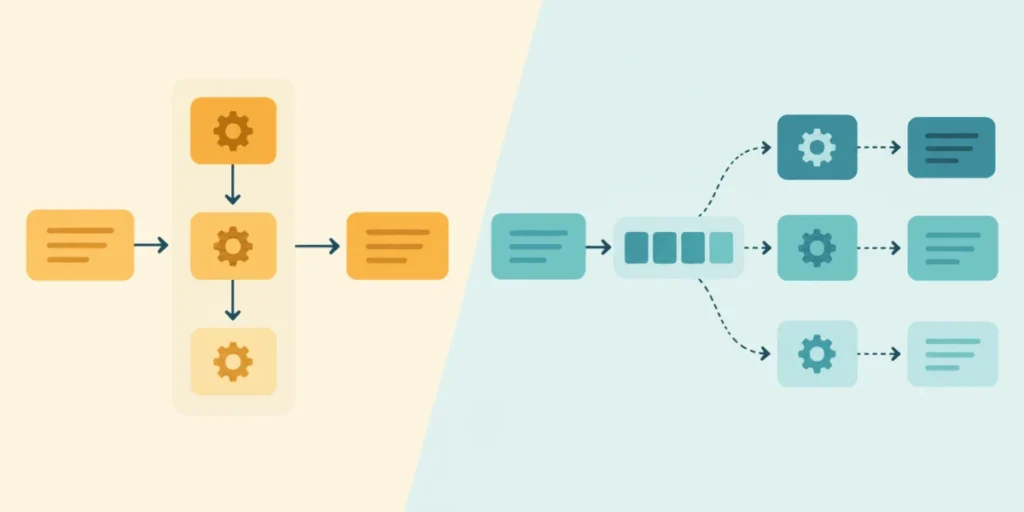
The synchronous execution pattern is the digital equivalent of a classic HTTP request-response cycle. In this configuration, a client submits a prompt to the agent, and the server thread remains blocked—occupied entirely by the agent’s reasoning loop—until a final response is generated.
Core Rationale and Use Cases
Synchronous architectures are best reserved for high-speed, low-complexity interactions. They excel in scenarios such as:
- Standard RAG Pipelines: Where retrieval and synthesis occur within a predictable, short timeframe.
- Latency-Sensitive Chatbots: Where immediate feedback is essential to user retention.
- Internal Tooling: Where the volume of requests is low and the complexity of the agent’s reasoning chain is strictly bounded.
Architectural Constraints
The primary vulnerability of the synchronous approach is its fragility. Because the connection is tied to the lifecycle of the agent, any hiccup in the reasoning process results in a total failure of the request.
Consider a scenario where an agent must plan, search the web, and aggregate results. If the web search provider takes 10 seconds and the LLM reasoning takes another 20 seconds, the agent is already pushing the limit of most standard load balancer timeouts. If a single retry is required due to an API error, the total time will inevitably exceed the timeout threshold, leading to a "504 Gateway Timeout" error.
Implementing a Synchronous Mock
The following Python implementation demonstrates the blocking nature of this pattern. We simulate a mock_llm_call that includes network latency, followed by a synchronous_agent loop.
import time

def mock_llm_call(prompt):
    """Simulates an LLM call with built-in latency."""
    time.sleep(1)  # Simulate network latency
    if "research" in prompt.lower():
        return "action": "tool_call", "tool": "web_search", "query": "latest agent news"
    return "action": "final_answer", "text": "Found the data! Agents are scaling."

def synchronous_agent(query):
    print(f"[Sync API] Blocking thread to process: 'query'")
    for step in range(3):
        print(f"  -> Agent Step step+1: Thinking...")
        response = mock_llm_call(f"query (step step)")
        if response["action"] == "final_answer":
            return response['text']
        else:
            print(f"  -> Executing Tool: response['tool']")
            query = "Tool output: 'Agents require async architecture for scale.'"
    return "Agent failed to complete in time."
As illustrated, the thread is held hostage until the final return. In a production setting, if the max_steps were increased or the network slowed down, the client would receive nothing but a timeout error.
Asynchronous Execution: The "Fire and Forget" Model
As agentic tasks grow in complexity—such as codebase refactoring, multi-agent debates, or workflows requiring Human-In-The-Loop (HITL) approval—the synchronous model collapses under its own weight. This is where asynchronous, event-driven architectures become mandatory.
Decoupling Tasks for Reliability
Under the asynchronous pattern, the submission of a task and its completion are fully decoupled. When a client sends a request, the API gateway receives it, assigns a job_id, and immediately acknowledges the receipt. The actual heavy lifting is offloaded to a background queue, where worker nodes process the task at their own pace.
This paradigm offers several critical advantages:
- Fault Tolerance: If a worker node crashes, the job remains in the queue or is marked as failed, allowing for automated retries or manual intervention without affecting the user interface.
- Persistence: Because the state is checkpointed to a database (like PostgreSQL or Redis), the agent can resume execution after a reboot.
- Scalability: You can scale your worker fleet independently of your API gateway, allowing you to handle spikes in traffic without overwhelming your request handlers.
The Infrastructure Overhead
The tradeoff for this resilience is operational complexity. An asynchronous system requires:
- Message Brokers: Tools like RabbitMQ, Redis, or Amazon SQS to manage task distribution.
- Persistent Storage: Databases to track state, logs, and metadata for every job.
- Monitoring: Sophisticated observability tools to track the health of background workers and the lifecycle of tasks.
Implementing an Asynchronous Worker
Using Python’s asyncio library, we can simulate an event-driven agent worker.
import asyncio
import uuid

task_queue = asyncio.Queue()
database =

async def agent_worker():
    while True:
        task = await task_queue.get()
        task_id = task['id']
        database[task_id] = "Running step 1 (Planning)..."
        await asyncio.sleep(1.5) # Simulate heavy lifting
        database[task_id] = "Completed: Report generated."
        task_queue.task_done()

async def submit_job(prompt):
    task_id = str(uuid.uuid4())[:8]
    await task_queue.put("id": task_id, "prompt": prompt)
    database[task_id] = "Pending"
    return task_id
In this model, the API layer is freed almost instantly. The user receives a job_id and can poll a status endpoint, ensuring the connection remains open and the user experience remains responsive, regardless of the time required to complete the task.
Comparing Execution Patterns: Implications for Production
When evaluating these patterns, developers must consider the specific needs of their application lifecycle.
The Case for Synchronous
- Pros: Minimal infrastructure, low maintenance, easier debugging, lower latency for short tasks.
- Cons: Highly susceptible to timeouts, poor scalability, prone to resource exhaustion if many long-running tasks are initiated simultaneously.
The Case for Asynchronous
- Pros: High resilience, excellent for long-running processes, enables complex multi-step workflows, inherently scalable.
- Cons: Requires message brokers and persistent storage, more complex development cycle, requires a robust monitoring strategy.
Strategic Recommendations
For organizations looking to scale their AI capabilities, the transition from synchronous to asynchronous is inevitable. However, a "big bang" migration is rarely recommended.
1. Start Synchronously for Discovery
Build your initial agents using synchronous patterns to validate the core reasoning logic and tool-use capabilities. This reduces the cognitive load on the development team and accelerates the feedback loop.
2. Introduce "Async" via Progressive Refactoring
Identify tasks that regularly approach the 20-second mark and migrate them to an asynchronous queue. Use simple polling mechanisms initially, moving to WebSockets or Webhooks for real-time updates as your frontend architecture matures.
3. Invest in Observability
Regardless of the pattern chosen, you must have visibility into the agent’s "thought process." In asynchronous systems, this is even more critical. Ensure every transition in your agent’s state machine is logged to a centralized store so you can reconstruct the sequence of events if a failure occurs.
Conclusion
The evolution of AI agents from local experiments to production-ready systems is fundamentally an architectural challenge. While synchronous patterns offer a low barrier to entry, they are insufficient for the non-deterministic nature of modern AI. By embracing asynchronous, event-driven architectures, developers can build systems that are not only resilient to the inherent unpredictability of LLMs but are also capable of scaling to meet the demands of enterprise-grade applications.
The future of agentic AI lies in this transition—from "wait-and-see" scripts to robust, distributed systems that can handle the complexity of tomorrow’s autonomous workflows.