Inside WordCamp US 2026: AI, Enterprise Scale, and a Renewed Push for Radical Simplicity in Phoenix
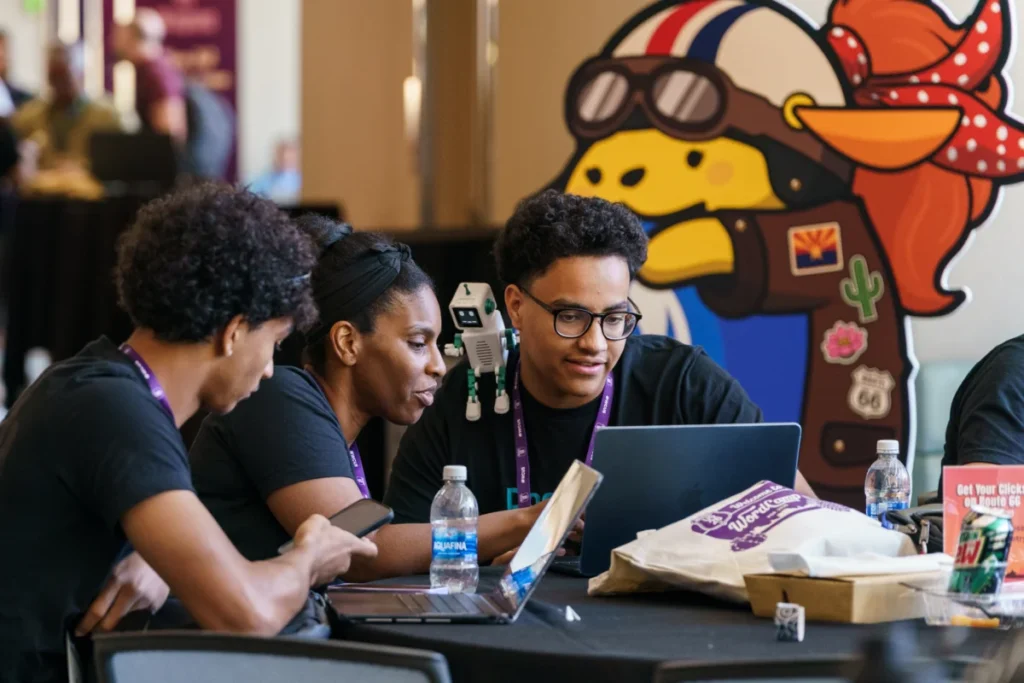
PHOENIX, Arizona — Beneath a punishing 111°F (44°C) desert sky, the global open-source community converged on the Phoenix Convention Center for WordCamp US (WCUS) 2026. Over four intensely packed days, more than 1,100 in-person attendees—augmented by thousands more tuning into global livestreams—tackled the tectonic shifts facing the world’s most popular content management system.

From the rapid, disruptive integration of artificial intelligence (AI) to massive enterprise migrations, supply-chain safety, and a surprise philosophical pivot toward radical software minimalism, WCUS 2026 captured a pivotal crossroads for WordPress.

Main Facts: WCUS 2026 by the Numbers
- Dates: Mid-August 2026 (spanning Contributor Day, Showcase Day, and two core conference days).
- Location: Phoenix Convention Center, Phoenix, Arizona (with air-conditioned golf carts ferrying attendees from the Sheraton Phoenix Downtown).
- Attendance: Over 1,100 registered attendees on-site, alongside a robust international digital audience.
- Core Software Milestone: The live release of WordPress 7.1 (“Mary Lou”), which racked up hundreds of thousands of downloads within hours of launch.
- Civic Recognition: Phoenix Mayor Kate Gallego officially proclaimed August 19, 2026, as Phoenix WordPress Day.
- Global Looking Ahead: The event set the stage for upcoming flagship gatherings, including the annual State of the Word, WordCamp Asia 2027 in Penang, Malaysia, and WordCamp Europe 2027 in Málaga, Spain.
Chronology of the Event
Day One: Contributor Day and the "Real Artists Ship" Ethos
The week kicked off with a reimagined Contributor Day operating under the mantra, "Real artists ship." Eschewing vague, open-ended participation, the 425 participants—including 29 first-time contributors—organized themselves into 26 hyper-focused teams with strict, same-day delivery mandates.

Instead of traditional sprawling groups, goal owners pitched their projects in rapid 30-second intervals. Participants fluidly moved between teams as tasks captured their interest.

- The Output: Contributors successfully closed critical tickets, shipped pull requests, and tested theme accessibility.
- Key Projects: One team engineered new description-list blocks for glossaries and product details; another built comprehensive email settings, testing tools, and account recovery verification checks. Additional groups constructed a Photo Directory importer, modernized dashboard and multisite documentation, and pushed forward core PHP and PHPUnit testing standards.
Day Two: Showcase Day and Enterprise Migrations
Shifting from code contributions to real-world deployment, Monday’s Showcase Day highlighted how large-scale publishers and civic institutions maintain robust operations on WordPress.

Discussions centered on digital sovereignty and breaking away from restrictive proprietary or hosted platforms. Standout case studies included:

- The Ankler: Nicola Catton detailed the monumental migration of 15 distinct newsletters from Substack to a custom WordPress block theme, allowing the independent publication to reclaim full control over subscriber data, paywall architectures, and revenue models.
- Daily Kos: Ben Greeley and Allison McHenry outlined the migration of a massive community-driven political platform boasting 2.7 million users, 1.5 million posts, and 88 million comments—a feat achieved via a public beta involving over 500 community members.
- Civic Infrastructure: Manny Costa addressed public-service digital ecosystems, demonstrating how municipal sites leverage WordPress for emergency alerts, resident services, and government transparency, where accessibility and strict governance are mandatory.
Days Three & Four: Core Conference, Keynotes, and the Call for Simplicity
The main conference days featured more than 50 speaker-led sessions spanning AI, publishing, security, accessibility, and business ownership.

AI dominated the dialogue, but not in the hyperbolic, utopian terms of previous years. Instead, speakers across multiple tracks converged on a sobering realization: AI does not eliminate labor; it relocates it. Whether dealing with machine-translated multilingual technical content or AI-generated code snippets that frequently overlooked keyboard navigation or introduced insecure software dependencies, speakers stressed that human judgment must remain firmly in the loop.

The event reached its climax during the closing session, which combined civic honors—such as Chief Innovation Officer Michael Hammett presenting Mayor Kate Gallego’s official WordPress Day proclamation to co-founder Matt Mullenweg—with a forward-looking architectural vision.

Supporting Data & Technical Insights
The Rise of WordPress Piplets
In a wide-ranging, dynamic discussion alongside Robert Jacobi, Matt Mullenweg threw down a surprising gauntlet for the future of the platform: Simplicity must supersede complexity.

Highlighting how modern AI models inherently favor simple, self-contained HTML and code files, Mullenweg introduced WordPress Piplets—a modern evolution of a 2007 concept. Piplets package an entire functional site into a single, self-modifying PHP file that manages its own data without relying on external databases or third-party packages. Capable of holding up to 25 megabytes (roughly four million words) and loading in a blistering 50 milliseconds, Piplets represent an extension of lightweight experiments like WordPress Playground, pointing toward a future where single-file apps can be easily published, forked, and remixed via WordPress.org.

Profile Redirection and Release 7.1
- Profile Links: WordPress.org streamlined community identity, rolling out ultra-short profile redirects in the format
w.org/@username(such asw.org/@matt). - WordPress 7.1 "Mary Lou": Released live on stage amid raucous applause, the latest core update immediately scaled across hundreds of thousands of active installs, delivering refined developer tools and performance tweaks.
Official Responses and Perspectives
Open-source sustainability and trust emerged as core product practices throughout the conference.

- Bo English-Wiczling (Keynote): Addressed the psychological friction of adopting automated tools, noting that trusting AI requires the same rigorous peer-review habits the WordPress community has honed over decades: "AI doesn’t remove your work. It moves it."
- Loyal Pyczynski (Disney/Meta Alumnus): Emphasized iterative development and creative confidence, famously reminding attendees: "We need to make sure that we make better mistakes tomorrow. Success is an iterative endeavor, and time is our most precious resource."
- Amanda Ventura (Waymo): During a cross-industry fireside chat with David Levine, Ventura reframed trust not as a marketing buzzword, but as an ongoing operational commitment. Detailing how Waymo adapted its autonomous vehicle app for visually impaired riders through iterative physical and digital feedback, she demonstrated that user trust requires relentless listening and rapid product adaptation.
- Matt Mullenweg on "Five for the Future": Critiqued the current self-reported pledge system, which claims two million hours of sponsored contribution weekly across 150,000 contributors. Mullenweg advocated for tying official recognition directly to verifiable on-chain project impact—such as code commits, resolved tickets, and organized WordCamps—rather than unverified pledges.
Implications for the Open Web
WordCamp US 2026 exposed a community maturing in real-time. As AI tools accelerate code generation and content creation, the open-source ecosystem is actively grappling with structural risks, including supply-chain integrity (highlighted by Core committer Jonathan Desrosiers) and login security (explored by Robert Abela).

At the same time, the migration case studies from The Ankler and Daily Kos signal a powerful industry counter-trend: creators, publishers, and enterprises are actively fleeing closed corporate silos in favor of self-hosted open-source infrastructure that preserves data sovereignty.

Ultimately, WCUS 2026 served notice that while WordPress continues to scale into enterprise environments and integrate cutting-edge machine learning, its long-term survival depends on an uncompromising commitment to human oversight, robust security, and—above all—radical software simplicity.