Mastering Agentic Precision: Fine-Tuning Llama 3 for Reliable Custom Tool Calling
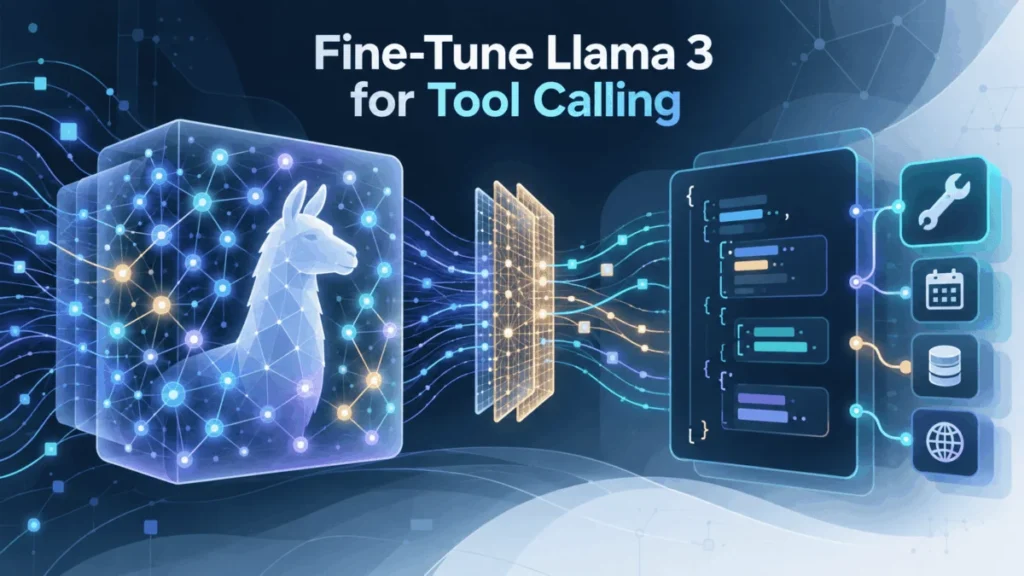
In the rapidly evolving landscape of Large Language Models (LLMs), the transition from "chatting" to "acting" represents the next frontier of artificial intelligence. While models like Meta’s Llama 3 8B are exceptional at creative writing and general reasoning, they often struggle with the rigid requirements of programmatic integration. When an LLM acts as an autonomous agent, a single hallucinated word or a stray sentence of conversational filler can crash an entire software pipeline.
To bridge this gap, developers are increasingly turning to fine-tuning—not for knowledge acquisition, but for behavioral conditioning. By utilizing Unsloth and QLoRA (Quantized Low-Rank Adaptation), developers can now transform Llama 3 into a high-precision tool-calling engine capable of returning strictly formatted JSON payloads, all within the constraints of a free-tier Google Colab environment.
The Core Problem: Why Base Models Fail at Tool Use
The fundamental challenge in agentic AI is "output drift." When tasked with interacting with an API—such as retrieving a stock price or querying a weather service—a generalist model is trained to be helpful and conversational. Consequently, even when prompted to "return only JSON," the model is statistically likely to preface its output with phrases like, "Certainly! Here is the JSON for your request:" or append an explanation afterward.
In a production environment, this prose is catastrophic. Code parsers expecting a raw JSON object will throw an error when they encounter conversational text, causing the "agentic loop" to break. While prompt engineering can mitigate these issues, it remains a fragile solution that consumes expensive context window tokens and fails under the pressure of complex, multi-step queries.
Fine-tuning changes the model’s fundamental response distribution. By training the model on a specialized dataset where the only acceptable output is a clean, schema-compliant JSON string, we are effectively pruning the "conversational" pathways of the model and reinforcing the "functional" ones.
Chronology of the Implementation Workflow
Successfully implementing this transformation requires a structured approach. The process can be broken down into five distinct phases:
1. Environment Preparation
The journey begins by configuring the computational environment. We leverage Unsloth, an optimization framework that significantly reduces memory overhead, allowing for the fine-tuning of 8B parameter models on the relatively limited VRAM of a T4 GPU. The installation utilizes bitsandbytes for 4-bit quantization, which maintains model intelligence while drastically lowering the memory footprint.
2. Attaching LoRA Adapters
Rather than updating the billions of parameters within Llama 3, we utilize LoRA. This technique freezes the pre-trained weights and injects small, trainable matrices into the attention layers. By training only ~1% of the total parameters, we achieve the behavioral shift required for tool calling without the risk of catastrophic forgetting or the need for enterprise-grade hardware.
3. Constructing the Training Dataset
This is the most consequential phase. The model requires a dataset consisting of three parts:
- The System Prompt: A strict definition of the available tools and their JSON schemas.
- The User Query: A natural language request that necessitates a specific tool.
- The Gold Standard Output: The exact, unadorned JSON payload the model should produce.
4. Training the Agent
Using the TRL (Transformer Reinforcement Learning) SFTTrainer, the model is exposed to these examples. During this process, we monitor the loss function. A healthy training run shows a steady decline in loss, signaling that the model is successfully learning to map user intent directly to the required JSON structure.
5. Inference and Validation
Once trained, the model is switched to inference mode. We test it against "unseen" queries—prompts that were not in the training set—to ensure the model has internalized the pattern of tool calling rather than simply memorizing the training data.
Supporting Data: Efficiency and Performance
The efficacy of this workflow is supported by the efficiency of the QLoRA architecture. In traditional full-parameter fine-tuning, the memory requirements for an 8B model would exceed 40GB of VRAM. By contrast, the QLoRA approach combined with Unsloth’s optimized kernels allows this entire pipeline to operate under 16GB of VRAM.
| Metric | Full Fine-Tuning | QLoRA (Unsloth) |
|---|---|---|
| VRAM Usage | > 40 GB | < 12 GB |
| Training Speed | Slow | 2x – 3x Faster |
| Precision Loss | Negligible | Negligible |
| Hardware Requirement | A100 / H100 | T4 (Free Colab) |
The reduction in compute requirements does not come at the cost of performance. Because we are targeting the attention heads (specifically the q_proj, k_proj, and v_proj modules), the model retains its core language capabilities while developing a "reflex" for JSON formatting.
Implications for Autonomous Agents
The implications of this technology for the software industry are profound. When an agent can reliably call tools without manual oversight, the potential for autonomous workflows increases exponentially.
Reliable API Orchestration
The primary implication is the creation of "Reliable Middleware." Developers can create agents that act as a bridge between human intent and complex legacy systems. For example, a customer service agent can now be fine-tuned to pull data from a SQL database, perform arithmetic calculations, or trigger email workflows, all through standard JSON interfaces.
Cost-Effective Specialization
Because these models can be trained in minutes on free or low-cost hardware, businesses can move away from monolithic, "one-size-fits-all" models. Instead, an organization can maintain a fleet of "specialized" Llama 3 agents—one for financial analysis, one for database management, and one for CRM interactions—each optimized for its specific toolset.
Reduced Latency and Token Costs
Prompt-engineered agents often require massive system prompts to "remind" the model how to behave. These prompts are sent with every single request, consuming valuable tokens. A fine-tuned model requires significantly less "behavioral instruction" in the prompt, leading to lower latency and reduced operational costs over millions of API calls.
Conclusion and Future Outlook
Fine-tuning Llama 3 8B for custom tool calling is no longer a task reserved for large research labs. Through the democratization of tools like Unsloth and the efficiency of QLoRA, individual developers can now create robust, agentic systems that are both reliable and performant.
The journey from a generalist language model to a specialized tool-calling agent is defined by the quality of the dataset and the discipline of the training process. By focusing on consistent, structured examples and keeping LoRA ranks optimized, practitioners can eliminate the volatility that has historically hindered LLM-based automation.
As we look toward the future, the integration of these models into frameworks like LangChain or LlamaIndex will become standard practice. The ability to "teach" a model to speak the language of your API is not just a technical optimization—it is the foundational capability required for the next generation of truly autonomous, reliable AI agents. Whether you are building a financial bot or an automated research assistant, the path forward is clear: define the schema, prepare the data, and train for the behavior you need.