Mastering the Architecture of Information: A Strategic Guide to RAG Chunking
In the rapidly evolving landscape of generative AI, Retrieval-Augmented Generation (RAG) has emerged as the gold standard for grounding Large Language Models (LLMs) in proprietary or domain-specific data. Yet, the bridge between raw data and accurate retrieval is often broken by a seemingly mundane architectural choice: chunking.
As developers scale RAG systems from proof-of-concept to production, they frequently encounter the "context wall." Because embedding models and LLM context windows have finite limits, documents must be partitioned into smaller segments. However, the mechanism of this partitioning—the "chunking strategy"—is the silent determinant of retrieval success. When boundaries are poorly defined, the system loses the semantic cohesion required to answer complex queries, leading to "hallucinations" or, worse, irrelevant results.
This article provides a rigorous, decision-tree-based framework for selecting the optimal chunking strategy, ensuring that your RAG pipeline is both efficient and semantically precise.
The Core Mandate: Why Chunking Defines RAG Performance
At its core, a chunking strategy is an assumption about how information is organized. Whether you are processing dense legal contracts, concise FAQ entries, or complex technical specifications, the way you "slice" that text dictates what the vector search engine sees.
If your boundaries sever a subject from its context, the embedding model will struggle to generate a vector representation that accurately captures the intent. While techniques like reranking and prompt engineering are powerful, they are not "recovery" tools for poor preprocessing. If the semantic link is broken at the ingestion phase, no amount of downstream tuning can fully reconstruct the original meaning. Therefore, selecting a strategy must be a conscious engineering decision based on document structure rather than a default configuration.
Chronology of Decision: A Systematic Approach
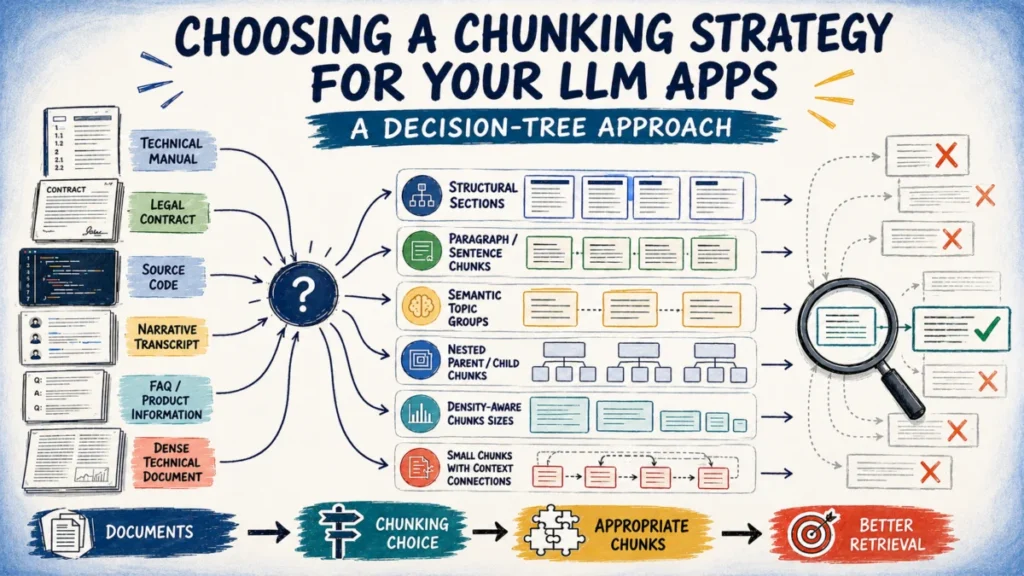
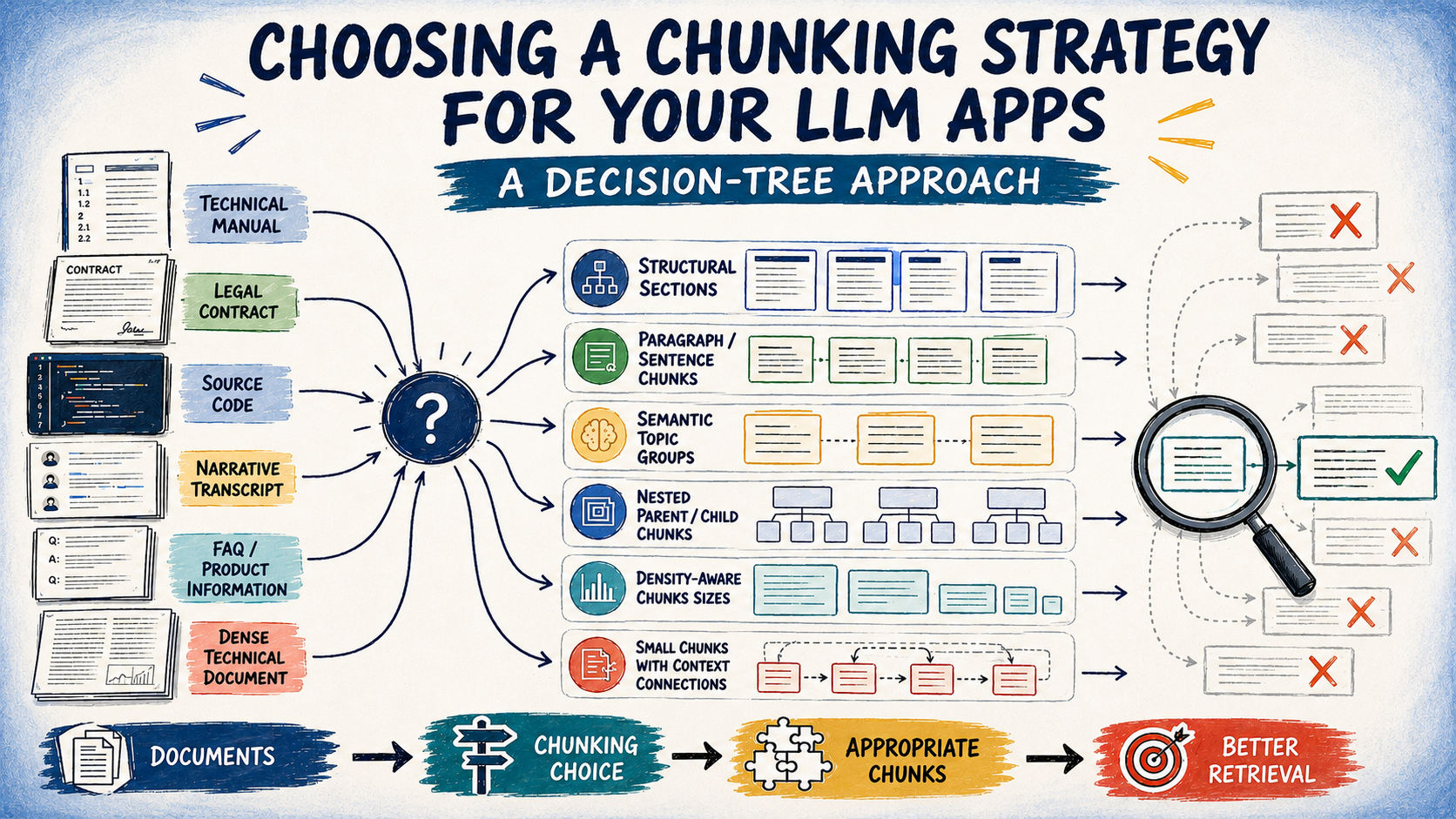
To navigate the complexity of chunking, developers should follow a structured decision tree. This approach systematically reduces the scope of options by evaluating the document’s physical properties and the retrieval task’s specific demands.
Question 1: Does the Document Need Chunking at All?
Before implementing complex pipelines, evaluate the document’s footprint. Short-form content—such as product descriptions, single-issue FAQ entries, or configuration snippets—often fits comfortably within a model’s context window. If the content is self-contained and does not cross-pollinate with other subjects, skip chunking entirely. Over-segmenting coherent content introduces unnecessary fragmentation, which can dilute the signal-to-noise ratio during retrieval.
Question 2: Does the Document Possess Structural Integrity?
If your data is structured—think Markdown headers, HTML tags, or code classes—leverage that inherent architecture. Document-based chunking is highly effective here, as it preserves the natural logic of the text. By splitting according to structural markers, you ensure that a paragraph remains associated with its preceding header, preserving the context essential for high-quality retrieval.
Question 3: Are There Dependencies Across the Document?
For technical manuals or legal documents, meaning is often distributed across the text. A term defined on page one might be invoked on page fifty. In such cases, standard local chunking fails. Late chunking is the solution: you embed the entire document first using a long-context model, then derive the chunk embeddings from the resulting representation. This ensures each segment retains a "memory" of the document’s global context.
Question 4: How Do You Manage Density and Granularity?
Information density is rarely uniform. In scenarios where a document contains both high-level summaries and granular technical details, hierarchical chunking allows for multi-scale retrieval. By creating parent-child relationships between chunks, the system can retrieve a specific detail while keeping the broader context accessible.
Question 5: Prioritizing Quality vs. Computational Cost
This is the ultimate RAG trade-off. If retrieval accuracy is mission-critical, LLM-based chunking—where a model is used to identify logical breakpoints—is the gold standard. While computationally expensive, it offers the highest semantic fidelity. If budget constraints are tighter, semantic chunking provides a middle ground, using embedding distance to detect topic shifts dynamically.
Question 6: Assessing the Collection
Finally, consider the variety of your corpus. If your system handles a heterogeneous collection of documents—ranging from financial reports to informal transcripts—agentic chunking is required. An intelligent agent can classify the document type upon ingestion and dynamically select the optimal strategy, ensuring that each piece of content is processed according to its unique characteristics.
Supporting Data: Comparative Analysis of Strategies
| Strategy | Primary Assumption | Ideal Use Case | Trade-off |
|---|---|---|---|
| Fixed-size | Boundary location is irrelevant | Rapid prototyping | Ignores semantic flow |
| Recursive | Paragraphs/sentences act as proxies for meaning | General uniform corpora | Less precision than AI methods |
| Semantic | Topic shifts correlate with embedding distance | Unpredictable topic shifts | Sensitive to threshold tuning |
| LLM-based | Models understand boundaries better than rules | High-stakes, complex data | High compute cost |
| Agentic | One size does not fit all | Diverse, mixed document sets | High architectural complexity |
Implications for Production Environments
Implementing these strategies carries significant implications for the lifecycle of an LLM application. A well-chosen strategy directly influences the Cost-per-Query, Latency, and Retrieval Recall.
- Caching and Compute: In large-scale systems, performing on-the-fly analysis (such as agentic or LLM-based chunking) can lead to latency spikes. Forward-thinking engineers cache the results of these decisions to ensure that the heavy lifting is done only once during the ingestion phase.
- The Maintenance Burden: Hierarchical and adaptive chunking strategies require more sophisticated indexing. Developers must account for the overhead of keeping parent and child chunks in sync within the vector database.
- The "Symptom-Fix" Loop: Real-world data is messy. If your system is consistently cutting sentences mid-stream, it is a clear indicator that the structure-blind approach is failing. The fix is rarely to increase the overlap—which only adds bloat—but to move to a more structure-aware method like recursive or document-based chunking.
Professional Insights and Official Recommendations
Leading practitioners in the RAG field consistently emphasize a "bottom-up" validation process. Do not begin with the most complex architecture. Start with recursive chunking as your default baseline. If your retrieval metrics (such as Hit Rate or Mean Reciprocal Rank) fall short, only then should you layer in more sophisticated techniques.
"The goal is not to find the most advanced chunking algorithm," says one lead data engineer, "but to find the simplest one that honors the structure of your data."
Furthermore, maintain an observability layer. By tracking the distribution of chunk sizes and the retrieval success of specific segments, you can identify "hot spots"—sections of your document corpus that are consistently under-performing—and refine your chunking logic specifically for those formats.
Conclusion
The architecture of your RAG system is only as strong as the boundaries of its data. By shifting from arbitrary fixed-size splits to a strategy that respects the inherent logic, dependencies, and density of your documents, you move closer to a truly reliable AI system.
Use the decision tree provided to diagnose your current setup, validate against your specific domain, and adjust as your corpus grows. The path to superior retrieval is not found in the prompt, but in the precision with which you prepare the information that fuels it. Match your strategy to your data, optimize for the cost-quality balance, and you will build a system capable of navigating even the most complex information landscapes.