Streamlining Cloud Architecture: Vercel Integrates Native Amazon S3 Support for Web and AI Development
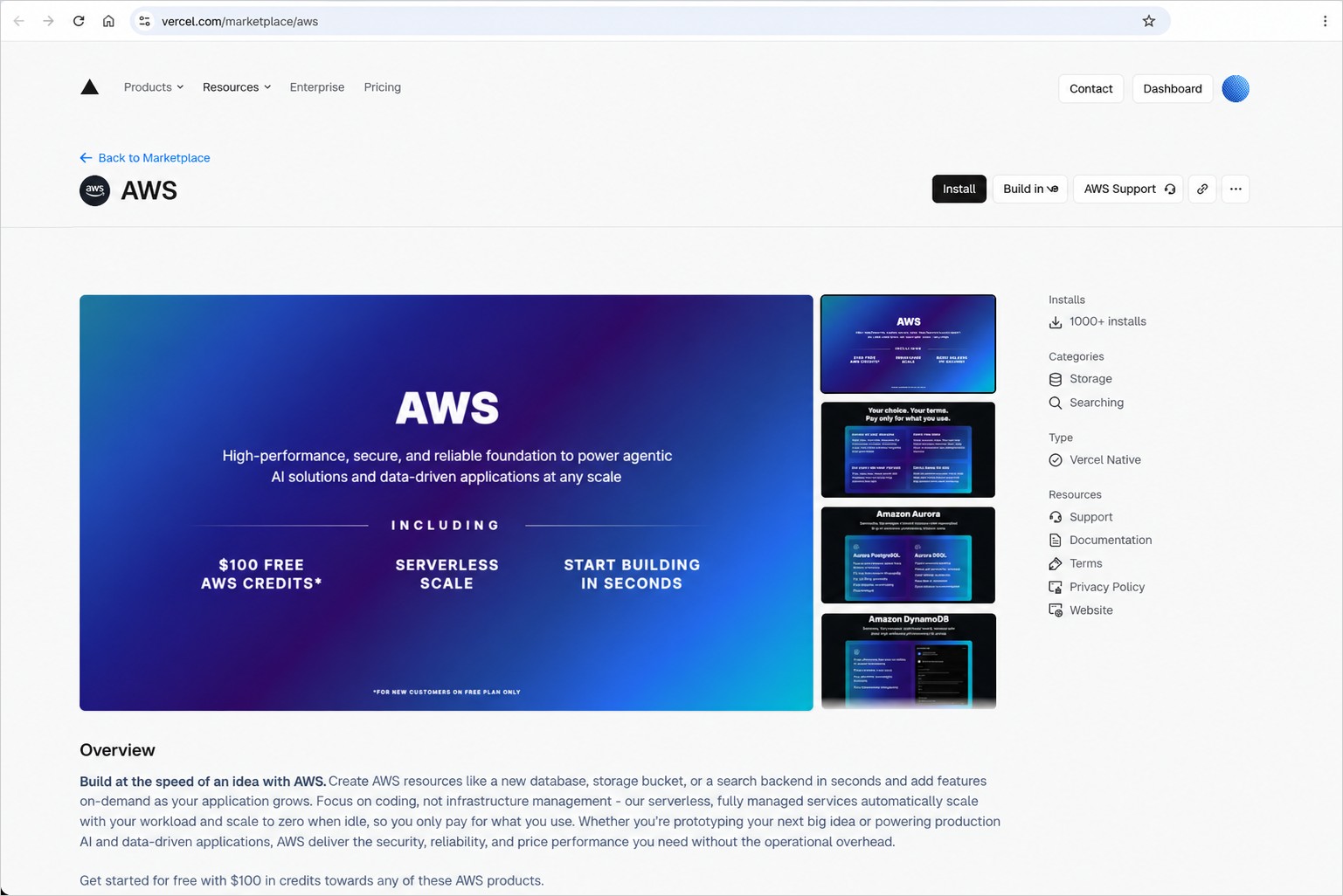
SAN FRANCISCO & SEATTLE — In a major development for the modern cloud ecosystem, Vercel and Amazon Web Services (AWS) have announced a deep native integration bringing Amazon Simple Storage Service (Amazon S3) directly into the Vercel Marketplace and v0 by Vercel. The collaboration bridges Vercel’s agile, developer-first frontend framework provisioning with the enterprise-grade durability, scalability, and performance of AWS storage infrastructure.
The rollout covers three distinct, high-demand workloads: everyday general-purpose object storage, high-performance analytics via Amazon S3 Tables, and specialized semantic vector storage through Amazon S3 Vectors. By eliminating the historical friction of manually configuring permissions, security credentials, and cross-platform infrastructure policies, the integration promises to drastically accelerate how full-stack and artificial intelligence applications are built, deployed, and scaled.
Main Facts: What the Vercel-S3 Integration Delivers
The newly launched integration radically simplifies how web and AI developers handle data persistence. Rather than requiring developers to log into the AWS Management Console to create buckets, manage AWS Identity and Access Management (IAM) policies, and manually copy static API keys, the entire lifecycle of S3 resources is now managed natively inside the Vercel dashboard.
Key components of the release include:
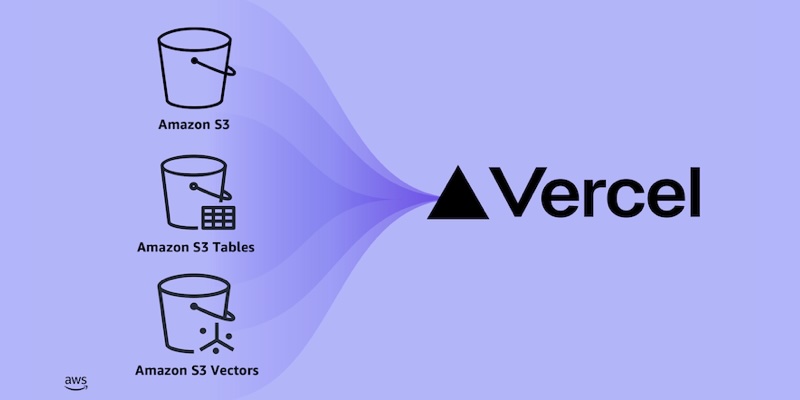
- Comprehensive Workload Coverage: Developers gain native access to standard S3 buckets for object storage, S3 Tables for optimized data lake analytics via Apache Iceberg, and S3 Vectors for AI agent memory, retrieval-augmented generation (RAG), and semantic search.
- Zero Static Keys via OIDC: Security is anchored by OpenID Connect (OIDC). Vercel functions exchange short-lived OIDC tokens with AWS Security Token Service (AWS STS) dynamically at runtime, ensuring that no long-lived static AWS credentials are ever stored in environment variables or code repositories.
- Unified Application Stack: S3 joins existing Vercel integrations for Amazon Aurora, Amazon DynamoDB, and Amazon OpenSearch Serverless, completing a unified database, object, vector, and open table storage architecture billed through a single AWS account.
- Natural Language Provisioning via v0: Users of v0 by Vercel can now prompt the generative UI tool in plain English—such as asking for a "PDF support bot" or a "photo upload gallery"—and have v0 automatically provision the correct underlying AWS S3 resource and generate the corresponding production-ready TypeScript code.
Chronology: The Evolution of Serverless-AWS Synergy
The journey toward seamless interoperability between frontend-focused edge networks and deep hyperscale cloud backends has been unfolding over several years:
- Phase 1: The Disconnected Era. Historically, developers utilizing Jamstack or serverless frontend deployment platforms like Vercel had to maintain entirely separate management workflows for backend cloud resources. Configuring AWS S3 buckets meant manual provisioning in AWS, generating programmatic Access Keys and Secret Keys, and manually hardcoding or injecting secrets into environment variables—introducing security vulnerabilities and maintenance overhead.
- Phase 2: Database Integrations. Vercel began bridging this gap by introducing managed integrations for relational and NoSQL databases like Amazon Aurora and Amazon DynamoDB, allowing developers to link database instances directly from the Vercel dashboard. However, unstructured object storage, data lakes, and vector indices remained external bottlenecks.
- Phase 3: The AI Boom and the Need for Vectors. As generative AI and large language models (LLMs) exploded in popularity, the demand for vector databases and scalable object storage surged. Developers required friction-free ways to store document embeddings, handle unstructured files, and execute analytical queries without spinning up complex, dedicated external infrastructure.
- Phase 4: Native S3, Tables, and Vectors on Vercel Marketplace (Current). Today’s launch marks the culmination of this evolution. By introducing native S3, S3 Tables, and S3 Vectors directly into the Vercel Marketplace and v0, AWS and Vercel have eradicated the boundary between edge application logic and hyperscale cloud storage.
Supporting Data & Technical Architecture
The technical implementation of the Vercel-S3 integration emphasizes robust security best practices and modern developer ergonomics.
Provisioning and Environment Injection
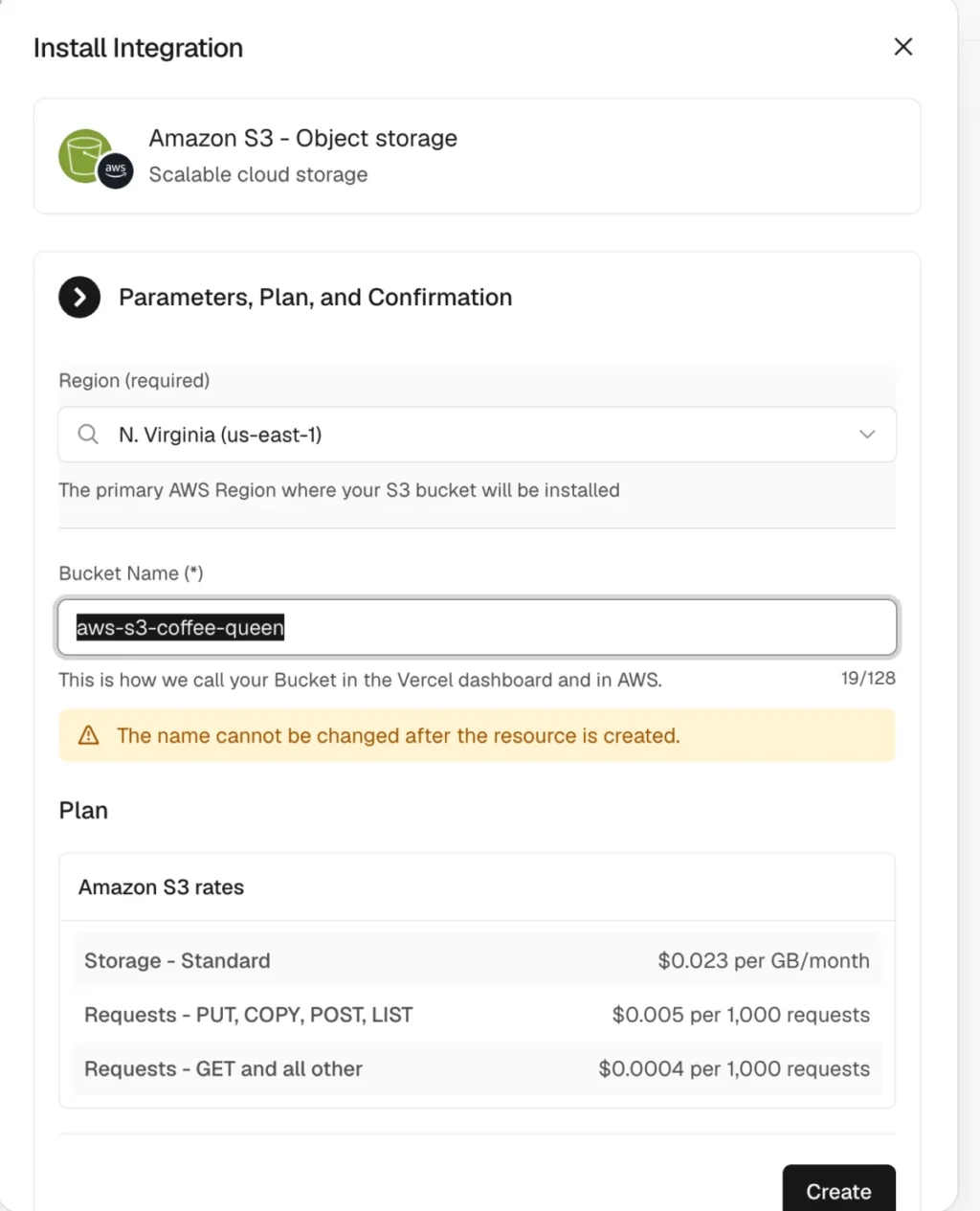
When a developer goes to the Vercel dashboard, navigates to the Storage tab, and clicks "Create" under AWS, the platform provisions the requested bucket type within seconds. Pulling these variables into a local development environment via the Vercel CLI (vercel link followed by vercel env pull .env.local) automatically injects critical runtime parameters:
AWS_REGIONAWS_ROLE_ARNAWS_RESOURCE_ARN- Resource-specific identifiers such as
S3_BUCKET_NAME,S3_TABLE_BUCKET_NAME, orS3_VECTOR_BUCKET_NAME.
Instead of relying on hardcoded credentials, applications authenticate using the awsCredentialsProvider utility from @vercel/functions/oidc, establishing secure, ephemeral sessions dynamically.

Code Implementation Examples
1. General-Purpose Object Storage (Next.js)
Handling file uploads in a Next.js API route or server action is now streamlined using the standard @aws-sdk/client-s3 paired with Vercel’s OIDC credential provider:
import  S3Client, PutObjectCommand  from "@aws-sdk/client-s3";
import  awsCredentialsProvider  from "@vercel/functions/oidc";

const s3 = new S3Client(
  region: process.env.AWS_REGION,
  credentials: awsCredentialsProvider(
    roleArn: process.env.AWS_ROLE_ARN,
  ),
);

export async function POST(request)
  const formData = await request.formData();
  const file = formData.get("file");

  await s3.send(new PutObjectCommand(
    Bucket: process.env.S3_BUCKET_NAME,
    Key: file.name,
    Body: Buffer.from(await file.arrayBuffer()),
    ContentType: file.type,
  ));

  return Response.json( success: true );
2. Analytics with S3 Tables and DuckDB
For analytics workloads, S3 Tables offer fully managed Apache Iceberg tables that automatically optimize query performance. Developers can run lightweight queries directly inside Vercel Functions using DuckDB:
import  DuckDBInstance  from "@duckdb/node-api";
import  awsCredentialsProvider  from "@vercel/functions/oidc";

const creds = await awsCredentialsProvider(
  roleArn: process.env.AWS_ROLE_ARN,
)();

const db = await DuckDBInstance.create();
const conn = await db.connect();

await conn.run("INSTALL aws; LOAD aws; INSTALL httpfs; LOAD httpfs; INSTALL iceberg; LOAD iceberg;");

await conn.run(`
  CREATE SECRET s3cred (
    TYPE s3,
    KEY_ID '$creds.accessKeyId',
    SECRET '$creds.secretAccessKey',
    SESSION_TOKEN '$creds.sessionToken',
    REGION '$process.env.AWS_REGION'
  );
`);

await conn.run(`
  ATTACH '$process.env.AWS_RESOURCE_ARN' AS s3tables (
    TYPE iceberg,
    ENDPOINT_TYPE s3_tables
  );
`);

const rows = await (await conn.run(`
  SELECT town_city, AVG(median_price) AS avg_price
  FROM s3tables."$process.env.S3_TABLES_NAMESPACE".town_monthly
  GROUP BY town_city
  ORDER BY avg_price DESC
  LIMIT 10
`)).getRowObjects();
3. Semantic Vector Search with S3 Vectors
Building AI applications that require semantic search no longer necessitates managing an independent, dedicated vector database infrastructure. S3 Vectors integrates directly into retrieval workflows:
import  S3VectorsClient, QueryVectorsCommand  from "@aws-sdk/client-s3vectors";
import  awsCredentialsProvider  from "@vercel/functions/oidc";

const vectors = new S3VectorsClient(
  region: process.env.AWS_REGION,
  credentials: awsCredentialsProvider(
    roleArn: process.env.AWS_ROLE_ARN,
  ),
);

export async function POST(request)
  const  embedding  = await request.json();

  const result = await vectors.send(new QueryVectorsCommand(
    vectorBucketName: process.env.S3_VECTOR_BUCKET_NAME,
    indexName: "documents",
    queryVector:  float32: embedding ,
    topK: 5,
    returnMetadata: true,
  ));

  return Response.json( matches: result.vectors );
Official Responses and Industry Perspectives
Industry leaders have lauded the integration as a milestone in developer productivity and cloud architecture simplification.
"Storage is essential to performant applications, but provisioning it previously required navigating to the AWS Management Console to configure policies and credentials," engineering spokespeople noted during the rollout. "Now, S3 storage integrates directly into the Vercel developer experience, with resource provisioning and connection configuration handled automatically."
By allowing developers to either spin up brand-new AWS accounts directly through Vercel—complete with a promotional $100 AWS credit valid for six months—or link pre-existing enterprise AWS accounts, the partnership accommodates both indie hackers and large engineering organizations. Crucially, because all underlying S3 resources reside directly within the user’s own AWS account, teams retain full governance, native tool compatibility, and a consolidated billing structure.
Implications for Developers and the Broader Cloud Market
The introduction of native S3, S3 Tables, and S3 Vectors to Vercel carries profound implications for software engineering workflows and cloud economics:
- Eradication of Boilerplate Overhead: Frontend and full-stack developers can now construct sophisticated, data-intensive web applications and AI agents without needing deep operational expertise in cloud networking and IAM policy generation. The cognitive load of connecting frontend interfaces to enterprise cloud storage has been virtually eliminated.
- Mainstream Adoption of Vector and Table Storage: By embedding S3 Vectors and S3 Tables directly into tools like v0 and the Vercel dashboard, AWS has dramatically lowered the barrier to entry for advanced analytics and generative AI patterns (such as RAG and semantic caching). Developers can experiment with and deploy complex data workloads using natural language prompts.
- Enhanced Security Posture: The mandatory adoption of OIDC-based temporary credentials over static, long-lived access keys significantly hardens applications against accidental credential leaks in public code repositories—a historically persistent vulnerability in modern web development.
- Consolidated Cloud Spend: Enterprises can seamlessly unify their frontend edge hosting and backend storage budgets under a single AWS billing framework, simplifying financial operations and procurement cycles.
Availability and Getting Started
The integration carries no additional platform fee from Vercel; developers simply pay standard AWS pricing for the S3 resources consumed. The feature is available immediately in all commercial AWS Regions supported by Vercel. Developers can begin provisioning resources today via the Vercel Marketplace AWS Page or through v0 by Vercel.