Accelerating the Cloud: AWS Launches CloudFormation Express Mode to Revolutionize Infrastructure Deployment
In a move that marks a significant shift in how developers interact with infrastructure-as-code (IaC), Amazon Web Services (AWS) has officially unveiled AWS CloudFormation Express mode. This new deployment feature is designed to slash wait times for infrastructure provisioning, providing a much-needed boost to developer velocity and AI-assisted engineering workflows. By decoupling the act of resource configuration from the time-intensive process of stabilization checks, AWS is enabling teams to iterate on their cloud environments with unprecedented speed.
The Core Innovation: Rethinking Deployment Cycles
At its heart, CloudFormation Express mode addresses a fundamental bottleneck in modern cloud operations: the "stabilization phase." Historically, every time a developer deployed a stack via CloudFormation, the service would not mark the deployment as "complete" until it verified that every individual resource was fully operational, healthy, and ready to receive traffic. While this rigorous verification is essential for production-grade stability, it has long been a source of friction for developers who are simply testing incremental changes or experimenting with new architecture patterns.
Express mode fundamentally changes this by shifting the completion signal. Under this new configuration, CloudFormation triggers a "success" state as soon as the resource configuration is successfully applied to the AWS control plane. The underlying infrastructure continues to stabilize in the background, but the developer—or the automated tool—is freed to move on to the next step of the workflow without waiting for the full validation cycle.
This shift is not merely cosmetic; it is a structural optimization that reduces deployment times by up to four times, and in some specific resource-heavy scenarios, can turn multi-minute waits into sub-ten-second operations.
Chronology of Development: From Rigidity to Agility
The journey toward Express mode reflects the evolving needs of the modern AWS customer. In the early days of CloudFormation, reliability and consistency were the primary mandates. Users needed to know, with absolute certainty, that their stack was ready before proceeding.
However, as the ecosystem matured—marked by the rise of the AWS Cloud Development Kit (CDK), sophisticated CI/CD pipelines, and, most recently, the explosion of Generative AI coding assistants—the "wait-and-see" model began to show its age. Developers using AI to iterate on infrastructure found that the feedback loop was hampered by the time taken to confirm stabilization.
Internal benchmarking at AWS identified that for iterative development, the full stabilization check was often redundant. If a developer is adding a single SQS queue or updating a Lambda function, they do not necessarily need to wait for the entire network stack to reach a "Ready" state before moving on to the next line of their infrastructure code. By the second quarter of 2026, the demand for a "fast-track" deployment path had become a priority, leading to the development and subsequent launch of the Express mode capability.
Supporting Data: Quantifying the Speed Gains
The performance improvements offered by Express mode are most visible in operations that previously required extensive polling for status updates.
Performance Benchmarks
To illustrate the efficacy of this new mode, AWS provided clear comparative data:
- Amazon SQS Queue Creation: In standard mode, creating a queue with a Dead Letter Queue (DLQ) configuration typically takes roughly 64 seconds. With Express mode, this time is reduced to approximately 10 seconds—a 6.4x speed increase.
- AWS Lambda Cleanup: The deletion of a Lambda function involving network interface attachments was previously one of the most time-consuming tasks, often taking 20 to 30 minutes due to the complexity of detaching and deleting virtual network interfaces. Express mode brings this process down to under 10 seconds.
These figures represent a massive reduction in idle time. When aggregated over hundreds of builds per week in a large engineering organization, the cumulative time saved translates into significant improvements in developer productivity and cost-efficiency.
How it Works: Resilience and Background Stabilization
A common concern regarding faster deployments is the risk of "brittleness." If a resource fails to stabilize in the background, what happens to the stack?
AWS has engineered Express mode with built-in resilience. If a resource encounters a transient failure during its asynchronous stabilization phase, CloudFormation will automatically retry the operation. This logic is handled internally, shielding the user from the need to intervene or write custom "wait" scripts.
Crucially, the provisioning logic remains identical to Standard mode. The service still enforces security, IAM permissions, and resource dependencies. The only difference is the timing of the completion signal. Furthermore, for users who require the traditional safety guarantees, the feature is entirely opt-in. This flexibility allows teams to use Express mode for their sandboxes and dev environments while maintaining Standard mode for their critical production pipelines where complete, pre-traffic validation is non-negotiable.
Implementation: Integrating Express Mode
For developers, moving to Express mode requires minimal overhead. There is no need to rewrite existing templates or migrate to a new format.
Enabling via Console and CLI
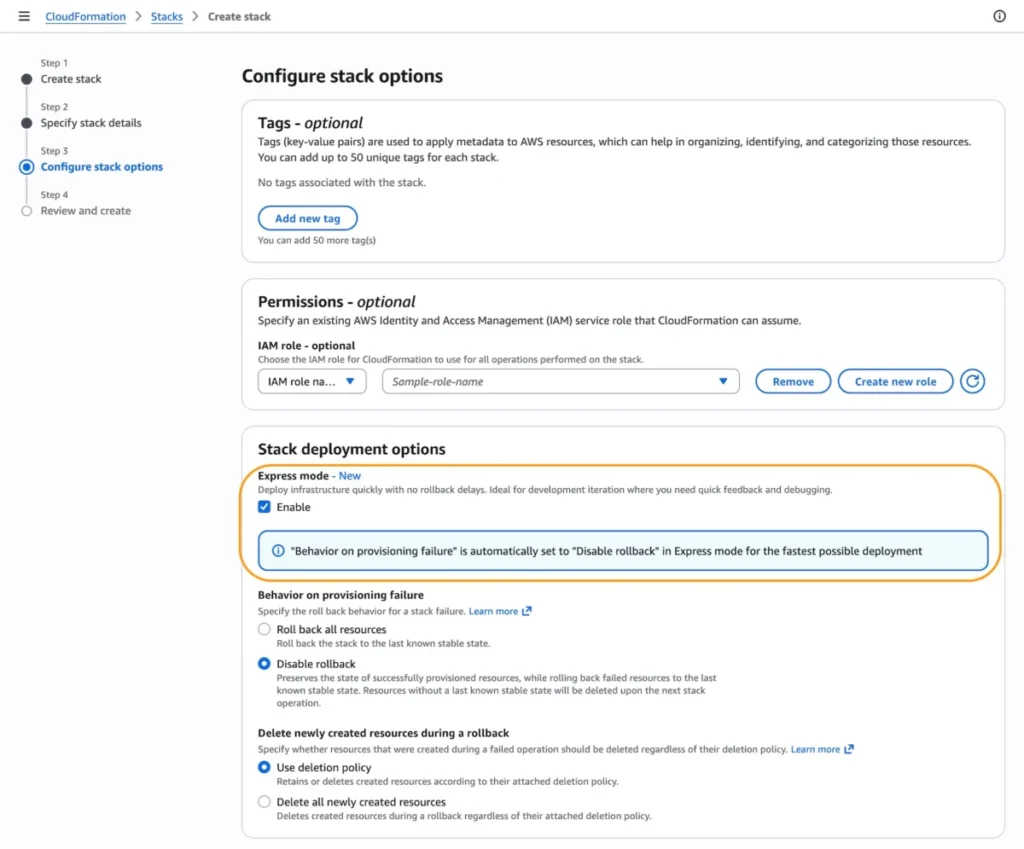
For those who prefer the AWS Management Console, the option is located under "Stack deployment options." Simply selecting "Enable" is enough to toggle the behavior.
For infrastructure-as-code practitioners, the integration is just as seamless. When using the AWS CLI, one simply includes the --deployment-config parameter:

aws cloudformation create-stack
   --stack-name my-app
   --template-body file://template.yaml
   --deployment-config '"mode": "EXPRESS", "disableRollback": true'
The disableRollback flag is a key component of this configuration. By default, Express mode disables rollback to ensure the fastest possible iteration speed. However, for production-leaning scenarios where state integrity is paramount, this can be toggled back on, allowing developers to balance speed with the safety of automated rollbacks.
CDK and AI Tooling
The integration extends to the AWS CDK, where developers can now use cdk deploy --express to trigger the new mode. Furthermore, with the growing trend of AI-driven infrastructure development, tools like Kiro are now optimized to interface with the Express mode, allowing AI agents to generate and deploy infrastructure with sub-minute feedback loops.
Implications for the Industry
The release of CloudFormation Express mode signals a broader trend in cloud computing: the transition from "managed infrastructure" to "responsive infrastructure."
1. The Era of Real-Time Infrastructure
Infrastructure development is moving closer to the experience of writing application code. Just as hot-reloading in web development allows for instant visual feedback, Express mode provides a similar "hot-reload" experience for cloud resources. This will likely encourage more experimentation, as the "cost" of deploying a change—both in terms of time and patience—is drastically lowered.
2. Empowering AI Agents
Perhaps the most profound implication is for AI-assisted development. Large Language Models (LLMs) often struggle with long-running tasks because they rely on rapid feedback to correct errors in code generation. By shortening the deployment cycle to seconds, Express mode creates a "tight loop" that allows AI agents to act, fail, correct, and succeed in real-time, effectively functioning as a virtual DevOps engineer.
3. Cultural Shift in DevOps
While the speed is a clear benefit, it also places more responsibility on the developer. With the rollback mechanisms often disabled in favor of speed, teams will need to adopt more robust monitoring and testing strategies earlier in their development lifecycle. The onus shifts from "relying on CloudFormation to catch everything" to "using automated testing and observability to ensure quality."
Conclusion: A New Standard for Velocity
AWS CloudFormation Express mode is more than a performance patch; it is a strategic evolution of the platform’s capabilities. By acknowledging that not every deployment requires a long-winded stabilization check, AWS has unlocked a new level of agility for developers.
Available now in all commercial regions at no additional cost, this feature is poised to become a staple in the toolkit of modern cloud engineers. Whether you are a solo developer prototyping a microservice or an enterprise team managing complex IaC pipelines, Express mode offers a compelling path toward faster, more efficient, and ultimately more enjoyable infrastructure management. As the cloud continues to scale, tools that prioritize developer time will inevitably win the day—and with Express mode, AWS has taken a decisive step in that direction.