Allegations of ‘Horse-Trading’ Rock Tamil Nadu Politics: Minister Nirmalkumar Accuses DMK of Attempting to Topple Government
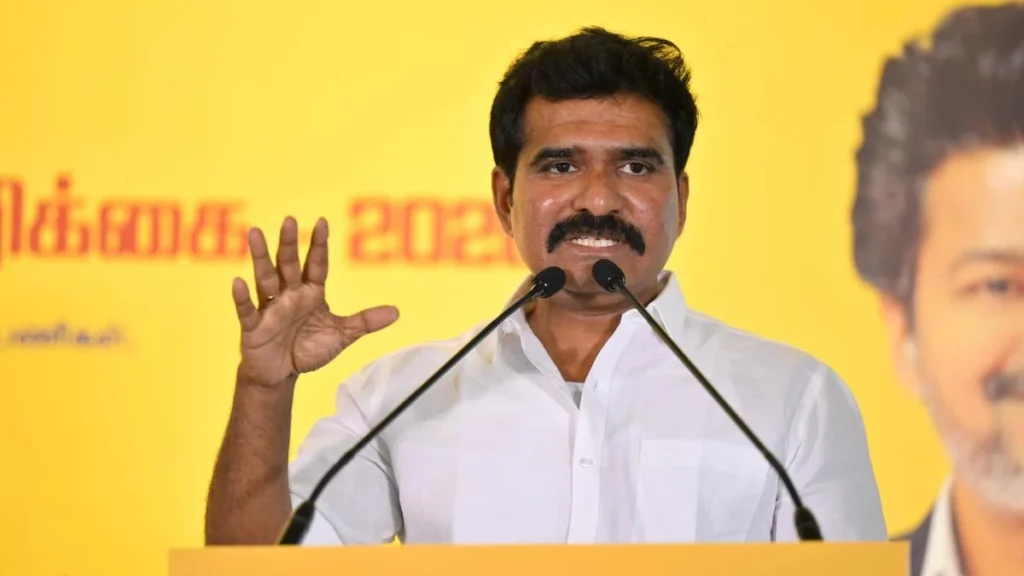
CHENNAI – The political landscape of Tamil Nadu witnessed a dramatic escalation on Wednesday, July 1, 2026, as the State Minister for Energy Resources and Law, R. Nirmalkumar, leveled explosive allegations against the Dravida Munnetra Kazhagam (DMK). Addressing a press conference at the Secretariat, the Minister accused DMK president M.K. Stalin and the Leader of the Opposition, Udhayanidhi Stalin, of orchestrating a systematic campaign to destabilize the current government by attempting to “poach” MLAs from the Tamizhaga Vetri Kazhagam (TVK).
The allegations have sent shockwaves through the political corridors of Chennai, reigniting debates over ethics in state governance and the alleged use of "money power" to subvert democratic mandates.
The Allegations: A ‘Backdoor’ Strategy to Seize Power
Minister Nirmalkumar explicitly identified former Minister and incumbent Coimbatore South DMK MLA, V. Senthilbalaji, as the primary operative behind what he termed a “malicious attempt to subvert the people’s mandate.” According to the Minister, the DMK leadership tasked Mr. Senthilbalaji and his brother, V. Ashokumar, with approaching TVK legislators with astronomical financial incentives.
“We have credible evidence and reports that several TVK MLAs were approached by associates of Mr. Senthilbalaji,” the Minister stated. “They were offered bribes of up to ₹50 crore per head, with a clear objective: to facilitate a no-confidence motion against the Speaker in the upcoming Assembly session.”
Nirmalkumar characterized these maneuvers as a desperate attempt by the DMK to regain power through "backdoor means" after being rejected by the electorate. He argued that the repeated assertions by M.K. Stalin regarding the imminent fall of the government were not mere political rhetoric, but rather a reflection of an active, well-funded conspiracy.
Chronology of the Incident
The developments leading to the Minister’s public statement began unfolding late last week, according to government sources.
- Late June 2026: Several TVK legislators reportedly began notifying party leadership of "unsolicited outreach" from individuals claiming to represent the DMK’s interests.
- June 29, 2026: A formal complaint was lodged by a TVK MLA who alleged that he had been directly approached with a financial offer to switch allegiances.
- June 30, 2026: Acting on the complaint, state law enforcement agencies initiated an investigation, leading to the apprehension of three individuals allegedly involved in the bribery attempt.
- July 1, 2026: Minister R. Nirmalkumar held a press briefing at the Secretariat to confirm the arrests and publicly name the DMK leadership as the masterminds behind the operation.
The Minister confirmed that while three arrests have been made, the investigation is ongoing, and authorities are examining financial trails and digital communications to ascertain the extent of the conspiracy.
Financial Integrity and Electoral Ethics
A significant portion of the Minister’s press conference focused on the contrast between the financial ethics of the TVK and the DMK. Nirmalkumar took aim at the alleged "culture of corruption" that he claimed characterized the DMK’s previous tenure.
“The TVK legislators did not reach this assembly by spending ₹500 crore or ₹1,000 crore as the DMK has historically done,” the Minister asserted. “Our candidates spent modest sums—roughly ₹3 to ₹4 lakh—to win the trust of the people. We did not distribute ₹2,000 per vote, nor did we spend ₹70 crore in each constituency. The people voted for us because they saw a vision for the state, not because of a bribe.”
Nirmalkumar’s rhetoric suggests that the TVK is positioning itself as the "clean" alternative to the traditional Dravidian parties, framing the current crisis as a battle between ideological politics and "mercenary" politics.
Official Responses and Political Repercussions
The accusations have left the DMK in a defensive position. While the party has not issued an official, detailed rebuttal as of Wednesday evening, party insiders suggest that the DMK views the Minister’s statement as a "diversionary tactic" intended to distract the public from internal challenges within the government.

The Question of Defections
The political environment is further complicated by the impending transition of former AIADMK ministers, C. Vijayabaskar and M.R. Vijayabhaskar, into the TVK. When questioned about the legal challenges these leaders face—specifically the pendency of corruption cases—Minister Nirmalkumar maintained a stance of administrative impartiality.
“The law will take its own course,” the Minister said, dismissing suggestions that the TVK is offering a “safe haven” for politicians seeking to escape legal scrutiny. He emphasized that the shifting political allegiances are a natural outcome of politicians realizing that the AIADMK and DMK have "no future" in the current political climate.
Implications for Tamil Nadu Governance
The allegations of horse-trading raise critical questions about the stability of the current legislative assembly. If the government is indeed facing an organized attempt to move a no-confidence motion, the upcoming session of the Legislative Assembly is likely to be one of the most volatile in recent state history.
1. Legislative Stability
If the opposition manages to create a rift within the ruling party or its coalition, the government could face a precarious majority. This would force the administration to spend more energy on floor management and "protecting" its members than on policy implementation.
2. The Public Trust Factor
The "money-for-votes" narrative is deeply resonant in Tamil Nadu. By highlighting the alleged ₹50 crore offers, the Minister is tapping into the public’s frustration with electoral corruption. If the investigation into the three arrested individuals yields concrete evidence linking them to the DMK leadership, it could result in severe electoral fallout for the opposition party.
3. Judicial Oversight
Given the high-profile nature of the accusations and the involvement of former ministers, it is highly probable that the judiciary will be called upon to intervene. Legal experts suggest that if the government fails to provide airtight evidence connecting the arrested individuals to the top echelons of the DMK, the accusations could backfire, damaging the credibility of the incumbent administration.
Conclusion: A Turning Point for the TVK
The emergence of the Tamizhaga Vetri Kazhagam (TVK) as a significant power center has clearly unsettled the established political hegemony in Tamil Nadu. The allegations leveled by Minister Nirmalkumar serve as a declaration of war against the DMK, signaling that the TVK is ready to aggressively defend its legislative strength.
As the state awaits further details from the ongoing police investigation, the focus will remain on the Speaker’s office and the potential for a confrontation in the Assembly. Whether these allegations will serve to solidify the current government’s standing or trigger a deeper crisis of legitimacy remains to be seen.
For the citizens of Tamil Nadu, the unfolding saga is a stark reminder of the intense power struggle that continues to define the state’s political character. With the next election cycle looming in the distance, both the government and the opposition are clearly preparing for a protracted and potentially bitter battle for the state’s political soul.
Disclaimer: This report is based on statements provided by the Minister for Energy Resources and Law. As the investigation is in its preliminary stages, the allegations against the DMK leadership remain subject to judicial verification.