SEATTLE — In a major development for cloud database architecture and modern artificial intelligence applications, Amazon Web Services (AWS) has announced the general availability of native vector search in Amazon DynamoDB. The release enables developers to store vector embeddings directly alongside operational data within DynamoDB tables, executing high-performance similarity searches without the operational friction, cost, and complexity of replicating data to a separate, dedicated vector store.
The newly launched capability is designed to support mission-critical AI workloads at scale—ranging from retrieval-augmented generation (RAG) and agentic memory systems to recommendation engines, personalized user experiences, and real-time anomaly detection. By embedding vector search natively into its serverless, globally distributed database, AWS aims to streamline the development stack for engineers building modern, intelligent applications.
Main Facts: What is Native Vector Search in DynamoDB?
The introduction of vector search brings modern machine learning capabilities straight to DynamoDB’s core engine. Key architectural and operational highlights of the release include:
Single-Digit Millisecond Latency: The system delivers lightning-fast similarity searches with single-digit millisecond latency while maintaining a recall accuracy of 99% or higher.
Infinite Horizontal Scalability: Built to handle arbitrary scales—even trillions of vectors—vector indexes have no storage limits and grow dynamically alongside operational datasets.
Fully Serverless Infrastructure: Users do not need to provision, patch, or manage servers, nor do they need to install or operate specialized software. The service features zero-maintenance windows and zero-downtime maintenance.
Unified Pricing and Storage: Vectors and traditional operational attributes share the same underlying serverless infrastructure and utilize the familiar pay-per-request pricing model.
Rich Mathematical Support: The service supports up to 4,096 dimensions and accommodates three major distance functions: Cosine, Euclidean, and Dot Product.
Advanced Inline Filtering: Developers can apply exact-match filters on non-vector attributes (such as category or marketplace) during query execution, narrowing results efficiently at the database layer.
Chronology: The Evolution Toward Native Database Vectors
The journey toward native vector integration in mainstream transactional databases reflects the rapid convergence of traditional enterprise data systems and generative artificial intelligence.
1. The Proliferation of Generative AI and RAG
As large language models (LLMs) and foundation models gained mainstream enterprise adoption over recent years, developers quickly encountered the limits of static training data. Retrieval-Augmented Generation (RAG) emerged as the industry standard for grounding LLMs in proprietary, up-to-date enterprise datasets. This technique relies heavily on converting text, images, and audio into high-dimensional numerical vectors (embeddings) and searching them rapidly to find contextually relevant information.
2. The Era of Fragmented Architectures
Initially, storing and querying vector embeddings required organizations to adopt specialized, standalone vector databases. While powerful, this approach introduced significant architectural complexity. Engineering teams were forced to manage dual-database environments, build and maintain complex data synchronization pipelines, absorb extra data-movement and licensing costs, and struggle to maintain predictable, low-latency performance at global scales.
3. The Shift Toward Convergence
Recognizing these operational bottlenecks, cloud providers began exploring ways to unify operational and analytical capabilities. While AWS previously offered vector capabilities across other services, the lack of native vector support within DynamoDB—AWS’s flagship serverless NoSQL database—remained a notable gap for applications relying on transactional key-value data combined with semantic retrieval.
4. General Availability
Today’s announcement marks the culmination of this evolution. By baking vector indexing directly into the DynamoDB engine, AWS has bridged the gap between operational NoSQL workloads and semantic vector search, making enterprise-grade AI architecture dramatically simpler and more cost-effective.
Supporting Data: Technical Architecture and Implementation
To understand how native vector search functions within DynamoDB, it is helpful to examine the underlying data structures, API workflows, and practical deployment patterns.
Storing Vectors as Native Data Types
In traditional setups, adding vector search to an existing table required schema migrations or external storage. With DynamoDB’s new implementation, vector embeddings are stored using the database’s existing List data type. Each element within the list is a Number representing a single floating-point value of the embedding vector.
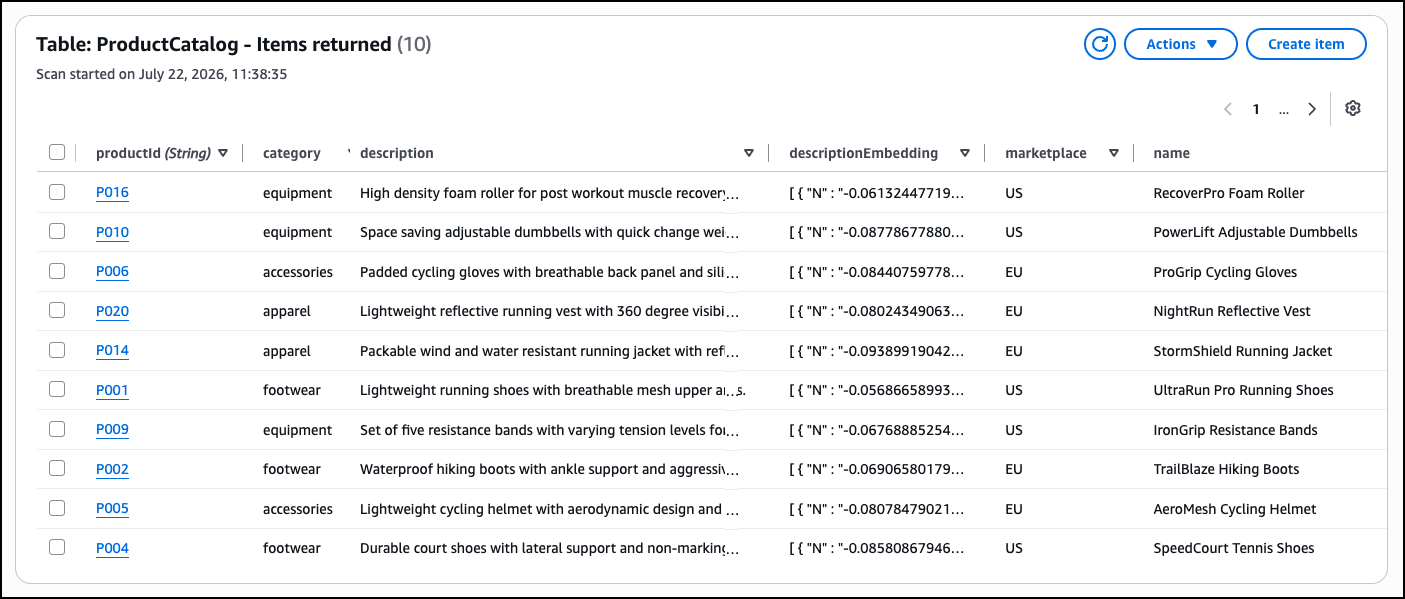
For example, a developer managing an online sporting goods catalog table (ProductCatalog) can generate embeddings from product descriptions using models like Amazon Bedrock Titan Text Embeddings, Cohere Embed, or OpenAI text-embedding models. These embeddings are then integrated into existing items using a standard UpdateItem or PutItem API call under a designated attribute, such as descriptionEmbedding.
Once the vector data resides in the table, administrators can create a dedicated vector index via the AWS Management Console, AWS CLI, SDKs, or Infrastructure-as-Code (IaC) tools like AWS CloudFormation.
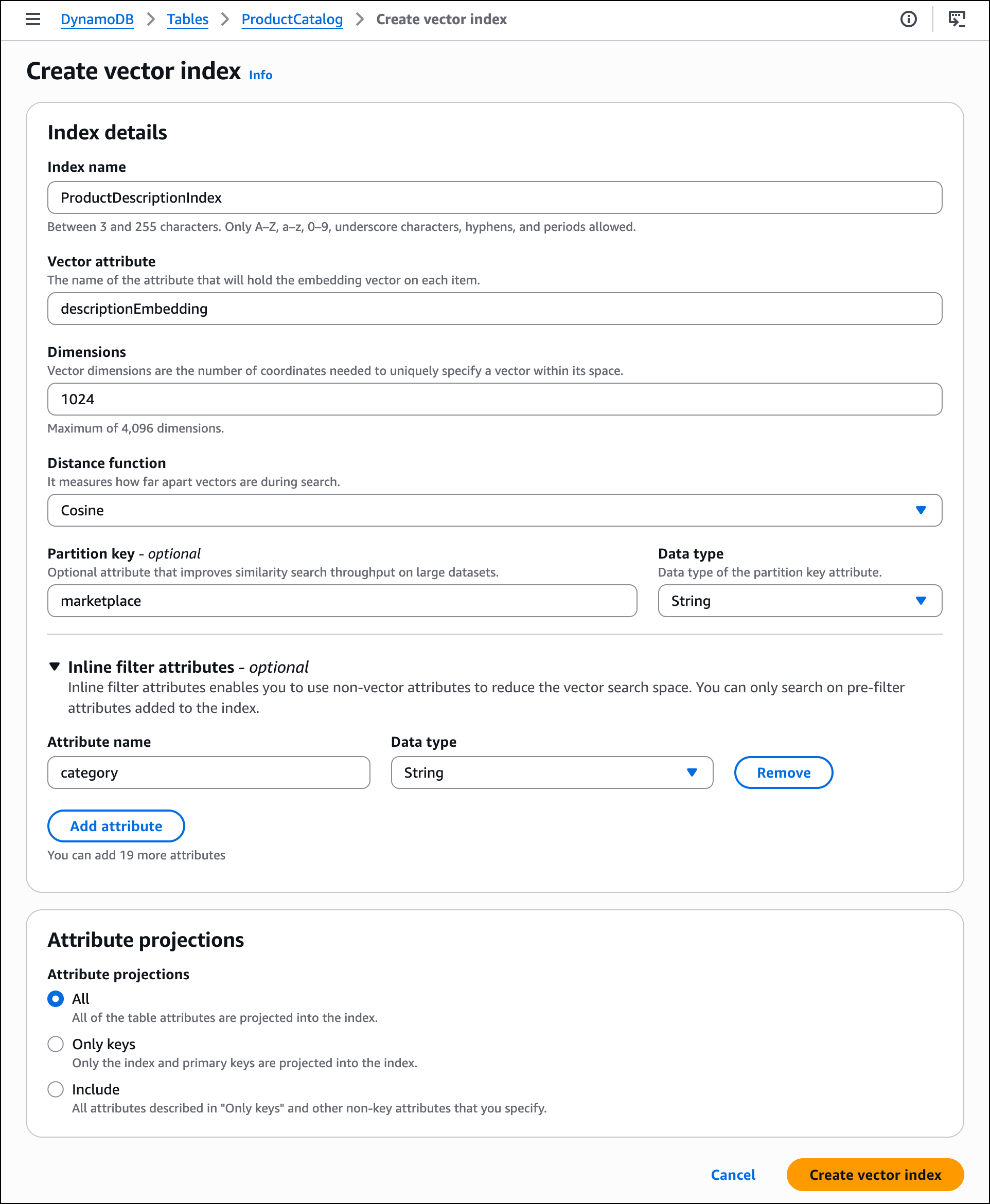
The index configuration requires four core parameters:
Index Name: A unique identifier for the index (e.g., ProductDescriptionIndex).
Vector Attribute: The specific table attribute storing the embedding list.
Dimensions: The exact number of dimensions matching the output of the chosen machine learning model (up to 4,096).
Distance Function: The mathematical metric used for comparison:
Cosine: Measures the angle between vectors; ideal for semantic text similarity.
Euclidean: Measures straight-line distance in vector space.
Dot Product: Measures vector projection; useful for normalized embeddings.
Additionally, administrators can define a Partition Key (such as marketplace) to distribute vectors horizontally across partitions, ensuring predictable latencies and scoped searches. Developers can also designate Inline Filter Attributes to allow exact-match filtering during queries.
Executing Queries with the SearchVectors API
Searching the database is handled via the new SearchVectors API. The application supplies a query vector generated from a natural language prompt (e.g., "lightweight running shoes for summer"), specifies the Top-K number of results desired (up to 100), provides partition key values, and applies inline filter conditions.
DynamoDB returns the most semantically similar items ranked by score, alongside standard operational attributes (like name, price, and inventory count) in a single, unified response.
Official Responses and Industry Perspectives
AWS product leaders and engineering advocates have emphasized the profound impact this release will have on application design and operational overhead.
"If your application already uses DynamoDB, adding vector search previously required copying data into a dedicated vector database while maintaining a synchronization pipeline between the two services," engineering representatives noted in the official launch documentation. "With vector search built into DynamoDB, your vectors and operational data share the same serverless infrastructure and the same pay-per-request pricing model."
By removing the friction of data synchronization, AWS aims to empower individual developers and small engineering teams to build sophisticated AI applications—such as personalized e-commerce recommenders and context-aware chat agents—without needing to master complex, multi-database synchronization frameworks.
Furthermore, AWS has integrated support for the new capability into modern developer toolchains. Engineers can interact with DynamoDB vector search APIs and documentation programmatically using the AWS MCP Server and associated plugins within their preferred AI coding assistants.
Implications: What This Means for Developers and Enterprises
The general availability of vector search in Amazon DynamoDB carries far-reaching implications for software architecture, enterprise IT budgets, and the broader database market.
1. Drastic Reduction in Architectural Complexity
For organizations running high-scale web applications, user profiles, catalogs, or session stores on DynamoDB, the need to provision and manage separate vector engines (such as dedicated vector databases or specialized search clusters) is largely eliminated. This consolidation slashes architectural overhead, reduces points of failure, and simplifies compliance and data governance.
2. Cost Optimization at Scale
Maintaining dual-database pipelines incurs costs across multiple vectors: infrastructure provisioning, data replication bandwidth, software licensing, and engineering hours spent debugging synchronization drift. By leveraging DynamoDB’s serverless, pay-per-request pricing model for both operational records and vector indexes, enterprises can align their cloud spend directly with actual usage.
3. Accelerated Time-to-Market for AI Features
Features that once required months of backend engineering—such as semantic product search, intent-driven discovery, and intelligent agent memory—can now be bolted onto existing DynamoDB tables with minimal code changes. Developers can enrich their current tables with embedding attributes, build a vector index, and immediately begin fielding natural language queries.
4. Broad Regional Availability
Vector search in Amazon DynamoDB is available starting today across all commercial AWS Regions, including AWS GovCloud (US) Regions. This ensures that enterprises operating under strict regulatory and compliance mandates can leverage native semantic search while keeping their data within approved geographic boundaries.
Conclusion
The launch of native vector search in Amazon DynamoDB represents a pivotal milestone in the convergence of operational databases and artificial intelligence. By allowing developers to store embeddings and operational data under one serverless roof, AWS has dismantled one of the most persistent architectural barriers in modern application development. As enterprises continue to race toward intelligent, AI-driven user experiences, tools like DynamoDB vector search provide the frictionless scalability and performance required to turn generative AI concepts into production-grade reality.