Amazon Web Services Expands EBS Capabilities with Cross-Account Volume Clones and Re-Encryption Support
SEATTLE — Amazon Web Services (AWS) has announced a significant expansion to its storage management portfolio, introducing cross-account copy functionality for Amazon Elastic Block Store (Amazon EBS) Volume Clones. Building upon the initial release of instant, point-in-time volume cloning capabilities within single Availability Zones, this new feature allows organizations to securely replicate EBS volume copies across distinct AWS accounts. Furthermore, the update empowers teams to apply custom re-encryption protocols using target-account AWS Key Management Service (AWS KMS) keys, bridging a critical gap in multi-account cloud architecture, data governance, and secure environment provisioning.
The release addresses long-standing operational friction for cloud administrators, DevOps engineers, and security compliance officers. In modern enterprise environments structured around AWS Organizations, production workloads are intentionally isolated from development, testing, and staging environments to minimize blast radiuses and enforce strict access controls. However, this isolation often complicates the process of refreshing non-production systems with realistic, up-to-date production datasets. With cross-account EBS volume cloning, AWS aims to streamline data pipelines while maintaining robust security boundaries.
Main Facts
The newly launched capability extends the utility of Amazon EBS Volume Clones—a feature originally deployed to provide rapid, instantaneous point-in-time data duplication without the latency traditionally associated with full data migrations or snapshot restorations.
- Cross-Account Replication: Users can now copy EBS volumes directly into separate AWS accounts, facilitating seamless data sharing across organizational units and distinct departmental boundaries.
- Target-Account Re-Encryption: When data is copied across accounts, administrators have the option to re-encrypt the volume using a designated AWS KMS key belonging to the target account, ensuring adherence to internal security policies and compliance frameworks.
- Integration with AWS Resource Access Manager (RAM): The sharing mechanism relies on AWS RAM, enabling granular permission controls and secure resource allocation either within an AWS Organization or across independent accounts.
- Programmatic and AI-Assisted Workflows: The feature supports both graphical user interface (GUI) interactions via the Amazon EBS and AWS RAM consoles and programmatic implementation, including compatibility with the AWS Model Context Protocol (MCP) Server and AI coding tool plugins.
- Global Availability: The feature is live today across all AWS Regions that currently support Amazon EBS Volume Clones.
Chronology of Development
To understand the strategic significance of cross-account volume clones, it is helpful to examine the evolutionary path of Amazon EBS data management features:

- The Traditional Snapshot Era: For years, Amazon EBS relied heavily on EBS snapshots stored in Amazon Simple Storage Service (Amazon S3) as the primary mechanism for backups, data transport, and environment cloning. While reliable, creating volumes from snapshots involved read-latency penalties as data blocks were lazily loaded from S3 upon first access.
- Introduction of Volume Clones (Prior Year): Recognizing the need for instant data availability, AWS introduced EBS Volume Clones. This capability allowed users to create full, high-performance volume copies instantaneously within the same Availability Zone by leveraging underlying storage virtualization layers rather than traditional block-by-block copying.
- The Multi-Account Challenge: While initial volume clones transformed single-account workflows—such as rapid debugging and local testing—enterprises operating complex multi-account strategies faced roadblocks. Moving cloned data into isolated sandbox or development accounts still required cumbersome snapshot-sharing routines, manual permission mappings, and separate encryption handling.
- Current Announcement: AWS eliminates this friction by merging the speed of Volume Clones with the multi-account sharing architecture of AWS RAM, culminating in today’s release of cross-account EBS volume copies with customizable re-encryption.
Supporting Data and Technical Mechanics
The technical execution of cross-account EBS volume cloning involves a structured handshake between the source account owner, AWS RAM, and the target account administrator.
Step-by-Step Operational Workflow
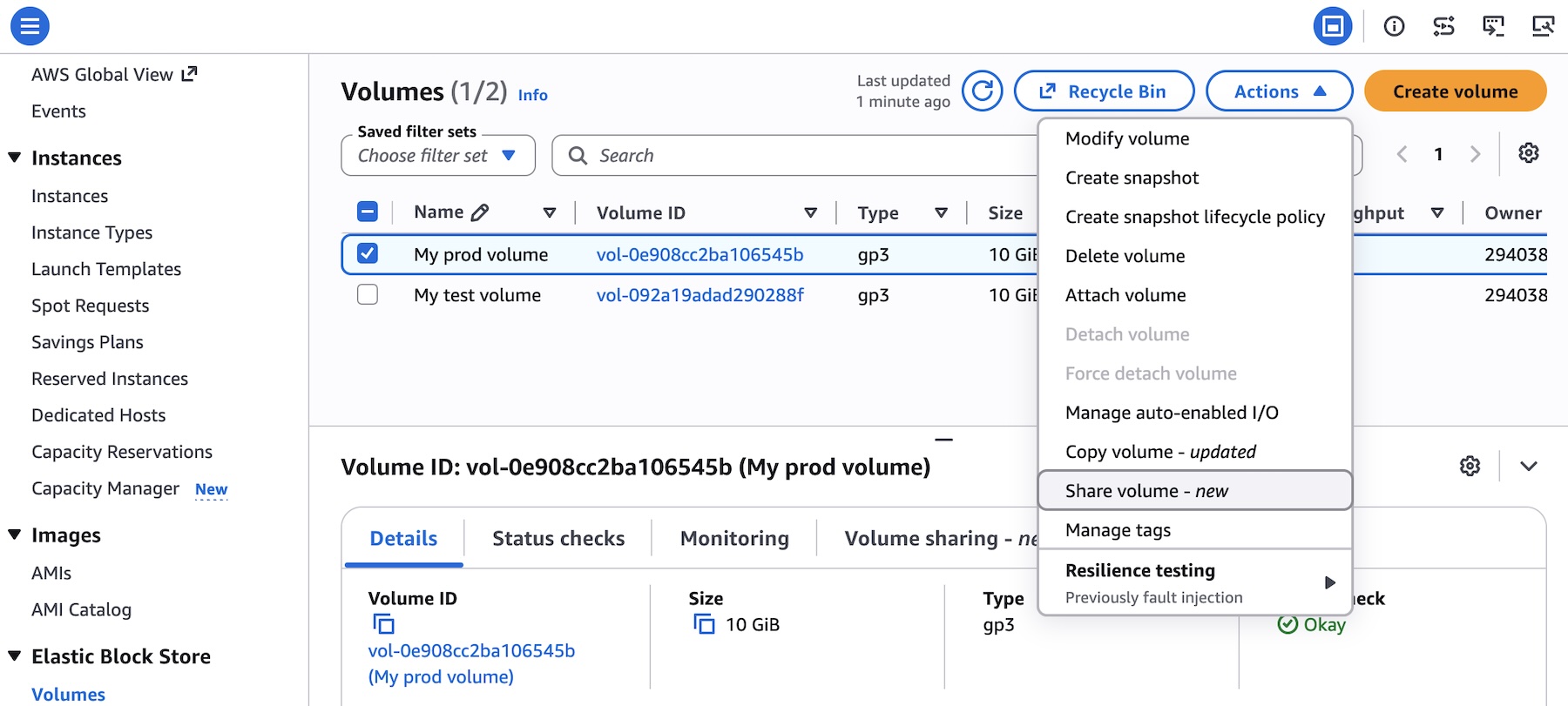
- Initiation (Source Account): The owner of the production EBS volume navigates to the Amazon EBS console, selects the desired volume, and chooses the Share volume option.
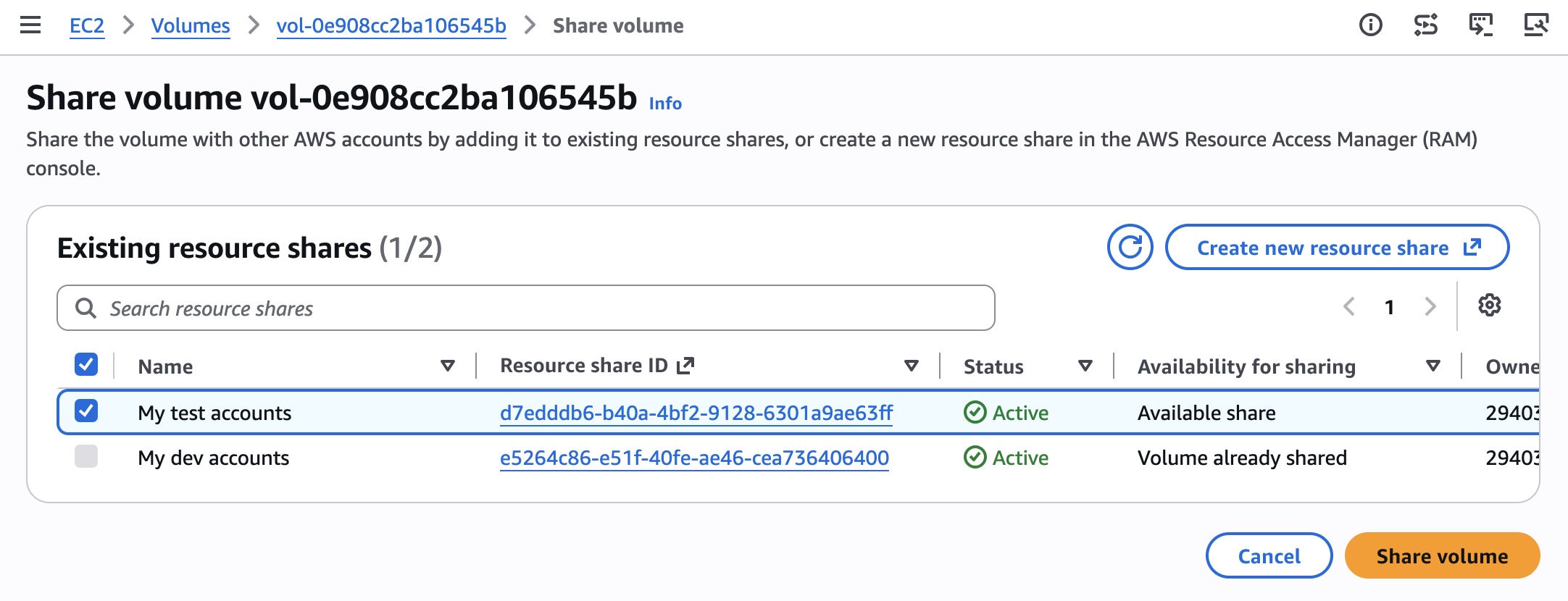
- Resource Sharing via AWS RAM: The volume is integrated into an existing resource share or a newly created resource share within the AWS RAM console. This step governs precisely which external accounts or AWS Organization units are granted visibility into the resource.
- Verification: The source account owner confirms that the volume displays a shared status under the Volume sharing tab within the volume’s detail page.
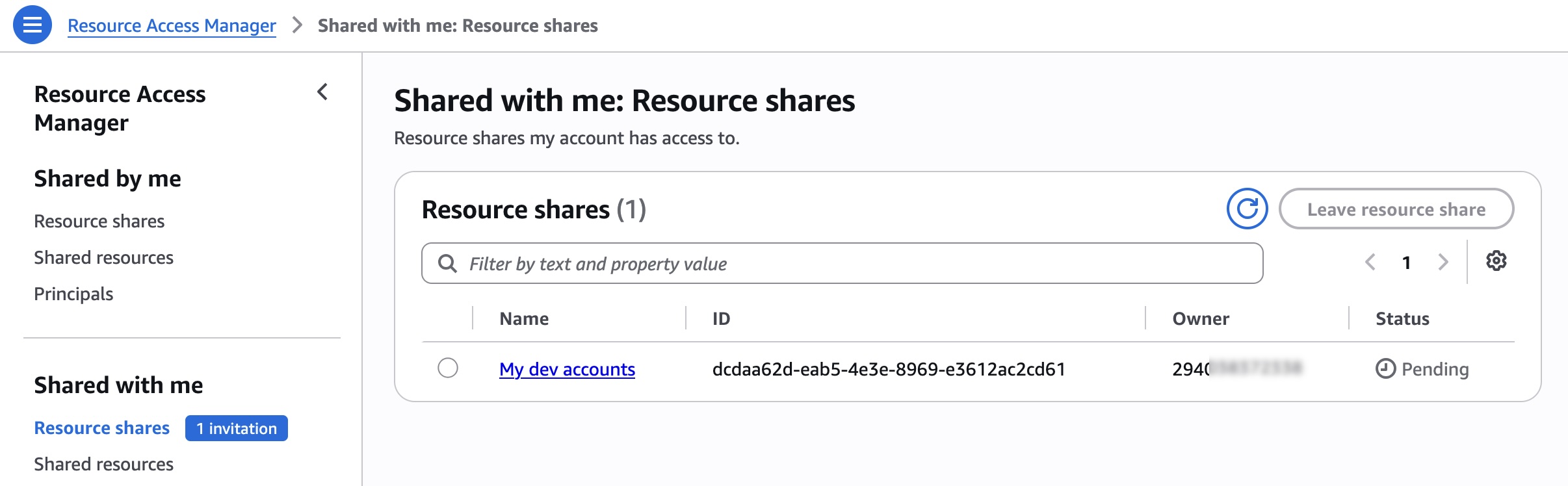
- Acceptance (Target Account): The administrator of the target account navigates to the AWS RAM console, reviews the pending invitation, and explicitly accepts the resource share.
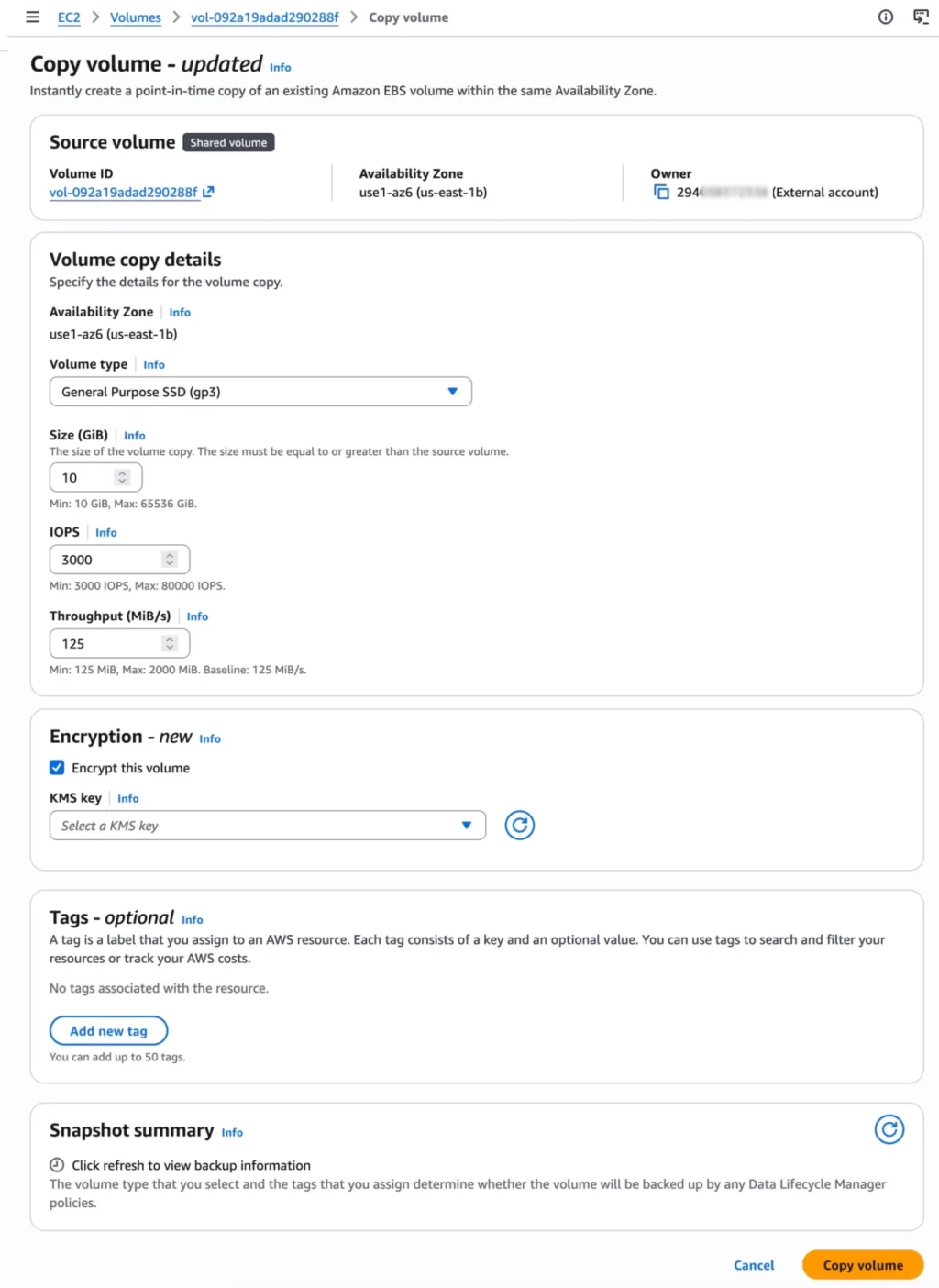
- Copy and Re-Encryption: Once accepted, the shared volume appears within the target account’s EBS console. The target administrator selects Copy volume, at which point they can allocate a new volume identifier, choose performance tiers, and assign a local AWS KMS key for targeted re-encryption.
Programmatic Integration and AI Tooling
For organizations leveraging infrastructure-as-code (IaC) and automated CI/CD pipelines, manual console clicks are insufficient. AWS has integrated support for this workflow into its developer ecosystem. Engineering teams can execute cross-account sharing and copying operations via API calls, command-line interfaces (CLI), and Software Development Kits (SDKs).
Furthermore, AWS has highlighted compatibility with advanced developer tooling, such as the AWS MCP Server and dedicated plugins. Developers utilizing AI-assisted coding environments can query documentation, construct API payloads, and manage cross-account EBS resource sharing parameters using natural language commands integrated directly into their development workflows.
Official Responses and Industry Implications
The release has drawn significant attention from enterprise architects and cloud governance specialists who manage large-scale AWS estates.
Cloud infrastructure analysts note that data freshness is one of the most persistent bottlenecks in software engineering. When developers test patches, database migrations, or major application upgrades against stale staging data, edge cases and performance anomalies frequently slip past testing phases into production. By enabling instant, cross-account replication of live data into isolated development environments, AWS is directly targeting software delivery velocity.
Security professionals have also praised the inclusion of target-account KMS re-encryption. In regulated industries—such as finance, healthcare, and government contracting—data sovereignty and cryptographic isolation are non-negotiable. Allowing a target account to wrap copied production volumes in its own cryptographic keys ensures that even if a cross-account data share is initiated, the principle of least privilege and strict cryptographic separation remain intact.

AWS representatives emphasize that the feature is designed to scale effortlessly alongside growing organizational complexities. By utilizing AWS RAM, companies retain centralized visibility and control over how data traverses account boundaries, satisfying both internal audit requirements and external regulatory standards.
Implications for Enterprise Architecture
The introduction of cross-account Amazon EBS Volume Clones reshapes best practices across several key operational domains:
- Streamlined CI/CD and Data Refresh Pipelines: Testing frameworks can now be automated to pull fresh production states into staging accounts instantly, reducing the manual overhead previously required to script snapshot creation, cross-account snapshot sharing, and subsequent volume provisioning.
- Enhanced Security Posture: Organizations no longer need to compromise security by sharing master production encryption keys across accounts. Target accounts can independently manage the keys protecting their test environments.
- Cost and Storage Efficiency: By leveraging the underlying architecture of EBS Volume Clones, organizations avoid the duplicated administrative storage overhead and long provisioning times historically associated with moving large block-storage volumes across organizational boundaries.
- Disaster Recovery and Forensics: Security operations and incident response teams can quickly isolate compromised workloads or capture forensic states by cloning production volumes into secure, air-gapped forensic accounts for deep-dive analysis without risking the integrity of active production systems.
Future Outlook
Cross-account volume clones for Amazon EBS are generally available today across all AWS Regions that support standard EBS Volume Clones. Organizations looking to adopt the feature can review regional support matrices via the AWS Capabilities by Region documentation and begin testing the workflow within the Amazon EC2 and EBS consoles. AWS continues to gather user feedback through community channels, such as AWS re:Post for Amazon EBS, as it maps out subsequent enhancements for its block storage ecosystem.