Andhra Pradesh Charts Ambitious Path to Economic Supremacy: HRD Minister Nara Lokesh Outlines ‘Viksit Andhra’ Vision at Pan-IIT Summit
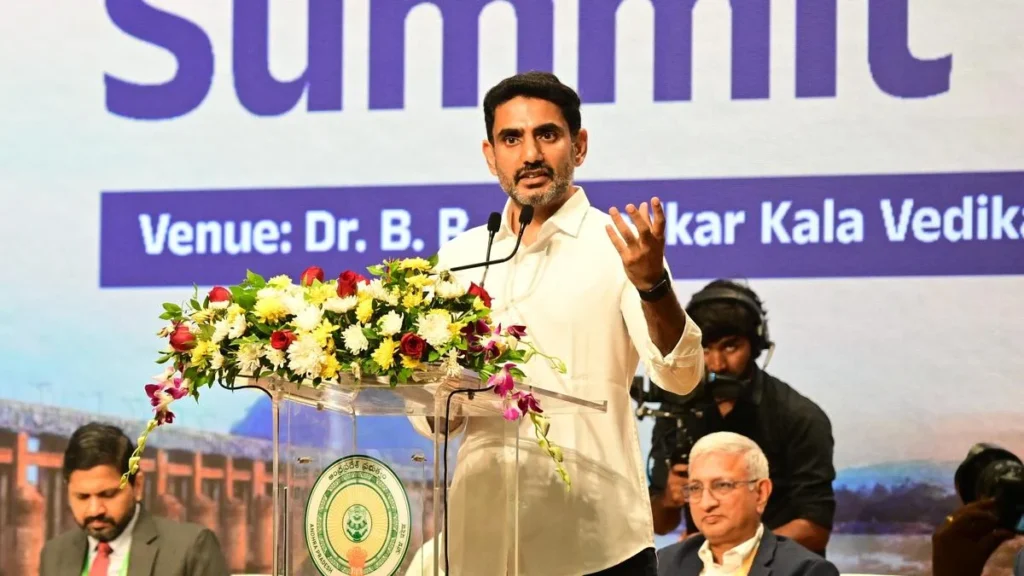
VIJAYAWADA – In a high-stakes address at the Pan-IIT Summit 2026, Andhra Pradesh’s Minister for Human Resource Development (HRD), Nara Lokesh, articulated a transformative roadmap designed to propel the state into the upper echelons of India’s economic hierarchy. Emphasizing the principles of "speed, service, and stability," the Minister detailed how the state government is aligning its developmental trajectory with Prime Minister Narendra Modi’s vision of a Viksit Bharat (Developed India) by 2047.
The summit, which brings together the brightest minds from the Indian Institutes of Technology, served as the platform for the government to showcase its shift from mere memorandum-of-understanding (MoU) rhetoric to tangible, infrastructure-led industrial growth.
The Strategic Blueprint: Speed, Service, and Stability
Addressing a global audience of technologists, investors, and policymakers, Minister Lokesh outlined the core pillars of the current administration’s policy framework. "Our governance model is anchored in the belief that policy should be robust enough to withstand legal scrutiny and political transitions," he noted.
The government’s strategy relies heavily on data-driven decision-making. By leveraging Artificial Intelligence (AI) to audit previous administrative bottlenecks, the state is rewriting its legislative and recruitment playbooks. A prime example highlighted by the Minister was the recent recruitment of 16,000 teachers. By utilizing AI to identify historical legal vulnerabilities in recruitment notifications, the state successfully mitigated potential litigation, ensuring the process remained fluid and timely.
"We are building a government that functions with the efficiency of a high-growth corporation," Lokesh remarked, adding that the state is actively blending the wisdom of experienced administrators with the agility of a younger, first-time legislative team—noting that 17 of the state’s 25 ministers and nearly half of the MLAs are serving their first terms.
Industrial Milestones: From MoUs to Implementation
One of the most significant takeaways from the summit was the government’s transition from "signing ceremonies" to ground-breaking ceremonies. Lokesh highlighted two major success stories that underscore the state’s current momentum:
1. The ArcelorMittal Steel Project
The Minister cited the 17-million-tonne greenfield steel plant by ArcelorMittal as the gold standard for bureaucratic efficiency. From the initial meeting with CEO Aditya Mittal to the formal foundation-laying, the entire process—including complex environmental clearances—was navigated in just 17 months. This, Lokesh argued, signals to global investors that Andhra Pradesh is "open for business" in the truest sense.
2. The Horticulture Ecosystem and the Indian School of Agriculture
The state is aggressively pushing for an integrated horticulture ecosystem in Madanapalle. By establishing the Indian School of Agriculture, the government aims to create a hub for research, mechanized farming, and advanced processing. The economic projections are staggering; the state anticipates this ecosystem could attract investments worth ₹1 lakh crore, effectively turning the region into a global agricultural powerhouse.
Technological Frontiers and Growth Clusters
Andhra Pradesh is not merely chasing traditional manufacturing; it is actively positioning itself as a hub for deep-tech industries. The state has adopted a "cluster-based" approach, developing 23 distinct sectoral growth zones.

Emerging Sectors
- Space and Defense: The government has allocated 300 acres to the space startup Skyroot, while providing critical waterfront access to Sagar Defence to bolster maritime drone capabilities.
- Data and Connectivity: The successful negotiation and establishment of a Google data center in Visakhapatnam were highlighted as proof of the state’s growing influence on the global technology map. Lokesh credited the seamless coordination between the state and the Union government for resolving complex regulatory and taxation hurdles that previously plagued such investments.
- Renewable Energy: With an impressive addition of 4.8 GW of capacity in just one year, the state is currently ranked third in India for renewable energy production, with a stated goal to ascend to the top position.
The Cluster Strategy
The 23 sectoral clusters are designed for "vertical and horizontal integration." By linking industrial supply chains with educational institutions, skills training, and testing facilities, the state hopes to create a self-sustaining ecosystem where innovation is birthed in the lab and scaled on the factory floor.
Amaravati: The Vision of a Future-Ready Capital
A significant portion of the Minister’s speech was dedicated to the development of the state capital, Amaravati. Far from being a traditional urban center, the government envisions Amaravati as a "global research and education hub."
Central to this vision is the proposal for a 5,000-acre greenfield airport. Lokesh emphasized that the capital’s development would be guided by future-proof urban planning, ensuring that it serves not just as a seat of power, but as a nerve center for India’s technological and academic pursuits.
Official Responses and Collaborative Governance
The summit served as a call to action for the Pan-IIT community. Minister Lokesh invited alumni and industry experts to partner with the state government to refine its "cluster strategy." He coined the term "Visible Governance, Invisible Government" to describe his administrative philosophy—meaning that while the impact of the government should be visible in the form of jobs, infrastructure, and ease of business, the bureaucratic processes themselves should be "invisible," seamless, and automated.
"We are institutionalizing speed," the Minister said, inviting the audience to contribute their expertise in creating policies that are not only pro-business but also socially equitable.
Implications: The Road Ahead
The implications of the policies outlined by Minister Lokesh are profound. For Andhra Pradesh, the success of these initiatives could mean a total economic pivot, moving from a regional economy to a global industrial competitor.
- Job Creation: By prioritizing sectors like semiconductors, quantum technology, and green energy, the state is creating high-value jobs for the youth, potentially reversing the brain drain that often plagues developing regions.
- Investor Confidence: The successful handling of the ArcelorMittal and Google projects sets a precedent for transparency and speed that will likely attract further Foreign Direct Investment (FDI).
- National Integration: By aligning the state’s growth with the Viksit Bharat vision, Andhra Pradesh is effectively positioning itself as a primary engine of India’s national economic growth.
As the summit concluded, the message from the Andhra Pradesh government was clear: the state is moving past the era of promises and into an era of execution. With a blend of AI-backed administration, a focus on emerging technologies, and a clear roadmap for industrial infrastructure, Andhra Pradesh is betting that its "speed, service, and stability" model will be the catalyst for a new chapter in India’s industrial history.
The challenge, as recognized by the Minister, lies in the consistency of these efforts. However, with the government’s commitment to "institutionalizing" these faster processes, the state appears poised to set a new benchmark for state-led development in India.