Critical Security Lapse: CISA Under Fire After Contractor Exposes Agency Secrets on Public GitHub
The U.S. Cybersecurity and Infrastructure Security Agency (CISA)—the federal body tasked with safeguarding the nation’s digital and physical infrastructure—is currently embroiled in a high-stakes security crisis. Following a report by KrebsOnSecurity, it has been revealed that a CISA contractor inadvertently, yet flagrantly, exposed a treasure trove of agency secrets, including AWS GovCloud keys and sensitive internal credentials, on a public GitHub repository.
The fallout has been immediate and severe. Lawmakers in both the House and Senate are now demanding a rigorous accounting of how such a catastrophic lapse in operational security could occur at the very agency responsible for setting the gold standard for federal cybersecurity. As CISA scrambles to invalidate the leaked credentials, the incident has reignited debates regarding agency staffing, the management of third-party contractors, and the inherent risks of human error in an era of sophisticated state-sponsored cyber threats.
The Anatomy of the Breach: A Repository Named "Private-CISA"
The incident centers on a public GitHub profile titled "Private-CISA." Created in November 2025, the repository served as a digital "scratchpad" for a contractor who possessed administrative access to CISA’s code development infrastructure. Rather than utilizing secure, air-gapped, or agency-approved internal tools for synchronization, the contractor appears to have utilized this public-facing account to shuttle data between workstations.
Security researchers who analyzed the repository’s commit history discovered that the contractor had manually disabled GitHub’s built-in "Secret Scanning" features—protections specifically designed to prevent the accidental publication of API keys, passwords, and tokens.
The contents of the repository were staggering in their scope. Files included plaintext credentials for internal CISA systems, AWS GovCloud configuration files, and even browser-saved passwords. By creating a public space to synchronize their work, the contractor effectively bypassed every layer of perimeter defense, placing the agency’s "keys to the kingdom" on the open internet.
Chronology of the Incident
- November 2025: The "Private-CISA" repository is established on GitHub. It begins to function as an unauthorized synchronization mechanism for the contractor.
- Late April 2026: The repository is updated with highly sensitive AWS GovCloud tokens and other critical authentication materials.
- May 18, 2026: KrebsOnSecurity publicly reports the breach after being alerted to the exposed secrets.
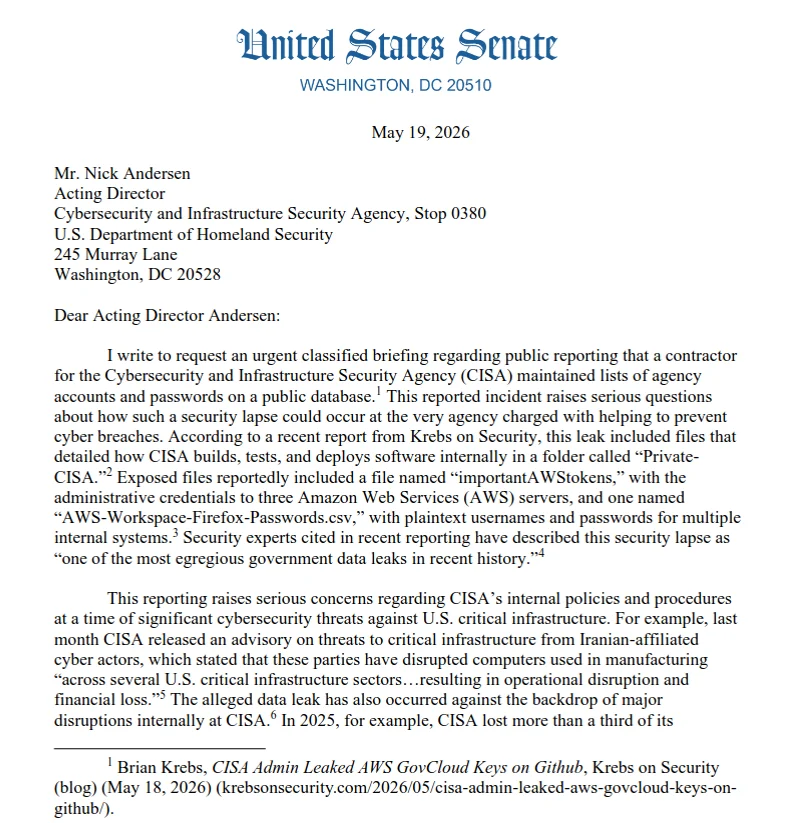
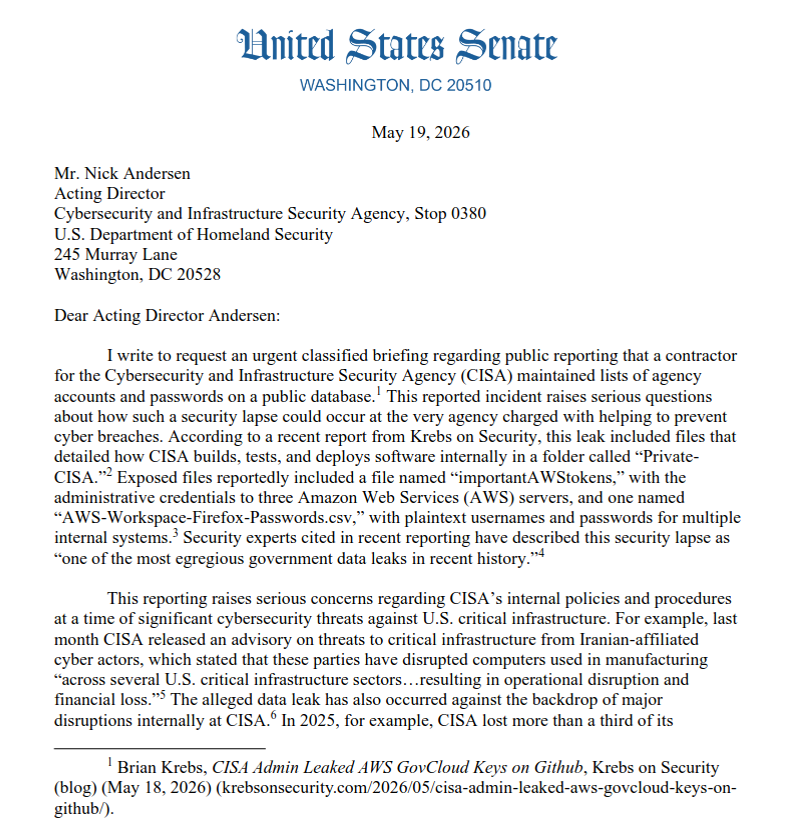
- May 19, 2026: Sen. Maggie Hassan (D-NH) sends a formal letter to CISA Acting Director Nick Andersen demanding answers. Rep. Bennie Thompson (D-MS) and Rep. Delia Ramirez (D-Ill) issue a joint letter expressing grave concern over the agency’s security culture.
- May 20, 2026: Dylan Ayrey, founder of Truffle Security, identifies that CISA has failed to rotate a critical RSA private key. The key provides administrative access to the
CISA-ITGitHub organization, potentially allowing an attacker to hijack CI/CD pipelines. - May 20, 2026 (Late Afternoon): Following notification from researchers, CISA finally revokes the critical RSA key, though other, less-publicized credentials remain unrotated.
The "TruffleHog" Revelation: A Path to Total System Compromise
The danger posed by this leak was not merely theoretical. Dylan Ayrey, the creator of the open-source security tool TruffleHog, highlighted that even after CISA was alerted to the breach, they failed to secure the most dangerous credential: an RSA private key.
This specific key allowed access to a GitHub app owned by CISA’s enterprise account. As Ayrey explained to KrebsOnSecurity, the implications were devastating. "An attacker with this key could read source code from every repository in the CISA-IT organization, including private repos, register rogue self-hosted runners to hijack CI/CD pipelines and access repository secrets, and modify repository admin settings."
In modern software development, CI/CD (Continuous Integration and Continuous Delivery) pipelines are the engine room of an organization. If an attacker gains control over these pipelines, they can inject malicious code into the agency’s software updates, essentially creating a "supply chain attack" against the very systems CISA is supposed to protect. The fact that this credential remained active for days after the initial discovery underscores a significant delay in the agency’s incident response capabilities.
Official Responses and Congressional Scrutiny
CISA’s official stance has been one of damage control. In a brief statement, the agency claimed, "there is no indication that any sensitive data was compromised as a result of the incident." However, this assertion is viewed with skepticism by cybersecurity experts who note that the "firehose" of GitHub public commits is constantly monitored by both security researchers and malicious actors.
Congressional Concern
The response from Capitol Hill has been blistering. Sen. Maggie Hassan’s letter to Acting Director Nick Andersen is emblematic of the frustration shared by many legislators. "This reporting raises serious concerns regarding CISA’s internal policies and procedures at a time of significant cybersecurity threats against U.S. critical infrastructure," Hassan wrote. She demanded a detailed timeline, an assessment of the potential for foreign exploitation, and a report on how the agency intends to prevent a recurrence.
Rep. Bennie Thompson and Rep. Delia Ramirez emphasized that this incident is not an isolated technical failure but a symptom of a larger, systemic problem. They noted that the incident occurred in the shadow of a massive internal upheaval at CISA, which recently saw the loss of over one-third of its workforce and a significant portion of its senior leadership following administrative changes.
The Broader Implications: A Culture of Fragility
The "Private-CISA" incident has forced a difficult conversation about the limitations of technical security controls in the face of human behavior.
The Human Element
As James Wilson and Adam Boileau of the Risky Business podcast noted, this breach highlights the limits of what a central IT department can control. While an organization can implement policies to stop an employee from pushing keys to a corporate GitHub, it is fundamentally difficult to prevent a contractor from using a personal device or personal account to manage work-related files.
This suggests that the solution is not just better software, but better vetting, better training, and a fundamental shift in the culture of contractors who may not fully grasp the sensitivity of the data they handle.
Adversarial Surveillance
The incident also exposes the reality of the modern threat landscape. "We monitor that firehose of data for keys," Ayrey noted, referring to GitHub’s public activity stream. "We have evidence attackers monitor that firehose as well."
For state-sponsored actors in Russia, China, and Iran, the "Private-CISA" repository was not a hidden treasure chest; it was a public broadcast of federal vulnerabilities. By failing to detect the leak for months, CISA provided these adversaries with a roadmap for persistence within their network.
Conclusion: The Long Road to Remediation
As of this writing, CISA continues to rotate compromised credentials. However, the damage to the agency’s reputation may be more difficult to repair. When the nation’s "cybersecurity agency" falls victim to the most elementary of security errors—leaking plaintext keys on a public platform—it weakens the entire federal posture.
The investigation by Congress will likely lead to stricter oversight of federal contractors and perhaps a mandate for more rigorous automated scanning of all employee-managed code repositories. Yet, the core takeaway remains the same: in an interconnected digital world, the security of a massive federal agency is only as strong as the security hygiene of its most junior contractor.
Until CISA can demonstrate that it has addressed the underlying issues of workforce attrition, contractor oversight, and incident response speed, the agency will continue to operate under a cloud of scrutiny. The "Private-CISA" incident serves as a stark, expensive reminder that in the realm of cybersecurity, the greatest threat to a secure system is often the convenience of the people tasked with maintaining it.