Empowering the Next Generation: How WordPress Education Initiatives are Transforming Global Tech Literacy
By Global Tech & Education Correspondent
Published: September 2026
Main Facts
In an era where digital literacy is just as vital as traditional reading and writing, the open-source community is stepping up to bridge the global tech skills gap. Through two core programs—WordPress Campus Connect and WordPress Credits—students across the globe are gaining hands-on development experience, contributing to the software that powers over 40 percent of the web, and breaking into tech fields completely free of charge.
Recent data highlights a monumental month of growth. In July alone, initiatives spanning Bangladesh, Spain, Uganda, Costa Rica, and Japan mobilized hundreds of learners. Most of these participants had never built a website prior to joining the workshops. Notable milestones include:
- Bangladesh: Students across two separate campuses in Kishoreganj constructed 108 fully functional websites in just a two-week span.
- Global Internships: The WordPress Credits program, which pairs students with mentors to contribute directly to the core software for academic credit, saw its graduate count surge to 226 in July (up from 199 in June). The program now actively collaborates with 38 partner academic institutions across 16 countries.
- Peer-to-Peer Innovation: In Costa Rica, university students designed and executed a high school STEM workshop, creating a standardized, open-source guide so educators worldwide can replicate the curriculum.
These programs eliminate financial barriers, provide practical certifications, and actively reshape how computer science and open-source contributions are taught outside traditional, expensive classroom environments.
Chronology of July 2026: A Month of Global Momentum
The international scope of the WordPress education initiatives unfolded rapidly over the course of July, demonstrating resilience, adaptability, and high-impact learning across diverse cultures and infrastructures.

Early July: The Kishoreganj Build Sprint (Bangladesh)
Organized by community leader Muhibul Haque, Campus Connect landed at two distinct institutions two weeks apart. In the first week, students at Kishoreganj University built 38 websites. Shortly after, at the Kishoreganj Polytechnic Institute—where guest speaker Shipon Karmakar traveled over 80 kilometers to support the event—participants built nearly 70 more websites, pushing the regional total past 108.
Mid-July: Innovation Meets Vocational Training in Spain
Josep Morán orchestrated two intense four-hour sessions for 100 vocational students at Escola Pia Sta. Anna in Mataró, Spain. Utilizing WordPress Playground and AI-assisted development tools, the students successfully built a working plugin designed to calculate optimal shore-fishing times for local residents.
Late July: Overcoming Adversity in Eastern Uganda
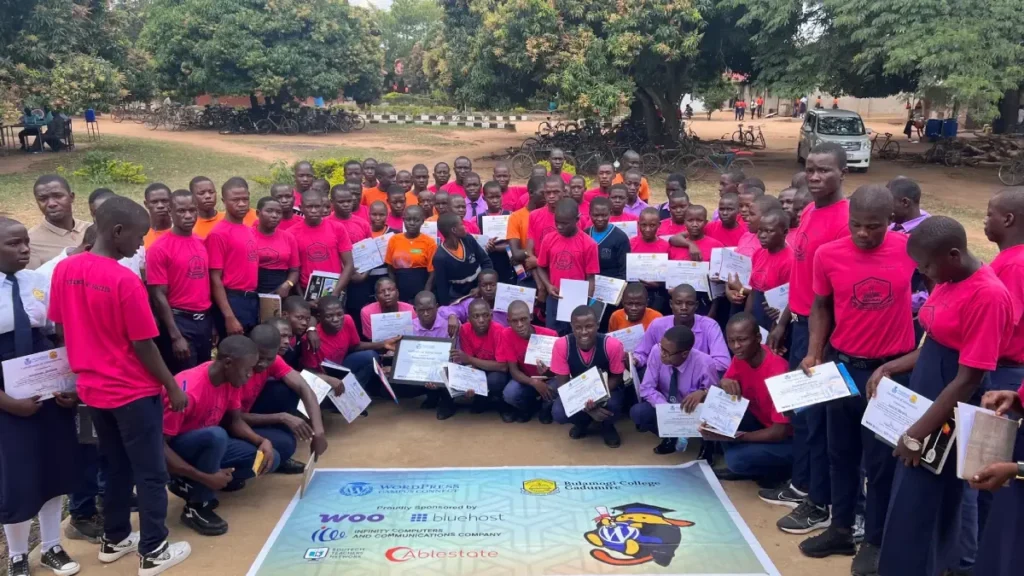
On July 29, organizer Moses Ssebunya and volunteer Mariam Nairuba arrived at Bulamogi College Gadumire in Kaliro. Nairuba, a former student who had advocated to bring the program to her alma mater, faced an unexpected hurdle: the school’s Director of Studies announced upon their arrival that there was no electricity.
Rather than cancel the workshop, the team adapted. They put aside the laptops, projectors, and extension cables, transforming the session into an interactive Q&A format around WordPress security, development paths, and open-source accessibility.
Late July: Peer Mentorship and Localization in Costa Rica
Rita Robles Loaiza spearheaded two distinct pilots in Costa Rica. First, three students from the Universidad Fidélitas WordPress Credits cohort taught a workshop to 40 high school girls at a science camp. Simultaneously, 13 students at Liceo Experimental Bilingüe José Figueres Ferrer began translating WordPress into es_CR alongside the Costa Rican Spanish Polyglots team as part of their community service requirement.

Supporting Data and Program Architecture
The success of these global initiatives relies on a structured framework designed to scale effectively while maintaining localized relevance. The ecosystem is split into complementary avenues:
[WordPress Education Initiatives]
       │
       ├──> WordPress Campus Connect (Free, hands-on localized workshops)
       ├──> WordPress Credits (Mentored internships for academic credit)
       └──> Student Clubs (Long-term peer communities and campus chapters)
Key Metrics and Growth Indicators
- 108 Websites: Built in a single two-week regional push in Kishoreganj, Bangladesh.
- 226 Graduates: Total alumni of the WordPress Credits internship program as of July (up from 199 in June).
- 38 Partner Institutions: Universities and high schools actively integrating the program.
- 16 Countries: The global footprint of the WordPress Credits initiative.
- 100% Satisfaction Rate: Reported across multiple student-led workshops, including the Patrones Hermosos STEM camp in Costa Rica.
Replicable Frameworks
A cornerstone of the program’s recent success is its focus on documentation. When university students in Costa Rica taught high schoolers, they systematically documented every step of their methodology. This resulted in the publication of the official WPCredits Replicable Guide, allowing educators anywhere in the world to pick up the curriculum and run an identical workshop without needing direct oversight from core organizers.
Official Responses and Perspectives
Organizers, educators, and student participants alike have emphasized the life-changing nature of these workshops, noting how open-source software provides a direct bridge to local employment and global collaboration.
"The room exploded," organizers noted in their official recap of the power-outage workshop at Bulamogi College Gadumire. When forced to abandon digital screens, students engaged in a deeply conceptual debate about software freedom, digital security, and whether everyday learners could genuinely aspire to become software developers.
For many participants, the primary value lies in utility and local economic relevance. Feedback from vocational programs in Spain highlights that students and faculty were united by two primary takeaways:

- The tangible certificate awarded upon completion.
- The direct alignment between the skills learned and the actual jobs available within the local economy.
By integrating students directly into the contribution pipelines of software that drives nearly half of the internet, programs like WordPress Credits shift the paradigm from passive consumption to active creation. Students are no longer just learning how to use tools—they are helping build the infrastructure that others use.
Implications for Global Tech Education
The rapid expansion of WordPress Campus Connect and WordPress Credits signals a shifting landscape in technology education. Traditional academic institutions often struggle to update their computer science curricula quickly enough to match the fast-paced evolution of web development and open-source technologies.
By injecting real-world, mentored contribution pipelines directly into schools—ranging from advanced universities in Japan and Bangladesh to rural high schools in Uganda—these programs achieve several critical outcomes:
- Democratization of Tech Skills: Geographic location and infrastructural limits (such as a lack of electricity) are met with resilience rather than exclusion, proving that core conceptual learning can happen anywhere.
- Empowering Underrepresented Groups: Targeted initiatives, such as workshops designed to boost female participation in STEM careers in Costa Rica, actively diversify the talent pipeline in technology sectors.
- Sustainable Local Impact: By training students to become teachers (peer-to-peer education) and translators (localization projects like es_CR), the initiatives ensure that knowledge stays within communities long after foreign or visiting volunteers leave.
As the Monthly Education Buzz Reports continue to log new milestones—such as student-led Campus Connects at the Kyoto University of Advanced Science and self-sustaining Student Clubs in Dhaka—the model serves as a blueprint for how open-source communities can successfully partner with global education systems to build a more inclusive digital future.