From Marginalization to Market Mastery: How the Irula Tribe is Revolutionizing Cashew Cultivation in Tamil Nadu
In the rural heartlands of Ariyalur, Tamil Nadu, a quiet economic revolution is taking root. For generations, over 230 families from the Irula tribal community—a group historically relegated to the fringes of the formal economy—have endured the volatility of seasonal labor, ranging from wild honey collection to precarious daily wage work. However, a landmark four-year collaborative intervention by the State’s Tribal Welfare and Forest Departments has transformed these families from vulnerable laborers into empowered stakeholders in the cashew industry.
By bridging the gap between traditional knowledge and scientific plantation management, this initiative has not only secured sustainable livelihoods but has also created a replicable model for tribal empowerment in India.
The Genesis of the Initiative: Breaking Structural Barriers
The socio-economic landscape of the Irula people in the Jayankondam, Udayarpalayam, and Andimadam regions was long defined by instability. Historically, the cashew plantations managed by the Tamil Nadu Forest Plantation Corporation Limited (TAFCORN) were effectively out of reach for these communities. While the land was physically present, the economic entry barriers—specifically the requirement for a substantial Earnest Money Deposit (EMD) to participate in public auctions—ensured that only affluent contractors could secure lease rights.
The turning point arrived with the launch of the Tholkudi Livelihood Scheme. Recognizing the systemic exclusion of the Irula, the Tribal Welfare Department stepped in to provide the necessary financial scaffolding. By injecting ₹86 lakh in support, the government enabled tribal welfare societies to bypass traditional middlemen and secure 549.21 hectares of cashew plantations on a five-year lease in 2022. This shift was not merely administrative; it was a fundamental change in the relationship between the state, the land, and the tribal inhabitants.
Chronology of Empowerment: A Four-Year Trajectory
The transition from subsistence to commercial success was not instantaneous; it was the result of a meticulously planned four-year rollout:
- 2022 (The Foundation): The Tribal Welfare Department, in coordination with the Forest Department, successfully facilitated the leasing of 549.21 hectares of TAFCORN land to Irula tribal welfare societies. The Tholkudi Livelihood Scheme provided the critical funding to bridge the EMD gap.
- 2023 (Skill Acquisition): Understanding that land access alone would not guarantee success, the government engaged the Directorate of Cashew Research (DCR) in Puttur, Karnataka. Experts provided intensive training in scientific plantation management, modern pest control techniques, and efficient harvesting protocols.
- 2024 (Optimization): The communities began implementing standardized harvesting practices, moving away from destructive collection methods toward sustainable yield maximization. The focus shifted toward collective bargaining power in the marketplace.
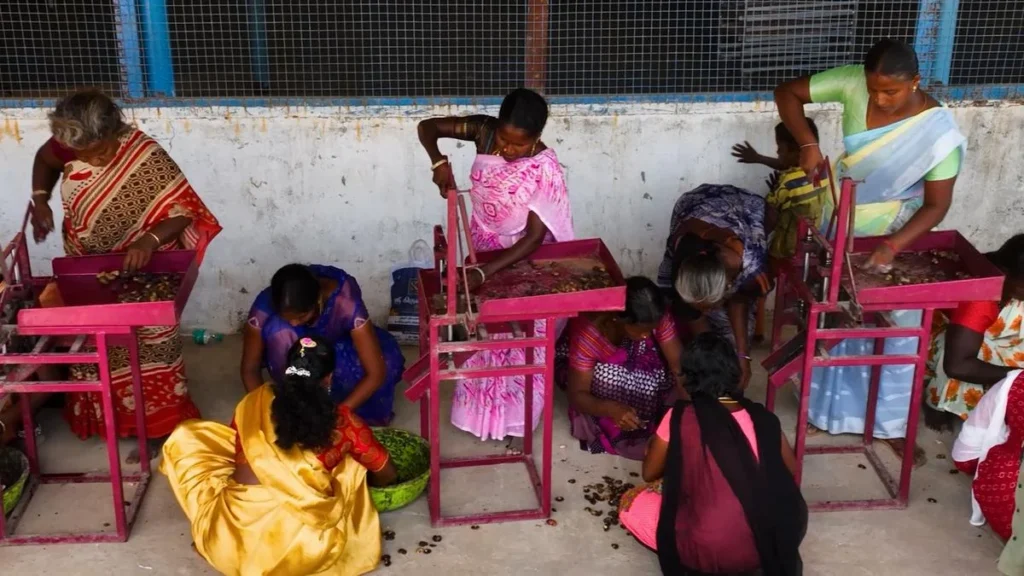
- 2025-26 (The Harvest): The program reached a significant milestone. The societies successfully harvested 96,400 kg of raw cashew nuts. This period also saw the operational integration of the modern cashew processing facility at Koovagam village, which provided direct employment to 164 tribal women.
Scientific Integration and Modern Processing
A critical component of this success story is the technical collaboration with the Directorate of Cashew Research (DCR). The training provided to the Irula communities shifted their operational philosophy. Instead of "wild harvesting," the families adopted scientific methods that prioritized tree health and long-term productivity.
Furthermore, the establishment of a processing facility at Koovagam serves as the industrial backbone of this initiative. By processing raw nuts into kernels locally, the community captures a larger share of the value chain. Rather than selling raw, unprocessed produce to wholesale buyers at low prices, the cooperative now adds value locally. This move has created a ripple effect in the local economy, specifically through the employment of 164 women, who are now central to the processing and marketing lifecycle of the crop.
Economic Impact: Data-Driven Success
The financial metrics of the 2025-26 season underscore the viability of this model. The project generated a total revenue of ₹1.37 crore, resulting in a net profit of ₹45.48 lakh. For the participating families, this translated into an average net income of approximately ₹19,800 per household—a figure that represents a significant uplift from their previous earnings as daily wage laborers.

Beyond the profit-sharing model, the project provides a consistent salary. Each member of the society receives a daily wage of ₹350 during the four-month harvesting window (January to April). This provides a predictable financial cushion, effectively eliminating the "hungry season" that often plagues agricultural communities.
G. Ramesh, a resident of Vettiyarvettu village, summarized the psychological shift as much as the financial one: "Earlier, we used to depend only on daily wage work. Now, with the government’s support, we have leased the land by paying for it and are cultivating it ourselves. We now feel like owners rather than labourers."
Official Perspectives: A Synergistic Approach
The initiative has garnered high-level praise for its collaborative structure. Supriya Sahu, Additional Chief Secretary for the Department of Environment, Climate Change and Forests, emphasized that the success of the Irula project is a blueprint for future tribal welfare initiatives.
"Empowerment cannot be achieved in isolation; it has to be synergistic," Sahu noted. "The members of the society have undergone the best training programmes, and the government has acted as a facilitator rather than a director. There is a fantastic opportunity to scale up such an initiative across the state."
The government’s commitment is further reflected in its infrastructure plans; officials have already begun discussing the establishment of a second cashew processing unit in the district to handle the anticipated increase in yields as the current plantations mature under scientific care.
Broader Implications: Sustainability and Self-Reliance
The Irula experience in Ariyalur offers several lessons for rural development policy in India:
- De-risking Participation: By providing financial support for EMDs, the state removed the primary barrier to entry for marginalized groups, proving that capital, not just intent, is required to level the playing field.
- Value-Chain Integration: The shift from raw material collection to local processing is essential. By controlling the processing units at Koovagam, the Irula societies have moved from the bottom of the commodity chain to becoming active participants in the secondary sector.
- Gender-Centric Employment: The explicit inclusion of 164 women in the processing facilities has decentralized the economic benefits, ensuring that the wealth generated is distributed across the family unit rather than concentrated solely in the hands of the male heads of households.
- Ecological Stewardship: Because the Irula are now the stewards of the land under a long-term lease, there is a vested interest in the long-term health of the plantations. This aligns tribal land-use practices with forest conservation goals.
Conclusion
The Irula tribal community’s transition into cashew entrepreneurship is more than a success story in agriculture; it is a profound testament to the power of state-facilitated self-reliance. By combining targeted financial assistance, expert technical training, and modern infrastructure, the Tamil Nadu government has successfully replaced a cycle of seasonal precarity with a model of sustained, dignified, and profitable labor.
As the state considers scaling this initiative, the experience of these 230 families stands as a beacon. It proves that when marginalized communities are given the tools, the training, and the institutional support to manage their own resources, they do not just survive—they flourish. The journey from the wild forests of Ariyalur to the modern processing floors of Koovagam is a long one, but for the Irula people, it is a path that has finally led them to true economic independence.