Tragedy in Murshidabad: Three Dead, Several Injured as Train Rams School Van at Level Crossing
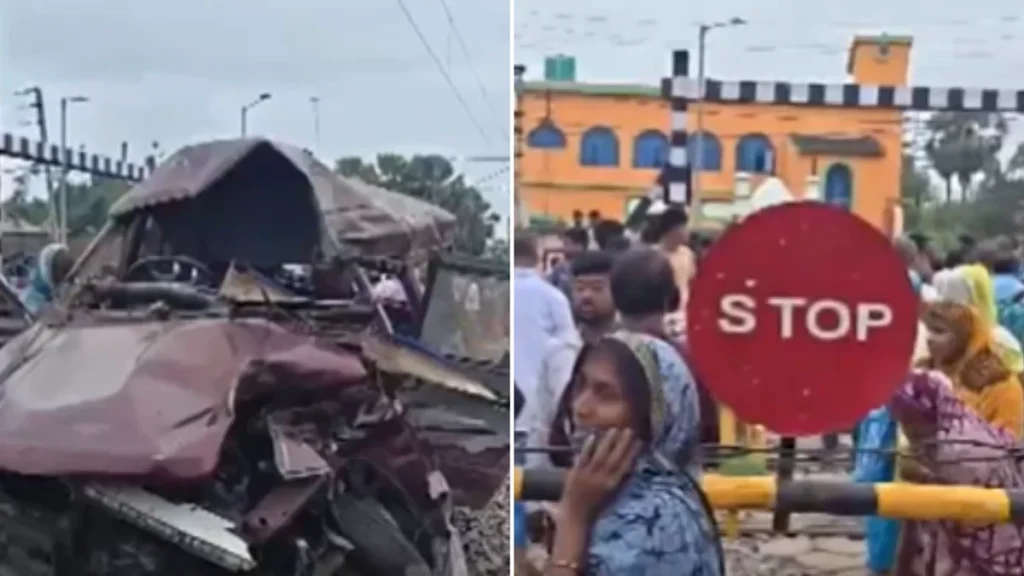
MURSHIDABAD, WEST BENGAL – A somber atmosphere has descended upon the Murshidabad district of West Bengal following a catastrophic collision between a passenger train and a school van on the morning of Friday, July 17, 2026. The incident, which occurred at an unmanned or poorly signaled railway level crossing, has claimed the lives of at least three individuals, including two children, and left several others battling for their lives in intensive care.
The collision, which took place near the Karna Subarna Railway Station, has ignited a firestorm of debate regarding railway safety protocols, the maintenance of level crossings in rural India, and the systemic lapses that continue to endanger the lives of daily commuters and schoolchildren.
Main Facts: A Morning of Devastation
The collision occurred at approximately 7:00 a.m. local time, a period when school transport is at its peak frequency across the district. According to preliminary reports, a van transporting students to their educational institution attempted to navigate a railway level crossing near the Karna Subarna station.
As the vehicle moved onto the tracks, it was struck by an oncoming train with significant force, dragging the vehicle for a considerable distance before coming to a halt. The impact resulted in the immediate death of three occupants, two of whom were confirmed to be minors.
Local villagers, who were among the first to arrive at the scene, described a harrowing environment characterized by the mangled remains of the van and the desperate cries of survivors trapped within the wreckage. Hundreds of residents from nearby localities converged on the site, forming makeshift rescue lines to extricate the victims before official emergency services could fully deploy.
The injured, including both children and the van driver, were rushed to the Murshidabad Medical College and Hospital. Medical officials have stated that several survivors remain in critical condition, having sustained severe head trauma, multiple fractures, and internal injuries. The hospital has reportedly mobilized additional medical staff to handle the influx of trauma patients.
Chronology of the Incident
- 06:45 a.m.: The school van commences its morning route, picking up students from various points in the Murshidabad region.
- 07:00 a.m.: The van approaches the level crossing near Karna Subarna Railway Station. Eyewitness reports suggest that visibility was relatively clear, but traffic at the crossing was heavy.
- 07:05 a.m.: The collision occurs. The train strikes the van, causing immediate, catastrophic structural failure to the vehicle.
- 07:15 a.m.: Local residents begin the primary rescue operations, pulling victims from the debris and alerting emergency services.
- 08:00 a.m.: Ambulances arrive on the scene to transport the injured to Murshidabad Medical College and Hospital.
- 09:30 a.m.: A specialized 10-member investigation team from the Indian Railways reaches the accident site to begin gathering forensic evidence and assessing the functionality of the crossing signals.
- 10:25 a.m.: Official reports regarding the casualty count are released to the media, confirming three deaths.
The Infrastructure Crisis: A Closer Look at Level Crossings
The incident in Murshidabad has once again brought the precarious state of India’s railway level crossings into the national spotlight. For years, railway safety audits have identified thousands of "unmanned" or "partially manned" crossings as high-risk zones.

While the Indian Railways has embarked on a multi-year mission to eliminate unmanned level crossings (ULCs) by replacing them with road-under-bridges (RUBs) or road-over-bridges (ROBs), progress remains uneven in rural districts. Experts argue that the transition from a manual crossing to a permanent safety structure often lacks the necessary vigilance during the interim phase.
The Karna Subarna crossing is now the subject of intense scrutiny. Questions are being raised about whether the warning signals were active at the time of the collision and whether the van driver was provided with adequate visibility of the approaching train. Historically, accidents at such junctions are often attributed to a combination of driver negligence and insufficient railway warning infrastructure, such as missing boom barriers or lack of audio-visual alarms.
Official Responses and Administrative Silence
As of the latest updates, the administration and the railway ministry have remained largely reserved, awaiting the preliminary findings of the 10-member technical committee dispatched to the site.
While the presence of the railway team indicates a formal investigation is underway, the lack of an immediate statement has drawn criticism from local political figures and grieving families. In such incidents, the public typically expects an immediate clarification regarding the operational status of the crossing at the time of the incident—specifically, whether the signal failed or if the van attempted to bypass a lowered barrier.
"The silence is deafening," noted a local community leader who arrived shortly after the incident. "Families are not just mourning; they are looking for accountability. They want to know why a crossing that handles school children every single day was not equipped with fail-safe measures that could have prevented this."
The Chief Medical Officer at Murshidabad Medical College confirmed that the hospital is providing all necessary resources, but emphasized that the severity of the injuries sustained by the surviving children presents a challenging prognosis for the medical team.
Implications: A Call for Systemic Reform
This tragedy serves as a grim reminder of the vulnerability of rural transport networks. The implications of the Murshidabad accident are manifold:

1. Safety Audits and Infrastructure Overhaul
There is an urgent requirement for a comprehensive re-audit of all railway crossings in West Bengal. The Ministry of Railways must expedite the installation of automated boom barriers and CCTV surveillance at every crossing that lacks them, ensuring that human error—on either the driver’s or the signalman’s part—does not result in loss of life.
2. Transportation Regulations
The incident raises questions about the regulation of school transport. Are these private vans adequately vetted for safety? Do they adhere to standardized transport guidelines that include mandatory helpers and reliable communication devices? Local educational boards may soon face pressure to implement stricter vehicle safety audits for all school-contracted transport.
3. Psychological Impact on the Community
The emotional toll on a small district like Murshidabad is profound. Schools in the vicinity are expected to hold memorial services, and the state government is anticipated to announce compensation for the families of the deceased. However, financial aid is only a fraction of the response needed; the community requires long-term counseling support for the students who witnessed the tragedy.
4. Legal and Political Accountability
The outcome of the 10-member railway committee’s investigation will be pivotal. If the report identifies a failure in the railway signaling system, it could lead to significant legal ramifications for the local railway division. Conversely, if the investigation points to driver error, it will likely lead to a renewed push for public awareness campaigns regarding road-rail safety.
Conclusion
The collision in Murshidabad is a tragedy that extends beyond the immediate loss of three lives. It highlights a recurring struggle in the nation’s push for modernization: the challenge of ensuring safety in the vast, often overlooked rural transport corridors.
As the survivors continue their fight for recovery and the families begin the agonizing process of laying their loved ones to rest, the national conversation must shift toward tangible, permanent solutions. The citizens of Murshidabad, and indeed the entire country, are waiting for more than just an investigation report; they are waiting for the guarantee that such a morning of terror will never be repeated.
The railway authorities have pledged a transparent investigation, with a preliminary report expected within the next 48 hours. Until then, the community remains in a state of mourning, united by the shared demand for safer passage and the accountability of those responsible for maintaining the nation’s vital infrastructure.