The Architecture of Autonomy: Mastering the 7-Layer Production AI Agent Stack
In the rapidly evolving landscape of 2026, the promise of AI has shifted from simple text generation to active, autonomous execution. Imagine a scenario where you task an AI agent with researching three global competitors, extracting granular pricing data from their respective portals, synthesizing the findings into a high-level strategic report, and delivering that file to a corporate Slack channel by 9:00 AM—all completed in less than a minute.
This level of performance is no longer science fiction, but it is also not "magic." While the foundation model (the Large Language Model) often claims the spotlight, it is merely the engine in a much larger, more complex vehicle. As industry analysts at Gartner recently noted, enterprise adoption of task-specific AI agents is projected to skyrocket from less than 5% in 2025 to 40% by the end of 2026. For engineers and technical leads, this near-vertical adoption curve demands a transition from "prompt engineering" to "systems architecture."
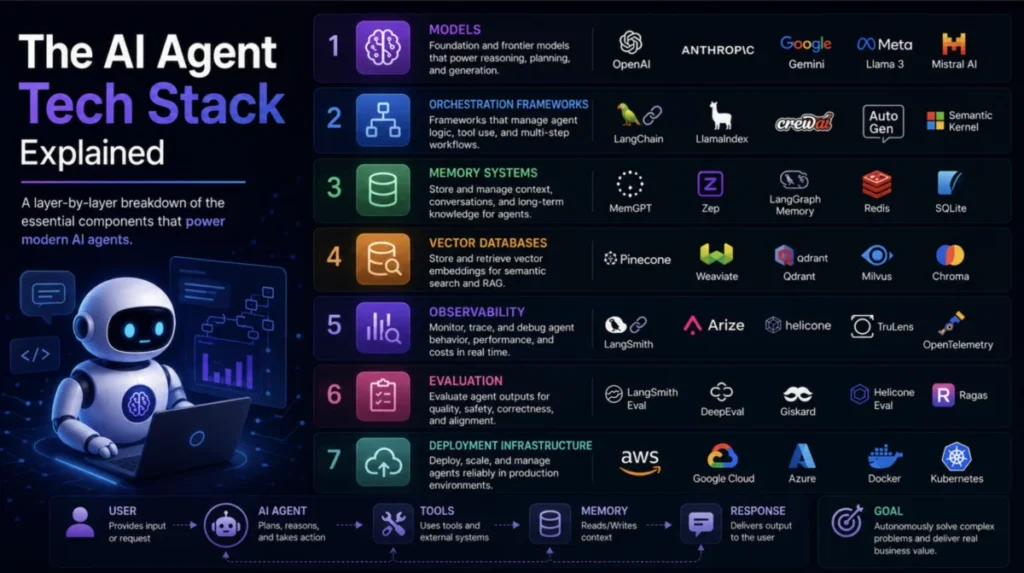
To build an agent that is robust enough for production, one must master the seven distinct layers of the AI Agent Tech Stack. Failure at any one of these layers—whether in memory, orchestration, or retrieval—is often the difference between a high-performing automated assistant and a costly, unreliable liability.
The Seven Layers of Agentic Architecture
The AI agent stack is a vertical dependency chain. At the summit sits the cognitive core, while the base comprises the infrastructure that keeps the system stable under load.
Layer 1: The Foundation Model (The Cognitive Core)
The foundation model is the brain of the operation. It manages reasoning, linguistic nuance, and decision-making. In the current market, the choice of model is a strategic trade-off. OpenAI’s GPT-5.5 remains the gold standard for tool-calling reliability and ecosystem maturity. Conversely, Anthropic’s Claude Sonnet 4.6 provides a cost-effective solution for massive document processing, while their Opus 4.8 variant is reserved for tasks requiring extended, complex logical chains. Google’s Gemini 3.1 Pro, with its industry-leading 1-million-token context window, is the preferred choice for agents requiring deep analysis of massive codebases.
Crucially, the 2025 distinction between "standard" and "reasoning" models has vanished. Modern foundation models now feature adjustable "reasoning effort" parameters. Dialing this effort up for complex mathematical or planning tasks—and dialing it down for routine queries—is essential for balancing latency and operational costs.
Layer 2: The Orchestration Framework (The Nervous System)
If the foundation model is the brain, the orchestration framework is the nervous system. It manages the ReAct (Reasoning and Acting) loop: the agent generates a thought, selects a tool, observes the output, and iterates until the goal is achieved.
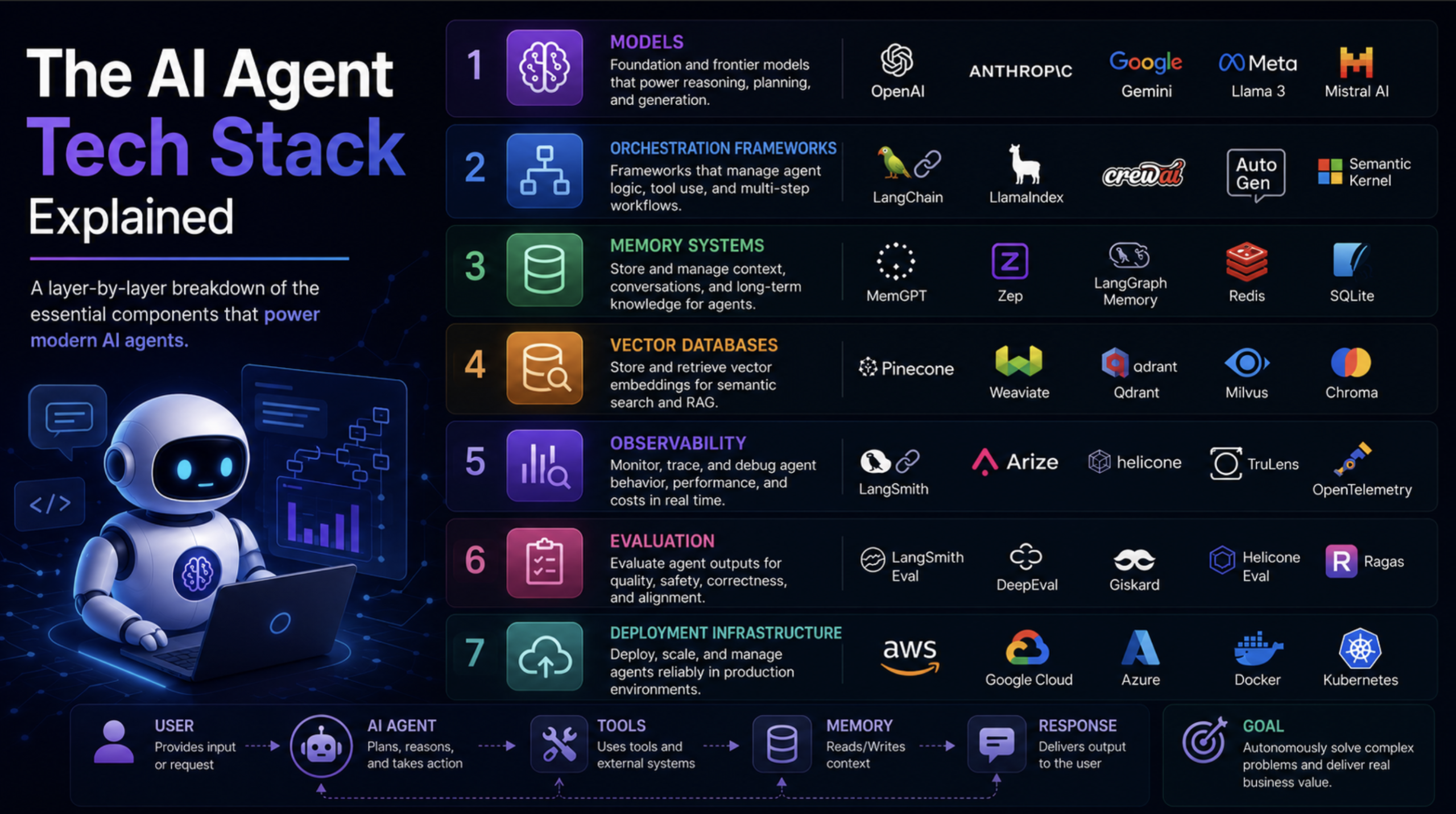
The most common point of failure in production occurs here. If the orchestration framework is not configured to handle "loop traps" or incorrect tool selection, the agent can spiral into infinite cycles. For single-agent tasks, LangGraph or LangChain are the industry standards. For complex multi-agent teams, platforms like CrewAI or AutoGen allow for specialized agent collaboration, where one agent may act as a researcher while another serves as a critic.
Layer 3: Memory Systems (The Context Store)
LLMs are inherently stateless. Every API call starts with a blank slate, which is the primary reason why 95% of 2025 generative AI pilots failed to deliver measurable ROI. An agent requires four types of memory to be effective:
- Working Memory: The immediate, in-context conversation history.
- Episodic Memory: Long-term storage of past interactions, typically stored in a database.
- Semantic Memory: The knowledge base (RAG) providing facts about the world.
- Procedural Memory: The set of rules and tool-usage instructions.
Implementing a memory layer requires more than just concatenating text; it requires intelligent trimming and summarization to ensure the agent stays within its context window without losing critical information.
Layer 4: Vector Databases and Retrieval (The Knowledge Base)
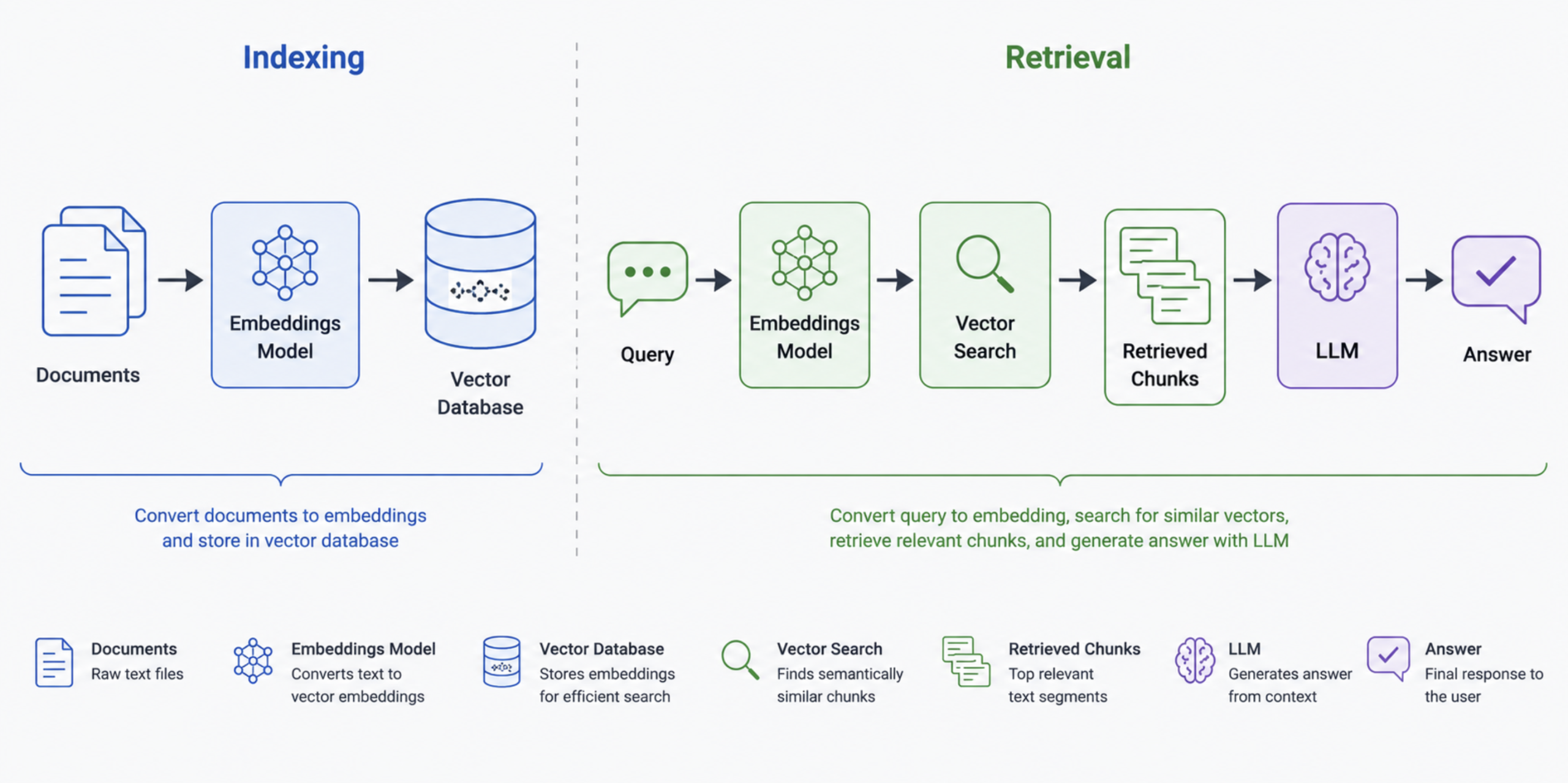
Foundation models suffer from a knowledge cutoff and lack awareness of your proprietary data. Retrieval-Augmented Generation (RAG) bridges this gap. By converting internal documents into numerical "embeddings" and storing them in a vector database like Chroma, Weaviate, or Pinecone, the agent can perform a semantic search to retrieve only the relevant information needed to answer a query. With the vector database market growing at 24% annually, this layer has become the bedrock of enterprise knowledge management.
Layer 5: Tools and External Integrations (The Hands)
An agent without tools is merely an expensive text predictor. Tools allow the agent to interact with the world: searching the live web, executing Python code, or calling internal APIs. The introduction of the Model Context Protocol (MCP) by Anthropic has revolutionized this layer, providing a universal standard for how agents connect to data sources. When designing tools, the "schema" is everything. Vague function descriptions lead to hallucinatory tool calls; precise, typed schemas ensure consistent, reliable action.
Layer 6: Observability and Evaluation (The Auditor)
In software engineering, a failing API returns an error code (like a 500). In AI, an agent can hallucinate a confident, incorrect answer while returning an "HTTP 200 Success." This "silent failure" makes traditional monitoring insufficient.
A production-grade observability stack—using tools like Langfuse or Arize Phoenix—tracks "semantic traces." It monitors the agent’s reasoning path, calculates token usage, and evaluates the output against metrics like "faithfulness" (is the answer based on retrieved context?) and "relevance" (did it actually answer the user’s question?).
Layer 7: Deployment Infrastructure (The Foundation)
Finally, the deployment layer ensures the agent remains stable under production traffic. Containerization via Docker is mandatory for environmental consistency. Furthermore, while simple agents can run on synchronous APIs (FastAPI), production agents involving complex workflows should utilize an asynchronous queue (such as Celery or AWS SQS). This allows the system to process long-running tasks in the background while the user receives a status update rather than a hanging connection.
Implications for Enterprise Strategy
The shift toward agentic AI is not merely a technical upgrade; it is a fundamental change in business operations. However, the path to implementation is fraught with risk. Gartner’s prediction that 40% of enterprise applications will feature task-specific agents by 2026 implies a massive shift in capital expenditure.
The primary implication for leadership is the need for "governance by design." Enterprises must treat agents as software products rather than experimental scripts. This includes implementing:
- Cost Management: Using caching and request batching to avoid unnecessary model costs.
- Data Residency: Ensuring that sensitive internal knowledge remains within the corporate perimeter, particularly when using third-party foundation models.
- Human-in-the-loop (HITL): For high-stakes actions, such as financial transactions or legal document generation, the orchestration framework must be configured to pause for human approval.
Conclusion
The "Agentic Era" is defined by the transition from human-commanded software to autonomous, reasoning systems. While the foundation model receives the most media attention, it is the least differentiated part of the stack. The true competitive advantage for organizations in 2026 will be found in the robustness of their memory, the precision of their retrieval, and the reliability of their observability.
As we look toward 2027, the projects that succeed will not be those that simply "wrap an LLM," but those that have carefully engineered each of the seven layers to function as a cohesive, auditable, and resilient machine. Understanding this full stack is the prerequisite for any engineer or leader aiming to move beyond the demo phase and into the future of autonomous enterprise.