PayPal Honey’s Fall From Grace: A Watershed Moment for Affiliate Marketing Ethics and Program Management

The digital marketing landscape was rocked by an unprecedented enforcement wave that saw PayPal Honey—one of the world’s most ubiquitous browser extensions and a crown jewel of PayPal’s multi-billion-dollar acquisitions—expelled or suspended from major U.S. affiliate networks. Coming on the heels of extensive investigative reporting by independent cybersecurity and digital economy experts, the move has sent shockwaves through the partnership economy.
For brand managers, network operators, and publishers alike, the sudden ouster of a household-name publisher serves as a stark reminder of the fragile nature of digital trust. As the dust settles, industry veterans are using this high-profile enforcement action as a case study to reevaluate compliance, attribution integrity, and program diversification.
Main Facts: The Downfall of a Giant
The core controversy centers on PayPal Honey, a popular browser extension acquired by fintech giant PayPal in 2020 for a staggering $4 billion. Honey’s primary value proposition to consumers is automatically scouring the web for discount codes and applying them at checkout. However, beneath the consumer-facing convenience lies a complex web of affiliate marketing mechanics.
In standard affiliate models, publishers drive traffic to merchant sites and earn a commission. Because the industry overwhelmingly relies on a "last-touch-wins-all" attribution model, the final affiliate to interact with a consumer before a purchase secures 100% of the commission.
Investigations led by researcher Ben Edelman and digital sleuth MegaLag revealed that PayPal Honey was systematically violating "stand-down" rules. These rules dictate that browser extensions must step aside and refuse to fire a tracking cookie if another affiliate has already established an earlier touchpoint in the user’s clickstream. By allegedly bypassing these rules through concealed technical maneuvers, Honey was overwriting legitimate cookies, effectively hijacking commissions from other publishers who had done the hard work of driving initial consumer interest.
The fallout was swift. Within days of the investigative exposés, America’s two premier affiliate marketing environments—Rakuten Advertising and impact.com—took punitive action against the digital giant.
Chronology of Events
The unraveling of PayPal Honey’s network standing unfolded rapidly over a single week in January, dominating industry discourse both online and at major sector gatherings:

- The Precursors: Weeks leading up to the crackdown saw the release of detailed technical investigations by Ben Edelman and a viral exposé by MegaLag, exposing the mechanics behind browser extension attribution manipulation.
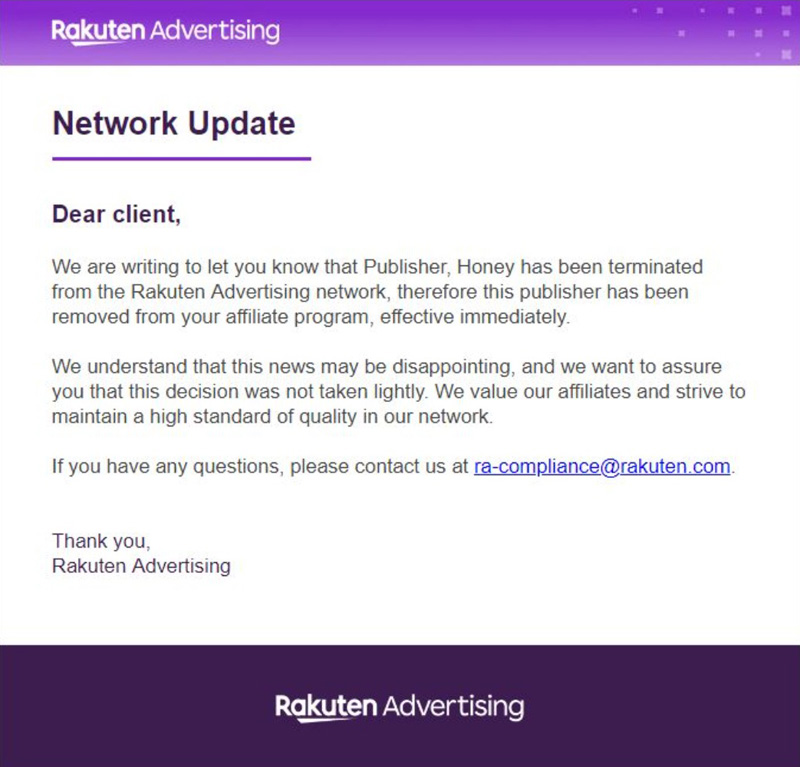
- Monday, January 12: Rakuten Advertising dropped the hammer on the first day of Affiliate Summit West—the largest U.S. affiliate marketing conference of the year. Rakuten publicly announced that Honey had been permanently "terminated from the network" to maintain core standards of quality.
- January 12–15: The timing of Rakuten’s announcement coincided perfectly with the kickoff of Affiliate Summit West. "Rakuten" and "Honey" immediately became the dominant buzzwords across conference floors, hallways, and social media channels like X (formerly Twitter).
- Friday, January 16: A second blow landed when impact.com confirmed that Honey was found "out of compliance" with its platform policies. Consequently, Honey was suspended and removed from impact.com’s Discovery Marketplace, though structured as a temporary suspension rather than a permanent ban.
Supporting Data and Industry Insights
The controversy highlights a long-standing structural flaw in performance marketing: the tension between early-funnel content creators and late-funnel conversion tools.
According to recent compliance audits, downloadable software publishers (DSPs) and browser extensions represent a notoriously difficult category to police. A comprehensive independent audit conducted by the UK’s Affiliate & Partner Marketing Association (APMA)—evaluating thirty brands across ten networks—shed light on the complex mechanics of attribution rules. The APMA audit emphasized the vital distinction between technologies that respect stand-down agreements and those that utilize "soft clicks" or covert overwriting mechanisms.
Furthermore, data from program management agencies like AM Navigator reveals a systemic vulnerability across corporate affiliate portfolios: the "all eggs in one basket" syndrome. Many enterprise-level affiliate programs rely on just a handful of massive publishers for over 80% of their revenue, leaving them dangerously exposed when a major partner faces sudden termination or regulatory scrutiny.
Official Responses and Network Statements
The regulatory and network responses were unequivocal, signaling a zero-tolerance approach toward attribution manipulation.
Rakuten Advertising Statement (Jan 12):
In its official notice to clients and partners, Rakuten stated that the termination of Honey was a mandatory measure enforced "to maintain a high standard of quality" within its ecosystem. The network emphasized that protecting the integrity of merchant and publisher relationships requires stringent adherence to platform policies.
impact.com Statement (Jan 16):
impact.com’s executive leadership adopted an equally firm stance. The platform’s CEO explicitly cited "attribution manipulation" as the primary driver behind Honey’s suspension. impact.com underscored that engaging in behavior that fundamentally undermines trust in the partnership economy will face swift administrative intervention, regardless of the publisher’s market valuation or brand recognition.
Implications for Affiliate Managers and Brand Owners
For industry professionals managing corporate affiliate programs, the PayPal Honey saga offers five foundational lessons on safeguarding brand equity and optimizing network operations:
1. One Bad Apple Spoils the Entire Program
In affiliate marketing, toxic publishers don’t just drain budgets through questionable tactics—they actively drive away high-quality partners. Savvy, rule-abiding content creators, influencers, and reviewers audit a merchant’s program before joining. If they see notorious cookie-droppers operating unchecked, top-tier partners will refuse to join or promote the brand. Maintaining rogue publishers alienates the very ecosystem a brand needs to grow.
2. Do Your Own Policing; Never Rely Solely on Networks
While network compliance teams monitor for violations of network-wide rules, they frequently move slowly or overlook infractions that directly harm individual merchant programs. Brand managers must implement robust Terms and Conditions (T&Cs) within their affiliate agreements, granting them the contractual right to audit and eject non-compliant partners independently. It is your brand, your revenue, and your reputation on the line.
3. Master the Technical Details
Affiliate compliance is rarely black and white. Managers must deeply understand the technical nuances of their publishers—distinguishing between ethical toolbar applications, aggressive browser extensions, soft-click mechanics, and proper stand-down implementations. Utilizing resources like the Performance Marketing Association’s (PMA) DSP comparisons and the APMA’s attribution audits is essential for intelligent policing.
4. Avoid Dangerous Generalizations
A common pitfall in program management is reactionary overcorrection—banning an entire class of publishers because of one bad actor. Just as not all paid search affiliates commit trademark infringement, not all browser extensions violate stand-down rules. Every publisher must be evaluated individually based on their specific tracking behavior and adherence to program guidelines.
5. Aggressively Diversify Your Affiliate Base
If the removal of a single publisher like Honey causes a catastrophic drop in an affiliate program’s revenue, the program suffers from a severe structural flaw. To build a resilient channel, brands must diversify beyond coupon and loyalty sites. Expanding recruitment across a broader spectrum—such as content producers, mobile-optimized partners, micro-influencers, card-linked offers, and podcast networks—ensures long-term stability.
Conclusion
The swift ejection of PayPal Honey from Rakuten and impact.com marks a maturation point for the affiliate and partner marketing industry. Networks and enterprise merchants are drawing a hard line against deceptive attribution practices, prioritizing ecosystem health over short-term conversion volume. For affiliate managers moving forward into 2026 and beyond, the mandate is clear: enforce your own rules, understand your technology stack, and build a diversified, trustworthy partnership portfolio.