Political Firestorm: BJP Announces Nationwide Protests Following Mallikarjun Kharge’s Controversial Remarks on PM Modi
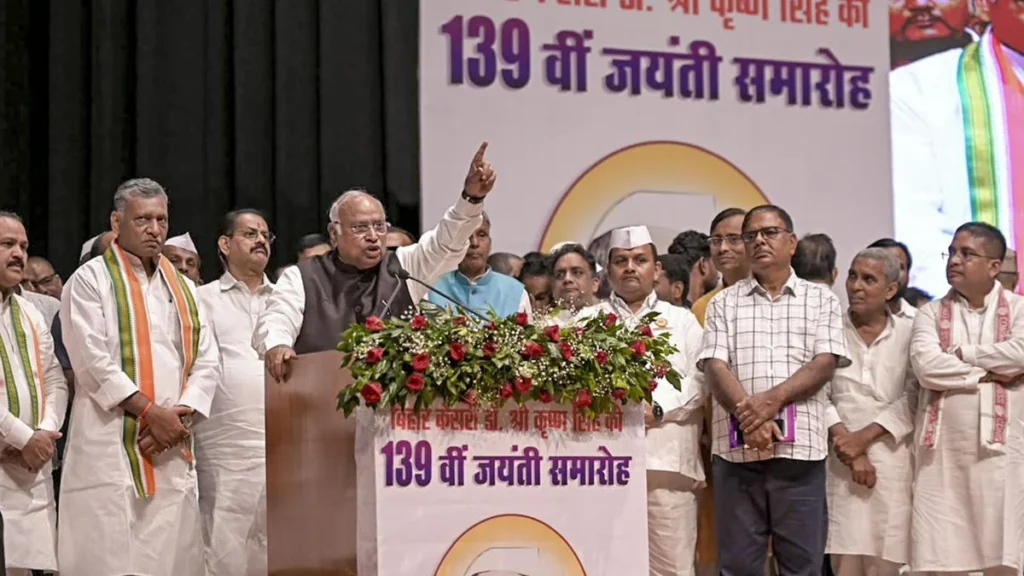
Patna/New Delhi, October 25, 2026 — A fresh political tempest has engulfed the Indian landscape as the Bharatiya Janata Party (BJP) declared a nationwide protest campaign against Congress President Mallikarjun Kharge. The escalation follows Mr. Kharge’s remarks made earlier today in Patna, where he addressed a gathering commemorating the 139th birth anniversary of Shri Krishna Singh, the first Chief Minister of Bihar, often referred to as ‘Bihar Kesari’.
The controversy centers on a specific, emotionally charged statement attributed to the Congress chief: "Modi ka baap bhi jayega" (Even Modi’s father will go). The comment, delivered in the heat of a political rally, has triggered a severe backlash from the ruling party, with top-tier leadership labeling the rhetoric as "unparliamentary," "indecent," and a new low in the discourse of Indian democracy.
The Genesis of the Controversy: A Contextual Breakdown
The incident occurred during a commemorative event in Patna on Sunday. While the primary purpose of the gathering was to honor the legacy of Shri Krishna Singh, the political discourse veered sharply toward contemporary national politics. Mr. Kharge, in a critique aimed at the Prime Minister’s tenure and political longevity, reportedly used the phrase that has now become the focal point of a national political standoff.
The BJP has moved swiftly to capitalize on the remark, framing it not as a slip of the tongue, but as a deliberate attempt to malign the Prime Minister and his family. The party’s decision to hold nationwide protests on Monday, October 26, 2026, signals a coordinated effort to frame the Congress party as being inherently disrespectful to the office of the Prime Minister.
Chronology of the Escalation
- October 25, 2026 (Morning): Congress President Mallikarjun Kharge addresses a public rally in Patna during the 139th birth anniversary celebrations of Bihar’s first Chief Minister, Shri Krishna Singh.
- October 25, 2026 (Afternoon): Clips of the controversial "Modi ka baap" remark begin circulating on social media, rapidly gaining traction.
- October 25, 2026 (Evening): Union Home Minister Amit Shah issues a blistering response on the platform ‘X’, accusing the Congress party of crossing all limits of decency.
- October 25, 2026 (Late Evening): The BJP officially announces a nationwide protest for October 26, demanding an apology from the Congress leadership.
- October 25, 2026 (Night): Senior BJP leaders, including J.P. Nadda and state-level chiefs like Nitin Nabin, join the chorus of condemnation, further widening the scope of the criticism to include the leadership style of Rahul Gandhi.
Official Responses: A War of Words
The reaction from the ruling establishment has been swift and multi-layered. The BJP has framed this incident as a continuation of a historical pattern of personal attacks.
Amit Shah’s Critique: "Tearing Apart Decorum"
Union Home Minister Amit Shah was the first to lead the charge. In a statement that resonated across the political spectrum, he remarked that Mr. Kharge had "torn apart all norms of decorum." Mr. Shah stated, "This is not the first time that the Congress party has used abusive language against Modi ji or his family. They have hurled insults at the Prime Minister’s mother, called him a ‘merchant of death,’ and mocked his poverty by addressing him as a ‘chaiwala’ in the past."

Mr. Shah linked the current rhetoric to a broader sense of desperation within the Congress party. "Under Rahul Gandhi’s leadership, the Congress party keeps crossing the limits of indecency every day. Repeated electoral defeats over the past 12 years have bred a sense of frustration that manifests in such hateful rhetoric," he noted.
J.P. Nadda: "Politics of Hatred"
Union Minister J.P. Nadda joined the condemnation, emphasizing the dignity required in a functioning democracy. "The Opposition’s panic—stemming from Modi ji’s rising popularity at home and abroad—is now plainly evident in its language and conduct," Nadda asserted. He argued that the Congress must realize that the trust of the Indian people cannot be won through the politics of humiliation.
Nitin Nabin: "The New Culture of the Opposition"
BJP state chief Nitin Nabin added a regional dimension to the critique. "There is a certain dignity to political opposition, but dragging the departed family members into speeches from public platforms has now become the real ‘culture’ of Rahul Gandhi and the whole Opposition," Nabin stated. He emphasized that the statement was a reflection of the party’s institutional mindset rather than an individual lapse in judgment.
The Implications for Indian Politics
The current controversy carries significant weight for the upcoming political calendar. As the nation prepares for a series of state elections and ongoing legislative sessions, the discourse surrounding the dignity of public office has become a central campaign theme.
1. The Impact on Parliamentary Proceedings
With the BJP planning nationwide protests, it is highly likely that the next session of Parliament will be marked by disruptions. The ruling party will likely use this incident to demand a formal apology or a censure motion against the Leader of the Opposition in the Rajya Sabha, potentially paralyzing legislative work.
2. Electoral Strategy and Voter Perception
Historically, the BJP has successfully turned personal attacks against Prime Minister Modi into electoral assets. By positioning the Congress as an elitist or "frustrated" entity that targets the self-made background of the Prime Minister, the BJP effectively consolidates its support base. This incident provides the BJP with a fresh narrative to push in the months leading up to crucial electoral contests.

3. The "Decency" Debate
The debate also forces a reflection on the standards of political speech in India. With the rise of digital media, the speed at which a stray remark can be amplified is unprecedented. Political analysts argue that the decline in civil discourse is a systemic issue, with both sides often failing to maintain the sanctity of debate.
Historical Context: A Pattern of Rhetoric?
The BJP’s argument hinges on the assertion that this is not an isolated incident. By cataloging past slurs—the ‘merchant of death’ (2007), the ‘chaiwala’ jibe (2014), and various remarks regarding the PM’s mother—the party is attempting to build a narrative of systemic institutional disrespect by the Congress.
For the Congress, the challenge remains balancing aggressive opposition with language that does not alienate moderate voters. While the party argues that its leaders are merely criticizing the policies and the political personality of the Prime Minister, the BJP’s effective messaging has often trapped the Congress in a cycle of having to defend its rhetoric rather than its policy proposals.
Conclusion: A Turning Point?
As the sun sets on October 25, 2026, the political atmosphere in India is tense. The upcoming protests are expected to be large-scale, with BJP cadres across the country set to take to the streets. Whether this incident will serve as a wake-up call for political parties to sanitize their public discourse remains to be seen.
What is clear, however, is that the "politics of slander," as described by Amit Shah, continues to dominate the Indian political theater. As the nation watches, the debate over where the line between legitimate political opposition and personal insult lies remains as contentious as ever. The coming days will likely witness a hardening of stances, with the Congress party forced to either clarify the context of the remark or weather a significant political storm that could further isolate them in the public eye.
Ultimately, the electorate remains the final arbiter. As J.P. Nadda noted, the people will likely respond through the ballot box, but until then, the rhetoric of 2026 promises to be as sharp and volatile as any in recent memory.