Salesforce Unveils ‘AIForce’ at High-Voltage Dreamforce 2026 Amid Tech Luminaries and Protests
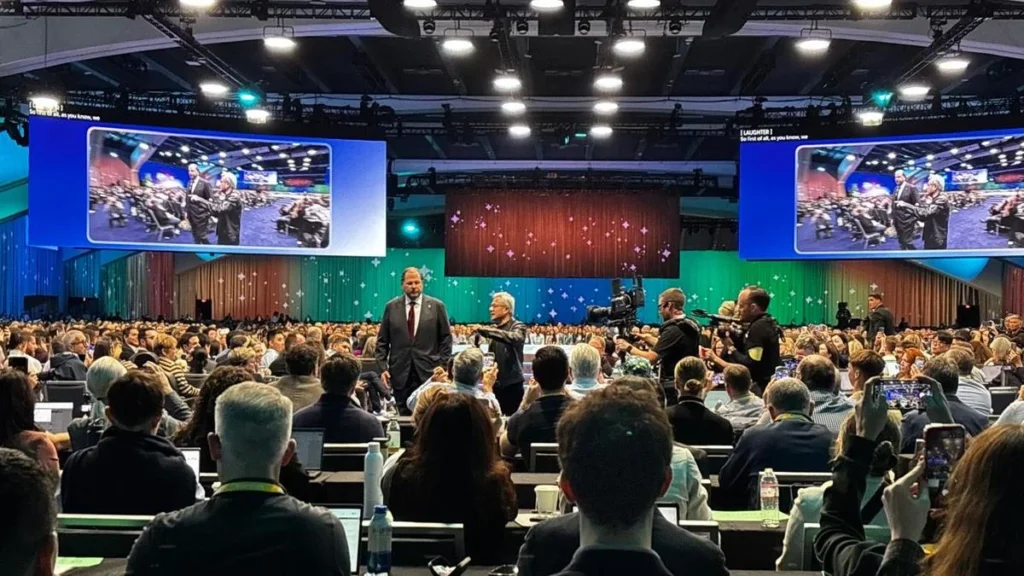
SAN FRANCISCO — Salesforce kicked off its flagship annual Dreamforce convention on Tuesday, September 15, 2026, with a high-energy keynote at the Moscone Center that blended Hollywood glitz, high-stakes tech announcements, and a vivid reminder of the socio-political tensions surrounding modern enterprise software.
Against a backdrop of demonstrators outside demanding an end to controversial corporate contracts with immigration authorities, Salesforce CEO Marc Benioff took center stage to introduce AIForce—a dynamic, live artificial intelligence interface layer designed specifically for enterprise users. Billed as an "interface revolution," the new platform aims to bridge the gap between raw AI potential and the rigid security, governance, and workflow requirements of global corporations.
The unveiling drew some of the biggest names in the technology ecosystem, including Anthropic CEO Dario Amodei and Nvidia CEO Jensen Huang, who joined Benioff for candid discussions on the future of autonomous agents, reasoning models, and the ongoing global debate over AI safety and regulation.
Main Facts: The Launch of AIForce
The centerpiece of the opening day at Dreamforce 2026 was the official rollout of AIForce, which Salesforce positions as a critical evolution in how businesses interact with artificial intelligence.
According to company executives, AIForce is engineered to solve a fundamental limitation of modern generative AI: standalone models are probabilistic, unpredictable, and ultimately incapable of running an enterprise on their own. By acting as a live interface layer, AIForce integrates directly with the deep corporate knowledge already stored within Salesforce ecosystems—including proprietary data, complex workflows, business logic, semantics, permissions, and security frameworks.

- Core Value Proposition: Companies can seamlessly extend Salesforce’s trusted context and governance into any agentic productivity tool or external AI interface.
- Security & Privacy: Addressing lingering industry anxieties, Benioff explicitly promised Zero Data Retention (ZDR) for AIForce customers, forcefully refuting media reports and market rumors that client data is being harvested or utilized to train external foundational AI models.
- Koa CRM Reasoning Model: Alongside AIForce, Salesforce introduced Koa, its first Customer Relationship Management (CRM) reasoning model built specifically for Agentforce, developed in close partnership with Nvidia using Nvidia Nemotron architecture.
"We believe that every company can become an agentic enterprise, and we’re going to show you the best way to do it by doing it ourselves," Benioff told the packed arena. "Models alone cannot run the enterprise. Models alone are not going to show us what’s possible. Models also are very probabilistic."
Chronology of the Keynote Opening
The path to the AIForce reveal on Tuesday morning followed a heavily choreographed, high-production sequence characteristic of Salesforce’s signature style:
- Cultural and Artistic Openings: The morning commenced with a traditional Hawaiian blessing, grounding the massive tech event in local cultural heritage.
- Hollywood & Pop Culture Integration: Attendees were treated to a pair of high-production enterprise AI advertisements starring Hollywood actor Matthew McConaughey, followed briskly by a live musical performance by pop icon Gwen Stefani.
- The Executive Address: Marc Benioff took the stage following the entertainment to formally introduce the "interface revolution" and articulate Salesforce’s vision for agentic enterprises.
- Fireside Chats with Industry Titans: Benioff was joined on stage by Nvidia CEO Jensen Huang and Anthropic CEO Dario Amodei. The trio engaged in a sprawling discussion that tackled everything from hardware acceleration and reasoning models to the contrasting philosophies of AI industry self-regulation versus mandatory international oversight.
Supporting Data & Technical Context
The introduction of AIForce arrives at a critical juncture for enterprise software. While enterprise adoption of generative AI has soared, industry analysts note that actual operational integration remains surprisingly low relative to the technology’s theoretical ceiling.
During the panel discussion, Anthropic CEO Dario Amodei noted that businesses are currently utilizing only a minuscule fraction—roughly 5% to 10%—of the total potential value that advanced AI technology can deliver. This "implementation gap" is precisely what Salesforce hopes to close by wrapping probabilistic large language models in deterministic enterprise guardrails.
By combining Salesforce’s deep metadata framework with Nvidia’s high-performance hardware and reasoning architectures like Koa, the ecosystem aims to transition corporations from passive chat-based assistants to active, autonomous digital agents capable of executing complex, multi-step business transactions without human micromanagement.

Official Responses and Industry Debates: Amodei vs. Huang
One of the most compelling segments of the Dreamforce opening day was the stark philosophical divide exposed between Anthropic’s Dario Amodei and Nvidia’s Jensen Huang regarding how the artificial intelligence sector should be governed, monitored, and scaled.
Anthropic’s Call for Pacing and Global Standards
Drawing attention to his recent essay published on September 12, titled "We Must Pace the Frontier," Dario Amodei advocated for a deliberate slowdown and heightened caution across the global AI ecosystem. He emphasized that as AI models grow exponentially more powerful, the industry must proactively establish standardized, international safety guardrails before catastrophic risks materialize.
"Let’s re-commit to transparency. Let’s invest more in safety. Then let’s organise the rest of the industry and say, ‘What can we do to set standards for everyone? What can we do to make everyone’s standards better?’ And then finally, there should be an international component to it," Amodei stated during the keynote.
Nvidia’s Market-Driven Optimism
In stark contrast, Nvidia CEO Jensen Huang offered an aggressive, free-market perspective on AI development. Huang argued against the implementation of new government laws or heavy-handed regulatory frameworks, asserting that existing market dynamics provide sufficient checks and balances.
Huang dismissed the notion that tech companies must choose between rapid innovation and product safety, framing it as a false dichotomy.

"The market forces are in there. We don’t need any new laws and we don’t need new regulations," Huang declared, encouraging companies to push technological boundaries as fast as humanly possible. "Innovation/speed and safe products… it’s a false choice. You could definitely have both at the same time. So run as fast as you can, but if you feel that at any given point in time, the company’s out of control or the product’s not gonna be safe, you know, take a pause and make sure you get it right."
Implications: Inside and Outside the Moscone Center
While the interior of the Moscone Center buzzed with corporate optimism, high-end production, and visionary tech panels, the reality of corporate social responsibility played out explicitly on the streets outside.
As attendees arrived for the opening day of Dreamforce 2026, they were forced to navigate crowds of demonstrators protesting Salesforce’s ongoing business ties with the United States Immigration and Customs Enforcement (ICE). Activists handed out informational flyers and raised banners calling on Bay Area tech giants to leverage their massive economic and political influence to protect human rights rather than profit from government operations linked to family separations and immigration enforcement.
Protesters also voiced broader concerns regarding fair labor practices within the technology sector and the accelerating push toward unvetted AI automation.
A Dual Narrative for Big Tech
The juxtaposition highlights the tightening pressure facing modern tech conglomerates. On one hand, companies like Salesforce are pushing aggressively into autonomous enterprise agents, promising unprecedented productivity gains, seamless data integration, and revolutionary interface layers like AIForce. On the other hand, civil society, ethics groups, and workforce advocates are demanding greater accountability—not only regarding how consumer data and AI models are governed, but also regarding the ethical boundaries of corporate client portfolios.

As Salesforce charts its course into the "agentic enterprise" era, the company must increasingly navigate these dual currents: pioneering the future of business automation while answering difficult questions about its corporate responsibilities in an interconnected, highly scrutinized global economy.