Samsung Expands Its Mid-Range Footprint in India with the AI-Powered Galaxy A08: A New Benchmark for Longevity and Affordability
NEW DELHI — In a strategic move to reinforce its dominance in the fiercely contested Indian smartphone market, consumer electronics giant Samsung has officially announced the launch of the Galaxy A08. Targeted squarely at value-conscious mid-segment buyers, the newly unveiled device attempts to bridge the historical gap between budget-friendly pricing and premium-tier software longevity. By integrating advanced artificial intelligence (AI) agents, a robust 6,000 mAh battery, and an unprecedented software support lifecycle of six generations of operating system upgrades, Samsung is signaling a clear shift in consumer expectations for sub-₹20,000 smartphones.
The launch event, held on Thursday, October 1, 2026, highlighted Samsung’s commitment to democratizing high-end features. As global smartphone manufacturers grapple with plateauing hardware innovation, the competitive battleground has decisively shifted toward software intelligence, energy endurance, and long-term device support. The Galaxy A08 arrives as Samsung’s flagship contender to capture this evolving sentiment among India’s tech-savvy, cost-conscious demographic.
Main Facts: Hardware Specifications and Core Features
At first glance, the Samsung Galaxy A08 presents a balanced hardware configuration tailored for everyday multimedia consumption, productivity, and dependable all-day connectivity.
Display and Build Durability
The device features a spacious 6.7-inch HD+ PLS LCD display, engineered with a fluid 90Hz refresh rate that ensures smooth scrolling and responsive touch interactions. Recognizing the rugged demands of the Indian market, Samsung has fortified the display with Corning Gorilla Glass 5, offering substantial resistance against accidental drops and scratches.
Complementing the front glass is a Glass Fibre Reinforced Polymer (GFRP) back panel, which provides structural rigidity while keeping the device lightweight and comfortable to hold. Furthermore, the smartphone carries an IP64 dust and splash resistance rating, offering users peace of mind against unexpected weather conditions or accidental liquid splashes.
Performance and Processing Power
Under the hood, the Galaxy A08 is powered by the MediaTek Helio G99+ processor. Built to handle daily multi-tasking and casual gaming with ease, the chipset is paired with 4 GB of physical RAM and 64 GB of internal storage. For users requiring additional space for media, applications, and documents, the storage is expandable up to a staggering 2TB via a dedicated microSD card slot. The device also incorporates virtual RAM technology, dynamically allocating internal storage to boost background app management during heavy usage.
Out of the box, the smartphone runs on Samsung’s latest One UI 9, layered atop Android 16. This provides a clean, highly customizable, and fluid user interface right from the first boot.
Camera Capabilities
Photography on the Galaxy A08 is driven by a dual-rear camera array headlined by a 50-megapixel wide-angle primary sensor designed to capture sharp, detailed images across various lighting conditions. This is supported by a 2-megapixel depth sensor that assists in rendering natural-looking bokeh effects for portrait photography. For selfies and video calls, the device houses an 8-megapixel front-facing camera integrated cleanly into the display notch.
Power and Endurance
One of the standout hardware attributes of the Galaxy A08 is its massive 6,000 mAh battery. Designed to comfortably outlast standard daily usage patterns—including heavy streaming, web browsing, and navigation—the battery caters directly to users who are constantly on the move. The device supports 25W fast charging, ensuring that replenishing the large power cell remains relatively efficient.
Pricing and Availability
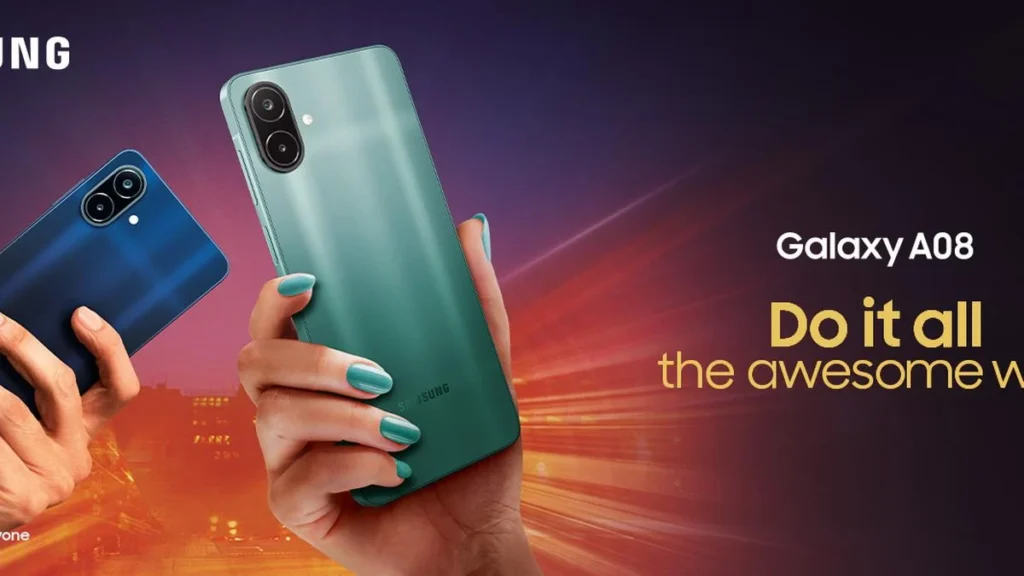
The Samsung Galaxy A08 is available in three distinct, contemporary colorways: Dark Blue, Silver, and Green. It carries a competitive retail price tag of ₹18,499. Prospective buyers can purchase the device across Samsung Exclusive Stores, authorized retail partner partners, Samsung’s official online store, and major e-commerce platforms nationwide.
Chronology of the Samsung Galaxy A08 Launch and Market Evolution
To fully understand the positioning of the Galaxy A08, it is essential to trace the developmental timeline of Samsung’s mid-range strategy in India over recent years.
- Early 2024: Samsung identifies a growing consumer demand for extended device lifecycles in the budget and mid-range tiers, as inflationary pressures prompt buyers to hold onto their smartphones for longer periods.
- Late 2024 to 2025: Competitors in the sub-₹20,000 category begin aggressive campaigns focusing heavily on fast charging speeds and raw processing power, while software updates remain largely neglected, typically capped at two to three years.
- Mid-2026: Samsung accelerates its research and development on affordable AI integration, successfully optimizing lightweight AI agents to run efficiently on mid-tier system-on-chips (SoCs) without compromising device performance.
- September 2026: Supply chain whispers and regulatory filings hint at a new upcoming A-series device featuring unprecedented software support metrics for its price class.
- October 1, 2026: Samsung officially launches the Galaxy A08 in India, introducing a 6-generation OS upgrade pledge, a 6,000 mAh battery, and deep native AI agent integration at a price point of ₹18,499.
Supporting Data and Comparative Market Analysis
The Indian mid-segment smartphone market is arguably the most dynamic and fiercely contested consumer technology arena in the world. Dominated by brands offering high specifications on paper, the market has historically suffered from rapid obsolescence, particularly regarding software updates and security patches.
| Feature / Specification | Samsung Galaxy A08 | Typical Competitor (Sub-₹20,000 Segment) |
|---|---|---|
| Display | 6.7-inch HD+ PLS LCD, 90Hz | 6.5 to 6.7-inch FHD+ / HD+, 90Hz / 120Hz |
| Durability | Gorilla Glass 5, GFRP Back, IP64 | Standard Glass, Plastic Back, IP52 / Unrated |
| Battery Capacity | 6,000 mAh | 5,000 mAh |
| Charging Speed | 25W | 33W – 45W |
| Processor | MediaTek Helio G99+ | Various 4G/5G Mid-tier Chipsets |
| Software Support | 6 Generations OS + 6 Years Security | 2 to 3 Generations OS / Security |
| AI Integration | Gemini & Perplexity (Direct Power Key Access) | Limited or Cloud-Dependent AI Tools |
| Price (India) | ₹18,499 | ₹15,000 – ₹19,999 |
The Longevity Factor
While some competitors offer slightly faster charging speeds (such as 33W or 45W) or higher-resolution Full HD+ panels, the Galaxy A08 changes the value proposition entirely through its software commitment. Offering six generations of OS upgrades and six years of security updates is a milestone historically reserved for flagship devices costing upwards of ₹70,000. By bringing this level of long-term support to an ₹18,499 smartphone, Samsung is directly targeting the electronic waste (e-waste) concern and providing exceptional long-term value.
AI Accessibility in the Mid-Tier
Another critical data point is the democratization of AI agents. The Galaxy A08 natively integrates prominent AI assistants such as Google Gemini and Perplexity. Users are not forced to dig deep into application menus; these tools can be invoked instantly via intuitive voice commands or by a simple long-press of the physical power button. This makes advanced search, content summarization, and contextual assistance accessible to users who may not be able to afford high-end flagship hardware.

Official Responses and Industry Perspectives
Samsung’s leadership has emphasized that the Galaxy A08 is not merely a hardware refresh, but a philosophical shift in how affordable technology should serve the modern consumer.
During the launch briefing, a senior spokesperson for Samsung India remarked:
"The modern Indian smartphone consumer is discerning, practical, and forward-thinking. They do not want to compromise on intelligence, durability, or future-proofing just because they are shopping in the mid-segment. With the Galaxy A08, we are breaking down barriers—bringing flagship-grade software longevity, massive battery endurance, and intuitive AI capabilities into the hands of millions at an accessible price point."
Industry analysts have responded positively to the announcement, noting that Samsung’s aggressive stance on software updates could force competing brands—particularly Chinese original equipment manufacturers (OEMs)—to rethink their support policies for budget and mid-range portfolios.
Tech market research analysts noted in early reactions:
"Samsung has successfully identified a major consumer pain point: device obsolescence. By guaranteeing six years of OS and security updates on an ₹18,499 phone, Samsung shifts the purchasing criteria from short-term spec sheets to long-term trust and reliability. This will likely set a new industry standard that competitors will find difficult to ignore."
Furthermore, feedback from early retail partners indicates strong initial interest. Store managers across major metropolitan hubs report an influx of inquiries from consumers looking for reliable secondary devices or dependable daily drivers that will remain relevant well into the late 2020s and early 2030s.
Implications for the Indian Smartphone Ecosystem
The introduction of the Samsung Galaxy A08 carries far-reaching implications for consumers, competitors, and the broader environmental landscape in India.
1. Redefining Consumer Expectations
For years, the sub-₹20,000 segment was treated as a disposable category where consumers expected to replace their devices every 18 to 24 months due to software slowdowns or dropped security support. The Galaxy A08 challenges this paradigm. By promising updates through Android 22 (or equivalent future iterations), Samsung encourages a shift toward multi-year device retention, altering how consumers evaluate the true cost of ownership.
2. Pressure on Competitors
Rival brands like Xiaomi, Realme, Motorola, and Vivo have built their market share on aggressive hardware specifications—such as 108MP cameras, ultra-fast charging, and powerful gaming processors—often paired with shorter update lifecycles. Samsung’s bold move forces these competitors to either match the extended software support or risk losing security-conscious and value-driven buyers who prioritize a stable, long-lasting user experience.
3. Sustainability and E-Waste Reduction
From an environmental perspective, extending the usable lifecycle of millions of mid-range smartphones aligns with global sustainability goals. By keeping devices secure and functional for six years, the Galaxy A08 naturally curbs the rapid turnover of electronic waste, contributing to lower carbon footprints associated with constant hardware manufacturing and disposal.
4. Mainstreaming Practical AI
By embedding Gemini and Perplexity directly into an accessible hardware shortcut on an entry-mid-range device, Samsung is accelerating AI literacy across diverse demographics. Students, gig workers, small business owners, and rural consumers gain immediate access to sophisticated productivity and information-retrieval tools, leveling the technological playing field.
Conclusion
The Samsung Galaxy A08 arrives as more than just another addition to a crowded product lineup. It represents a calculated evolution in how manufacturers must address the needs of the modern mid-segment buyer. By combining rugged physical construction—featuring Gorilla Glass 5 and an IP64 rating—with an endurance-focused 6,000 mAh battery, a capable MediaTek processor, and an unprecedented six-year software commitment, Samsung has crafted a compelling proposition.
Priced competitively at ₹18,499 and available immediately across online and offline channels in Dark Blue, Silver, and Green, the Galaxy A08 is poised to challenge existing market assumptions and set a high bar for what consumers can, and should, expect from an affordable smartphone in the years to come.