Taming the Temporal Drift: Building a Temporal Reasoning Layer for Graph-RAG Systems
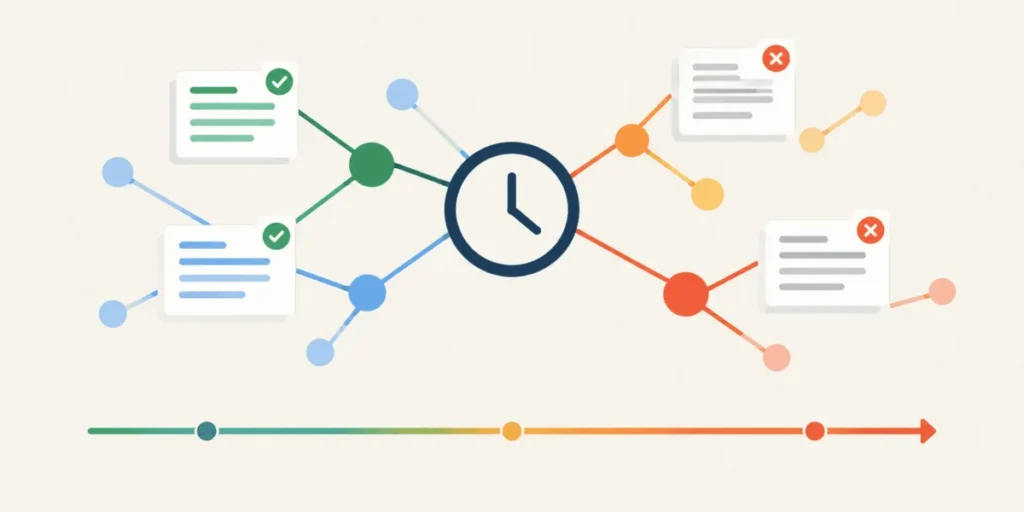
In the rapidly evolving landscape of Retrieval-Augmented Generation (RAG), the greatest challenge is not merely retrieving information—it is ensuring that the retrieved information is current. As enterprise-level knowledge bases grow in complexity, the "timeless" nature of standard knowledge graph triples is increasingly becoming a liability. When an LLM is presented with conflicting, outdated, or redundant facts, the result is the dreaded "hallucination"—a confident, yet factually incorrect, response.
This article explores the architectural implementation of a lightweight temporal reasoning engine designed to bridge the gap between static knowledge and a dynamic, real-world data environment. By transforming traditional Subject-Predicate-Object (SPO) triples into time-stamped quadruples and applying exponential decay models, developers can instill their Graph-RAG systems with a sense of "temporal awareness."
The Core Problem: Beyond Static Knowledge
Standard Knowledge Graphs operate on the assumption that a fact, once recorded, remains true indefinitely. For instance, a triple such as (Company, HAS_CEO, Alice) is treated as a foundational truth. However, the corporate landscape is fluid; Alice may transition out of the role, replaced by Bob, who is subsequently replaced by Charlie.
If a standard RAG system retrieves all three records without context, the LLM is forced to perform its own reasoning to determine which fact is the most relevant. This is an inefficient use of the model’s parameters and a high-risk strategy for factual accuracy. To solve this, we must move from a static model to a temporal one, where the timestamp of a fact is as important as the subject or object itself.
Chronology of a Temporal Quadruple
The transition from a triple to a quadruple (Subject, Predicate, Object, Timestamp) represents a paradigm shift in how we structure graph databases. By appending a fourth dimension—time—we enable the graph to store the entire lifecycle of a specific relationship.
The Implementation Strategy
To build this, we define a TemporalGraph class in Python. This structure acts as a container where the knowledge base is mapped as a nested dictionary: Subject -> Predicate -> List of (Object, Date).
import datetime
import math

class TemporalGraph:
    def __init__(self):
        self.knowledge_base =

    def add_fact(self, subject, predicate, obj, date_string):
        """Adds a time-stamped fact to the graph."""
        fact_date = datetime.datetime.strptime(date_string, "%Y-%m-%d").date()
        if subject not in self.knowledge_base:
            self.knowledge_base[subject] =
        if predicate not in self.knowledge_base[subject]:
            self.knowledge_base[subject][predicate] = []
        self.knowledge_base[subject][predicate].append((obj, fact_date))
        print(f"Added: subject predicate obj (as of date_string)")
This simple structure allows for the storage of overlapping facts. Instead of overwriting old data, the system preserves the history of the relationship, allowing for "time-travel" queries that can audit the state of the graph at any point in the past.
Supporting Data: Recency Weights and Exponential Decay
Having stored the history, the challenge becomes ranking it. How do we programmatically determine which version of a fact is the "current" truth? A linear ranking is often insufficient because the relevance of information does not degrade linearly—it fades rapidly at first, then lingers as a historical footnote.
The Mathematics of Freshness
The most effective approach is exponential decay. By assigning a "half-life" to a fact, we can calculate a weight between 0 and 1. If a fact has a half-life of 365 days, a record from exactly one year ago will have a weight of 0.5. A fact added today will have a weight of 1.0.
def calculate_recency_weight(fact_date, query_date, half_life_days=365):
    age_in_days = (query_date - fact_date).days
    if age_in_days < 0:
        return 1.0
    weight = 0.5 ** (age_in_days / half_life_days)
    return round(weight, 4)
This mathematical model ensures that when the system retrieves multiple facts for the same subject and predicate, it can sort them by their calculated weight. The result is a prioritized list where the "freshest" information is naturally elevated to the top of the context window.
Official Workflow: Querying the Temporal Graph
When the user executes a query, the query_temporal_graph function performs two critical tasks: filtering and ranking. It ignores all facts that occurred after the query date, ensuring the system respects the temporal boundaries requested by the user.
- Filtering: It iterates through the known history of the subject-predicate pair, selecting only those facts that are chronologically valid.
- Scoring: It applies the exponential decay function to assign a confidence weight to every valid candidate.
- Ranking: It sorts the results in descending order of weight.
This creates a deterministic output that the LLM can interpret with high confidence. Instead of providing the model with a confusing list of conflicting facts, the retriever provides a clean, ranked, and relevant subset of information.
Implications for RAG Architecture
The integration of this temporal layer into a 3-tiered RAG architecture (as previously discussed in our technical series) yields several profound advantages for enterprise deployment.
1. Mitigation of "Temporal Hallucination"
By shifting the burden of fact-selection from the LLM’s stochastic generation process to the deterministic Python retrieval layer, we significantly reduce the likelihood of the model hallucinating an outdated CEO or a defunct policy. The model no longer needs to guess the "truth"; it is explicitly provided with the most probable current state of the world.
2. High-Fidelity Auditing
Because the graph stores the full history of relationships, developers can perform retrospective audits. If a customer service agent asks, "What was the company’s stance on data privacy in 2022?" the system can effectively "rewind" the clock by adjusting the as_of_date parameter. This makes the system ideal for industries with strict regulatory and compliance requirements.
3. Tuning for Volatility
One of the most powerful features of this approach is the ability to adjust the half_life_days parameter. In a stable environment (e.g., historical records), a long half-life is appropriate. In a highly volatile environment (e.g., stock market data or breaking news), the half-life can be reduced to days or even hours. This allows the system to be tuned specifically to the domain it serves.
Future Considerations: Scaling the Engine
While the current implementation is lightweight and effective for small-to-medium-scale applications, scaling to millions of nodes requires a more robust approach. Future iterations should explore:
- Vector Database Integration: Embedding the temporal weights into the vector retrieval process to ensure that semantic search and temporal relevance work in tandem.
- Automatic Decay Detection: Utilizing machine learning to automatically determine the optimal half-life for different types of predicates. For example, a
HAS_CEOpredicate might require a shorter half-life than aFOUNDED_INpredicate, which is essentially a static constant. - Graph Database Optimization: Moving from a Python-native dictionary to a graph database (like Neo4j or ArangoDB) that natively supports temporal querying (Time-Series Graphs).
Conclusion
Adding a temporal reasoning layer to your Graph-RAG system is not just an optimization; it is an essential step toward building reliable, enterprise-grade AI. By treating time as a first-class citizen in our knowledge representation, we move away from the "static" limitations of early RAG systems and toward a model that truly understands the dynamic, shifting nature of the information it provides.
As the industry moves toward more autonomous agents and sophisticated reasoning systems, the ability to discern "current truth" from "historical record" will be the defining factor in the success or failure of AI deployments. By implementing the steps outlined in this article, you are positioning your architecture at the forefront of this shift, ensuring that your RAG system is not only intelligent but also temporally accurate.
The future of RAG is not just about retrieving the right information—it’s about retrieving the current information. The temporal quad is the key to unlocking that capability.