Tech Stocks Rally: A Resilient Market Signals a New Era for Indian New-Age Tech
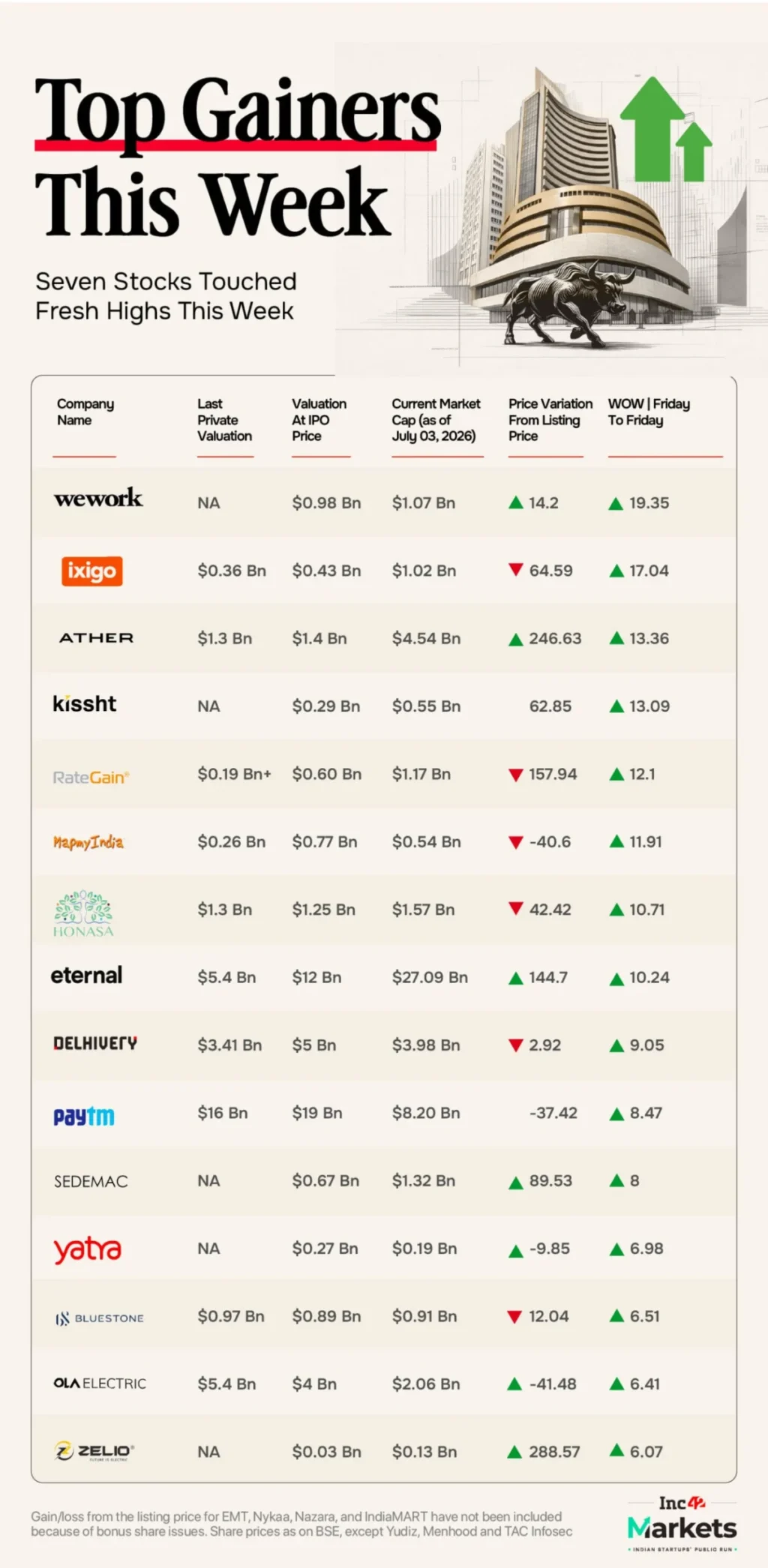
The Indian capital markets witnessed a significant resurgence in the performance of new-age technology companies this week, as investor sentiment shifted from cautious optimism to a robust appetite for growth-oriented assets. Out of the 57 tech-centric entities tracked by Inc42, a staggering 39 companies recorded gains, with individual stock performance ranging from a marginal 0.03% uptick to a significant 20% surge.
This broad-based rally spanned across multiple sectors, reflecting a maturation in how public markets perceive the business models of modern digital enterprises. The momentum was characterized by 11 major players—including WeWork India, Ather Energy, Kissht, RateGain, Honasa Consumer, Delhivery, Aye Finance, Amagi, Aequs, Nykaa, and Shadowfax—each achieving fresh 52-week highs.
The State of the Market: A Broad-Based Recovery
The recent market performance underscores a pivotal shift in the narrative surrounding Indian tech companies. While the last few months were marked by volatility and a selective approach by institutional investors, this week’s data suggests that the "tech winter" narrative is rapidly dissipating.
The total market capitalization of the 58 tracked companies (following the inclusion of Turtlemint) climbed to $139.29 Bn, up from $135.92 Bn the previous week. This growth in valuation, paired with the fact that only 18 stocks ended in the red, suggests that the market is beginning to reward companies with strong fundamentals and clear paths to profitability.
While the majority of the market trended upward, the underperformers faced specific challenges. SME-listed Yudiz led the list of losers, with its shares slumping 8.72% to close at ₹25.65. Interestingly, the broader market remained largely immune to these isolated pockets of weakness, highlighting a healthy appetite for risk among retail and institutional participants.
Chronology of the Week’s Key Developments
The week was defined by a rapid succession of strategic announcements, regulatory clearances, and operational shifts that kept investors on their toes.

- Monday: The week opened with the public market debut of the insurtech firm Turtlemint. Despite listing at a 10% discount, the stock showed resilience, gaining 1.73% to end at ₹138.55, signaling cautious investor interest in the insurance technology space.
- Tuesday: Swiggy, which had touched a fresh low of ₹235.85 earlier in the day, began a dramatic turnaround. Following positive market sentiment, the stock rallied to close the week at ₹248.15, marking a 3.1% gain from its June 26 closing price.
- Mid-Week: The IPO pipeline showed signs of renewed life. Fibe and OYO’s parent company, PRISM, filed their Draft Red Herring Prospectus (DRHP) papers. Simultaneously, the Securities and Exchange Board of India (SEBI) granted approval for the fintech unicorn Moneyview to proceed with its public offering.
- Late Week: Corporate restructuring dominated the headlines, with Lenskart proposing a major amalgamation of its subsidiaries, and Paytm announcing a significant international expansion via its Luxembourg-based subsidiary, Paytm Europe.
Supporting Data: Economic Fundamentals and Sectoral Tailwinds
The rally in new-age tech stocks did not occur in a vacuum; it was supported by a strong macroeconomic foundation. The Nifty 50 and Sensex both posted gains, rising 0.90% and 0.86% respectively, driven by robust domestic data.
Industrial production growth in India accelerated to 5.1% in May, while GST collections hit an impressive ₹1.95 Lakh Cr in June—a 13.9% year-on-year increase. These figures suggest that domestic consumption remains the backbone of the Indian economy, providing a stable environment for tech companies to scale their operations.
Sector Spotlight: Electric Vehicles (EV)
The EV sector emerged as one of the most vibrant areas of the market this week, buoyed by both company-specific milestones and favorable government policy. Ather Energy, in particular, saw its shares surge 13.36% to ₹1,130.20. This performance was underpinned by a 3.2% rise in vehicle registrations and the success of its family scooter, the ‘Rizta’, which now accounts for nearly 75% of its monthly sales.
The broader sector received a massive boost from the Delhi government’s new EV Policy 2030, which earmarks a staggering ₹15,000 Cr to accelerate electric mobility. With ₹7,000 Cr dedicated to consumer adoption and ₹8,000 Cr for infrastructure and tax incentives, the policy is expected to create a long-term runway for players like Ather and its competitors, Ola Electric and Zelio E-Mobility, both of which gained over 6% this week.
Strategic Moves: Corporate Reorganization and Expansion
Several major players took steps to optimize their corporate structures and capitalize on international opportunities.
Lenskart’s Consolidation
Eyewear giant Lenskart announced a strategic move to merge its wholly-owned subsidiaries, Dealskart Online Services and Lenskart Eyetech, into its primary entity, Lenskart Solutions. By consolidating its businesses under a single umbrella, Lenskart aims to simplify its corporate governance, reduce operational overheads, and streamline its decision-making processes.

Paytm’s European Foothold
In a significant move for the fintech sector, Paytm Europe Payments S.A. secured a payment institution licence from Luxembourg authorities. This registration allows the company to execute complex payment transactions, including credit transfers and the management of credit lines, marking a pivotal step in Paytm’s international growth strategy.
Swiggy’s Leadership Transition
Swiggy continued its organizational reshuffling by appointing Gautam Swaroop, formerly the CEO of OYO International, as the new Chief Business Officer (CBO) for Swiggy Instamart. His appointment comes at a critical time as the quick-commerce segment faces intensifying competition, requiring a leader with deep expertise in category management and rapid scaling.
Implications for the Future
The developments of the past week indicate three primary trends for the Indian tech ecosystem:
- Normalization of IPOs: The return of the IPO pipeline suggests that the private market valuation gap is narrowing. With companies like Fibe and Moneyview nearing public entry, the market is signaling that it is once again ready to price in the growth potential of private tech giants.
- Focus on Structural Efficiency: Moves by companies like Lenskart and PB Fintech (which invested ₹13 Cr in its subsidiary, PB Pay) demonstrate a shift toward internal efficiency. Companies are no longer chasing growth at any cost; instead, they are focusing on consolidated structures and subsidiary-level profitability.
- The FPI Sentiment Shift: Perhaps the most critical takeaway for the broader market is the stabilization of Foreign Portfolio Investor (FPI) sentiment. According to V.K. Vijayakumar of Geojit Investments, the moderation of outflows and the potential for FPIs to turn buyers are key indicators that Indian tech assets are being viewed as a "safe harbor" compared to other regional markets that are currently facing corrections.
Conclusion
As we look toward the coming weeks, the interplay between global interest rates, crude oil prices, and domestic macroeconomic indicators will dictate the next leg of this rally. While geopolitical tensions in West Asia remain a variable to monitor, the resilience shown by the tech sector—coupled with a clear focus on profitability and operational scale—suggests that the industry is entering a more sustainable growth phase.
Investors should remain vigilant, focusing on companies that are not only hitting 52-week highs but are also demonstrating the ability to navigate regulatory landscapes and executive transitions with agility. With the IPO market reopening and domestic demand holding firm, the coming quarter is shaping up to be one of the most consequential periods for the Indian new-age tech sector since its inception.