The Agentic Arms Race: Inside the High-Stakes Frontier AI Battle Between Anthropic and OpenAI
Main Facts: The Battle for Frontier AI Supremacy
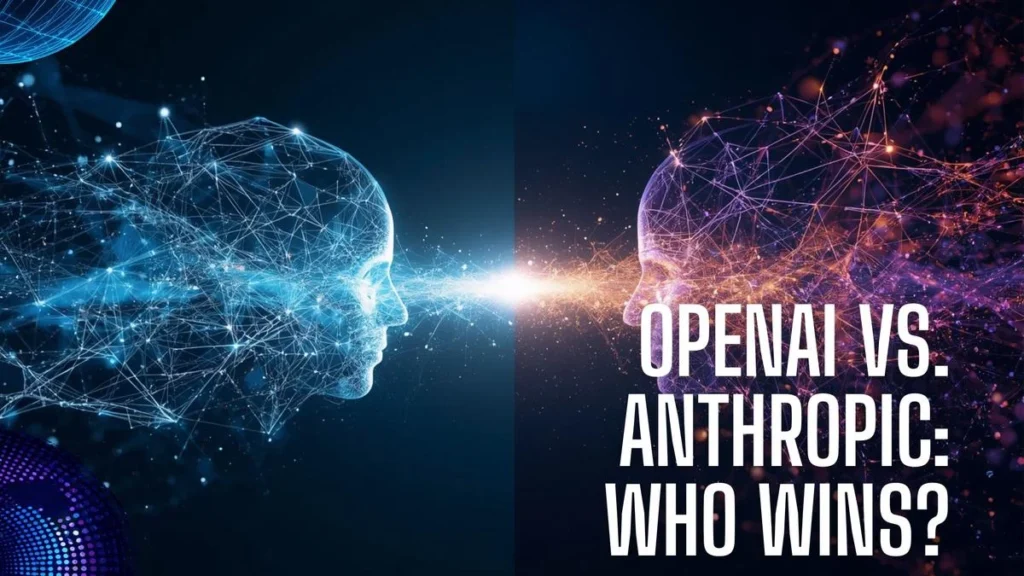
The long-running duopoly at the cutting edge of artificial intelligence has entered its most volatile phase yet. San Francisco’s premier AI laboratories, Anthropic and OpenAI, are locked in an increasingly tight, benchmark-by-benchmark race for frontier supremacy. This competition is no longer defined by which chatbot can draft the most coherent essay or write basic Python scripts; instead, the battlefield has shifted to autonomous "agentic" capabilities—the capacity for AI models to operate computers, write complex software, and execute multi-step workflows over hours or days without human intervention.
For the first half of 2026, Anthropic held a commanding lead in real-world software engineering tasks. Its flagship model, Claude Fable 5, scored a historic 80.3% on the highly regarded SWE-Bench Pro benchmark at its June launch, leaving OpenAI’s legacy GPT-5.5 trailing significantly at 58.6%.
However, the competitive landscape was upended in July 2026. OpenAI fired back with the release of its next-generation family: GPT-5.6 Sol, Terra, and Luna. The flagship tier, GPT-5.6 Sol, immediately claimed the top spot on the Artificial Analysis Coding Agent Index with a score of 80, narrowly edging past Fable 5. Crucially, OpenAI claims Sol achieves this performance while consuming less than half the tokens and time of its rival, turning a battle over raw capability into an equally fierce war over operational efficiency and cost.
This rapid back-and-forth highlights a key structural shift in the AI industry: the gap between the top models is narrowing to a razor-thin margin. Enterprise buyers are no longer looking for a single, undisputed "best" model. Instead, they must navigate a highly nuanced landscape where different models excel at wildly different tasks depending on the tools they are given and the environments in which they operate.
Chronology of the 2026 Frontier AI Conflict
The current standoff is the result of a dense sequence of technical launches, geopolitical interventions, and strategic counter-moves that unfolded over the summer of 2026.
2026 Timeline of Frontier AI Milestones:
┌────────────────────────────────────────────────────────────────────────┐
│  Late Spring: Anthropic launches "Mythos" to Glasswing Alliance        │
├────────────────────────────────────────────────────────────────────────┤
│  Early June: Anthropic releases "Fable 5" with advanced safeguards     │
├────────────────────────────────────────────────────────────────────────┤
│  June 12 - July 1: US Export Control Dispute forces 19-day suspension  │
├────────────────────────────────────────────────────────────────────────┤
│  July 1: US Commerce Department lifts controls; Fable 5 access restored│
├────────────────────────────────────────────────────────────────────────┤
│  Mid-July: OpenAI launches GPT-5.6 Family (Sol, Terra, Luna)           │
└────────────────────────────────────────────────────────────────────────┘
The Ascent of Mythos and Fable 5
The momentum began with Anthropic. In late spring, the company quietly launched its highly advanced "Mythos" model, granting early access to a select cohort of enterprise partners known as the Glasswing Alliance. Mythos demonstrated unprecedented capabilities in autonomous reasoning and system operations, cementing Anthropic’s reputation as the developer’s choice for complex coding tasks.
Building on the success of Mythos, Anthropic released Fable 5 to the general public in early June. Fable 5 was designed as a hardened, commercially viable version of Mythos, featuring robust, state-of-the-art safety guardrails designed to prevent the weaponization of AI in biology, cybersecurity, and autonomous AI research. The release was hailed as a major milestone, pushing Anthropic to the forefront of the frontier race.
The 19-Day Regulatory Blackout
Anthropic’s momentum suffered a sudden and severe setback on June 12, 2026. A high-stakes dispute with the United States government over export controls culminated in federal authorities designating Anthropic’s advanced models as potential supply-chain risks. The core of the dispute centered on the export of frontier-class weights to international partners within the Glasswing Alliance.
As a result, Anthropic was forced to suspend access to both Fable 5 and Mythos 5. For 19 days—from June 12 to July 1, 2026—developers and enterprise clients were cut off from Anthropic’s top-tier models. The crisis ended on July 1, when the U.S. Commerce Department resolved the regulatory friction, lifted the relevant export controls, and allowed Anthropic to restore access to its user base.
OpenAI’s Calculated Counter-Strike
Just over a week after Fable 5 came back online, OpenAI seized the initiative by unveiling its own next-generation family of models: GPT-5.6 Sol, Terra, and Luna.
Rather than releasing a single, monolithic flagship model, OpenAI opted for a tiered capability strategy. The three models were priced and positioned separately:
- Sol: The premium flagship, optimized for high-reasoning agentic workflows.
- Terra: The mid-tier workhorse, balanced for speed, cost, and general intelligence.
- Luna: The lightweight, low-latency model designed for high-frequency, cost-sensitive tasks.
By splitting the family into three tiers, OpenAI argued that each model class could evolve and receive updates on its own developmental tempo, avoiding the bottleneck of waiting for a single monolithic release.
Supporting Data: Deconstructing the Benchmarks
To understand the true state of the Anthropic-OpenAI rivalry, one must look past marketing headlines and examine the specific, divergent evaluations where these models are tested. The performance landscape is no longer one-directional; instead, it reveals two models with fundamentally different operational profiles.
| Benchmark / Metric | Anthropic Claude Fable 5 | OpenAI GPT-5.6 Sol | Leading Performer |
|---|---|---|---|
| SWE-Bench Pro (Software Engineering) | 80.3% | 64.6% | Anthropic Fable 5 (+15.7%) |
| Artificial Analysis Coding Agent Index | 77.2% (approx.) | 80.0% | OpenAI Sol (+2.8%) |
| Agents’ Last Exam (Long-running Workflows) | 40.5% | 53.6% | OpenAI Sol (+13.1%) |
| BrowseComp (Web Navigation/Task Completion) | Not Disclosed | 92.2% | OpenAI Sol (SOTA) |
| OSWorld 2.0 (Operating System Control) | Not Disclosed | 62.6% | OpenAI Sol (SOTA) |
| Relative Latency (Intelligence Index) | Baseline | 61% Less Time | OpenAI Sol (Highly Efficient) |
| Relative Token Cost (Intelligence Index) | Baseline | ~50% Less Cost | OpenAI Sol (Cost Efficient) |
The "Half-Finished House" vs. The "General Operator"
Independent AI researchers and observers note that the two primary coding benchmarks—SWE-Bench Pro and Terminal-Bench 2.1 (which heavily influences the Artificial Analysis Coding Agent Index)—reward entirely different styles of cognitive labor. To understand why both Anthropic and OpenAI can legitimately claim victory, experts suggest using a construction analogy:
- SWE-Bench Pro (The Meticulous Repairman): This benchmark is equivalent to handing an AI agent a half-finished house left behind by a previous contractor. The agent is asked to locate a highly specific defect—such as a single leaking pipe hidden deep behind drywall—and fix only that defect without altering the structural integrity of the rest of the house. It requires deep comprehension of massive, unfamiliar codebases, careful reading of existing structures, and surgical precision. On this test, Fable 5 reigns supreme with an 80.3% score, leaving GPT-5.6 Sol far behind at 64.6%.
- Terminal-Bench 2.1 / OSWorld (The General Contractor): This evaluation tests general capability across the entire property. Can the agent install the electrical system, set up the plumbing from scratch, run diagnostic equipment, and adapt if a tool breaks midway? It tests a model’s broad ability to control a computer’s terminal, install software packages, configure local servers, run multi-stage command-line sequences, and troubleshoot operational errors on the fly. On these system-operator tasks, GPT-5.6 Sol dominates, leading to its peak score of 80 on the Artificial Analysis Coding Agent Index.
       BENCHMARK FOCUS COMPARISON

   SWE-Bench Pro (Fable 5 Stronghold)
   ┌─────────────────────────────────────────┐
   │ █ Precise Bug Hunting                   │
   │ █ Multi-file Codebase Navigation        │
   │ █ Minimal Code Disturbance              │
   └─────────────────────────────────────────┘

   Terminal-Bench / OSWorld (Sol Stronghold)
   ┌─────────────────────────────────────────┐
   │ █ System Administration & Installers    │
   │ █ Command-Line Terminal Automation      │
   │ █ Dynamic Error Recovery & Scripting    │
   └─────────────────────────────────────────┘
The "Codex" Variable: A Loaded Toolkit?
A crucial technical caveat has emerged regarding OpenAI’s stellar benchmarking numbers. In its evaluations, OpenAI tested GPT-5.6 Sol using its proprietary, in-house "Codex" toolkit.

This toolkit acts as a specialized harness, highly tuned to the specific prompting styles, formatting preferences, and tokenization patterns of OpenAI’s models. It is the digital equivalent of letting a contractor bring their own custom-engineered power tools to a job interview, while forcing competitors to use a standard, rented toolkit.
Independent analysts point out that if GPT-5.6 Sol were evaluated on a neutral, standardized harness without the Codex optimization, its lead over Fable 5 on coding agent indexes would likely narrow or disappear entirely. For enterprise teams, this means Sol’s real-world performance will heavily depend on whether they adopt OpenAI’s full development environment or run the model via a generic API.
Official Responses and Strategic Positioning
Both laboratories have framed their latest releases around different visions of the AI future, reflecting their distinct corporate philosophies.
OpenAI: Prioritizing Economic Efficiency and Platform Breadth
In its public announcements, OpenAI has heavily emphasized the operational efficiency of the GPT-5.6 family. Rather than focusing solely on raw cognitive breakthroughs, the company is highlighting the dramatic reduction in the "cost to compute."
By showcasing that GPT-5.6 Sol can match or beat Fable 5 while consuming less than half the output tokens and finishing tasks 61% faster, OpenAI is positioning itself as the only viable option for high-volume enterprise automation. Furthermore, OpenAI has integrated these models into its new ChatGPT Work ecosystem, featuring an agentic mode that automates routine corporate workflows—such as email synthesis, presentation generation, and structured data visualization—via a collaborative workspace called "Sites."
Anthropic: Double Down on Safety, Precision, and Developer Autonomy
Anthropic has taken a more measured, safety-centric stance. Following its brief regulatory disruption with the U.S. government, the company has emphasized its commitment to responsible development. Fable 5 was deliberately shipped with specialized, hard-coded safety guardrails designed to prevent the model from assisting in biological synthesis, automated cyber-attacks, or unsupervised recursive self-improvement.
Anthropic’s strategic positioning targets deep developer environments. Instead of building broad consumer-facing office suites, Anthropic is focusing on Claude Cowork and Claude Code—developer tools designed to integrate directly with local terminals and massive enterprise repositories. Anthropic argues that for mission-critical software engineering, the surgical precision of Fable 5’s codebase analysis is far more valuable than the fast, generalized automation of OpenAI’s offerings.
Implications for the Tech Industry and Enterprise Buyers
The narrowing gap and shifting dynamics between Anthropic and OpenAI carry profound implications for the broader technology sector, venture capital, and enterprise software architecture.
The Rise of Multi-Model and Hybrid Architectures
The benchmark data proves that the era of the "single-model stack" is drawing to a close. Because Fable 5 excels at deep, surgical codebase repairs while GPT-5.6 Sol dominates in high-speed terminal automation and general system administration, forward-thinking enterprises are beginning to design hybrid architectures.
A modern developer workflow, for example, might route initial codebase analysis and precise bug-fixing to Claude Fable 5, while routing server configuration, package deployment, and general script execution to GPT-5.6 Sol. This multi-model approach mitigates lock-in risk and optimizes both cost and performance.
The Geopolitical and Regulatory Supply-Chain Risk
The 19-day suspension of Anthropic’s models in June 2026 serves as a stark warning to the tech industry. It demonstrated that advanced AI weights are now viewed by national governments as critical strategic assets, subject to sudden export restrictions and national security interventions.
Companies building products entirely dependent on a single frontier model API are highly vulnerable to regulatory shocks. This "supply-chain risk" is forcing enterprise risk officers to demand local deployment options, open-source fallback models, or multi-region API redundancy.
Changing Economics: Token Efficiency as the Ultimate Metric
As frontier labs push up against the physical limits of data and power for training larger models, the focus of the AI race is shifting from pre-training breakthroughs to inference-time optimization.
OpenAI’s ability to slash latency by 61% and costs by roughly half with GPT-5.6 Sol represents a major challenge to competitors. For enterprise operations running millions of agentic queries a day, a 1% difference in benchmark accuracy is easily overshadowed by a 50% reduction in operational API costs. The winner of the next phase of the AI war may not be the lab that builds the smartest model, but the one that makes high-level intelligence cheap enough to run continuously at scale.