Championing the Open Web: WordPress Joins Forces to Protect Open Weight AI Models and Secure the Future of Innovation
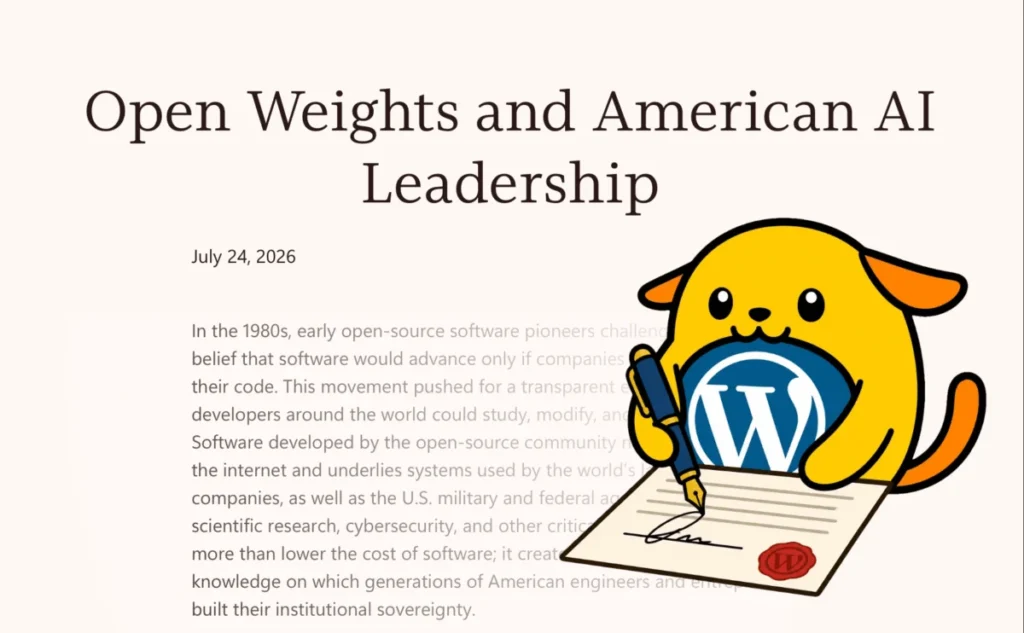
WASHINGTON, D.C. — In an era defined by the rapid convergence of artificial intelligence and digital publishing, the foundational platform behind more than forty percent of the global web has taken a definitive stand for digital autonomy. WordPress has officially announced its decision to sign the "Open Weights and American AI Leadership" open letter, a pivotal policy document urging U.S. lawmakers to refrain from enacting premature legislative or regulatory restrictions on open weight artificial intelligence models.
The decision places WordPress alongside a growing coalition of more than 270 technology companies, academic institutions, and advocacy organizations warning against regulatory overreach. By joining this movement, the platform is leveraging its immense global influence to advocate for a future where advanced artificial intelligence remains accessible, transparent, and customizable, rather than restricted to a monopolistic oligopoly of proprietary tech giants.
Main Facts: The Core of the Debate
At the heart of the debate is a fundamental distinction between closed and open artificial intelligence systems. Open weight models are AI architectures whose underlying parameters and weights are made publicly available. This allows developers, researchers, and everyday users to download, inspect, modify, and execute the models on their own private infrastructure.
Unlike closed models—proprietary software-as-a-service products tightly controlled by a handful of corporate entities—open weight models invite public scrutiny. They operate on the time-tested philosophy of open-source software: technology inevitably becomes more robust, secure, and adaptable when a global community of developers can study its architecture, identify vulnerabilities, and build upon its foundations.
WordPress’s decision to endorse the open letter is a natural extension of its own corporate and philosophical DNA. For more than two decades, the platform has operated entirely on open-source principles. Anyone in the world can download the WordPress software, examine its source code, modify it to suit specific needs, and share those innovations back with the community.
According to leadership at WordPress, open weight artificial intelligence represents the logical evolution of these same freedoms within the domain of machine learning. Just as open-source code democratized website creation and built the modern open web, open weight models democratize intelligence, allowing creators to tailor AI tools to their exact workflows without depending on external gatekeepers.
Chronology: The Road to the Open Weights Coalition
The campaign for open weight preservation has gathered momentum rapidly amid escalating regulatory debates in Washington, D.C., and Brussels.
- Late 2023 – Early 2025: As foundational large language models (LLMs) captured the global imagination, initial legislative proposals began circulating in the U.S. Congress and state legislatures. Many early policy drafts, drafted under intense pressure to address safety concerns, cybersecurity threats, and copyright issues, inadvertently threatened to classify general-purpose open-source models under the same stringent, compliance-heavy frameworks designed for proprietary corporate supercomputers.
- Spring 2026: Policy experts, open-source advocates, and startup founders recognized the urgent need to unify the voice of the decentralized tech ecosystem. Discussions began regarding a comprehensive legislative appeal that would articulate the economic and national security benefits of maintaining accessible AI infrastructure.
- July 24, 2026: The "Open Weights and American AI Leadership" open letter was officially published. The document went live with an initial cohort of signatories representing startups, independent research laboratories, and foundational open-source pillars.
- Late July 2026: WordPress officially formalized its backing of the initiative, bringing its massive global footprint and credibility as a champion of the open web to the coalition. The total number of corporate and organizational signatories surpassed 270, signaling a coordinated pushback against early regulatory containment.
Supporting Data and Policy Requests: What the Coalition Seeks
The open letter does not advocate for an unregulated "wild west" of artificial intelligence. Instead, it puts forward a series of pragmatic, targeted policy requests designed to foster safety and innovation simultaneously.
1. Expanding Access to Computing Power
The cost of training and fine-tuning advanced artificial intelligence models remains prohibitively high for independent researchers, academic institutions, and small-to-medium-sized startups. The letter urges U.S. policymakers to democratize computational access—similar to historic government investments in scientific infrastructure—ensuring that cutting-edge hardware resources are not monopolized exclusively by mega-cap technology conglomerates.
2. Investing in Shared Public Resources
To ensure safe and reliable development, the coalition calls for federal investment in public datasets, standardized evaluation benchmarks, and transparent auditing tools. By pooling resources into public-good infrastructure, policymakers can help smaller entities build and evaluate models safely without relying entirely on proprietary corporate data silos.
3. Preserving Model Diversity
A central risk identified by the signatories is the homogenization of the AI landscape. If regulatory burdens effectively price open-weight creators out of the market, the industry will narrow down to a handful of closed, proprietary systems. The letter argues that national security and economic resilience depend on maintaining a diverse ecosystem of multiple model architectures, use cases, and governance structures.
4. Protecting Standard Development Practices
Modern AI training and refinement frequently rely on established engineering techniques, such as using the synthetic outputs of one model to train, distill, or improve another. The open letter explicitly cautions policymakers against treating these standard machine-learning development practices as copyright infringement or theft by default, noting that such legal ambiguity would cripple open research and development.
These requests mirror the exact policy frameworks that allowed open-source software to thrive, creating a robust, dependable technological foundation that now powers the majority of global digital infrastructure.
Official Responses and Perspectives
The decision to sign the letter has drawn widespread praise from digital rights advocates, open-source developers, and technology executives who view the move as a crucial stand for technological democracy.
In an official statement accompanying the announcement, Mary Hubbard, WordPress Executive Director, underscored the vital connection between grassroots innovation and open architectures:
"The next generation of innovation won’t come from models alone. It will come from millions of people building with them. Open weights help make that possible. WordPress is proud to support the Open Weights and American AI Leadership letter."
Industry analysts have noted that Hubbard’s remarks strike at the core of the contemporary technological divide. While closed-model proponents argue that safety can only be guaranteed by locking down code and restricting access, the open-weight community counters that security is fundamentally enhanced through radical transparency. When thousands of independent academics and developers can inspect a model’s weights, they are far more equipped to identify biases, patch vulnerabilities, and deploy safety guardrails tailored to specific cultural and functional contexts.
Furthermore, academic researchers have rallied behind the coalition, pointing out that scientific progress relies entirely on reproducibility. Under a regime of closed-source AI, independent verification of research findings becomes virtually impossible, threatening the integrity of academic inquiry across fields ranging from medicine to climate science.
Implications: What This Means for Creators, Developers, and the Future Web
The alignment of WordPress with the open-weights movement carries profound implications for the future trajectory of the internet, content creation, and software development.
Empowering the Next Generation of Builders
As artificial intelligence rapidly integrates into content management systems, digital marketing tools, and publishing workflows, creators face a critical choice. They can either rely on black-box, subscription-based AI services whose underlying algorithms, pricing structures, and data usage policies are dictated entirely by external corporations—or they can utilize open-weight models that they can host, inspect, and modify locally.
By championing open weights, WordPress is actively working to ensure that the next generation of web developers and digital entrepreneurs—including the thousands of students currently learning the platform through educational initiatives like Learn WordPress—enjoy the same foundational freedom that fueled the early web: the freedom to examine how things work and make them better.
Economic Competitiveness and National Security
From an economic standpoint, proponents of the open letter argue that suppressing open-weight models under the guise of security would severely handicap American competitiveness. Open-source ecosystems serve as an incubator for rapid innovation, allowing small startups to iterate at speeds that legacy corporations cannot match. Stifling this grassroots ecosystem would hand a structural advantage to foreign competitors and entrench domestic monopolies.
Safeguarding Data Privacy and Sovereignty
For enterprises, government agencies, and privacy-conscious organizations, open-weight models offer an indispensable advantage: data sovereignty. Because these models can be downloaded and run on localized, private servers, organizations can utilize advanced artificial intelligence without transmitting sensitive proprietary data or user information to third-party cloud servers.
The Ultimate Crossroads for the Open Web
Ultimately, WordPress’s endorsement of the Open Weights and American AI Leadership letter serves as a timely reminder of what made the internet successful in the first place: decentralization, interoperability, and public trust.
As policymakers in Washington continue to grapple with the complexities of regulating artificial intelligence, the voice of the open-source community will be vital. By demanding regulatory frameworks that protect open access rather than stifling it, WordPress and its fellow signatories are laying the groundwork for an AI-powered future that remains open, equitable, and firmly in the hands of the people who use it every day.