The Future of Digital Engagement: Navigating the Top Marketing Trends of 2024
Marketing is an industry in a perpetual state of flux, mirroring the rapid evolution of the e-commerce landscape itself. Each year brings a fresh wave of innovation, driven by the bold strategies of market-leading brands and the pioneering concepts introduced by agile agencies. As we move through 2024, the marketing paradigm is shifting once more, heavily influenced by hyper-connectivity, the ethical integration of new technologies, and a fundamental change in how consumers interact with the brands they love.
Modern marketing is no longer just about visibility; it is about precision, ethics, and engagement. Organizations are allocating increasingly significant budgets toward digital strategies—both organic and paid—recognizing that the cost of inaction is far higher than the cost of investment. To remain relevant, brands must meet their target audiences at the exact moment of intent, across the most effective channels. This article explores the critical marketing trends defining the current landscape, providing a comprehensive guide for brands looking to sharpen their competitive edge.
1. Responsible Artificial Intelligence: The New Ethical Frontier
The rise of artificial intelligence (AI) has been the most significant technological disruption in marketing history. However, 2024 marks a shift from the mere "adoption" of AI to the "responsible" use of it. Responsible AI is defined by a commitment to ethical, transparent, and socially accountable deployment.
The Principles of Ethical AI
As brands automate content creation, data analysis, and customer interaction, the risk of bias or data privacy infringement grows. Responsible AI requires:
- Algorithmic Transparency: Brands must be clear about how AI systems are making decisions regarding customer targeting.
- Data Privacy: Compliance with global regulations (such as GDPR or CCPA) is not just a legal requirement but a brand value.
- Human Oversight: Ensuring that AI tools are used to augment, rather than replace, the nuanced judgment of human marketing professionals.
Implications for Strategy
Brands that prioritize ethical AI foster deeper trust. Consumers are increasingly wary of "black box" algorithms; therefore, companies that communicate their AI usage policies openly are seeing higher loyalty metrics.
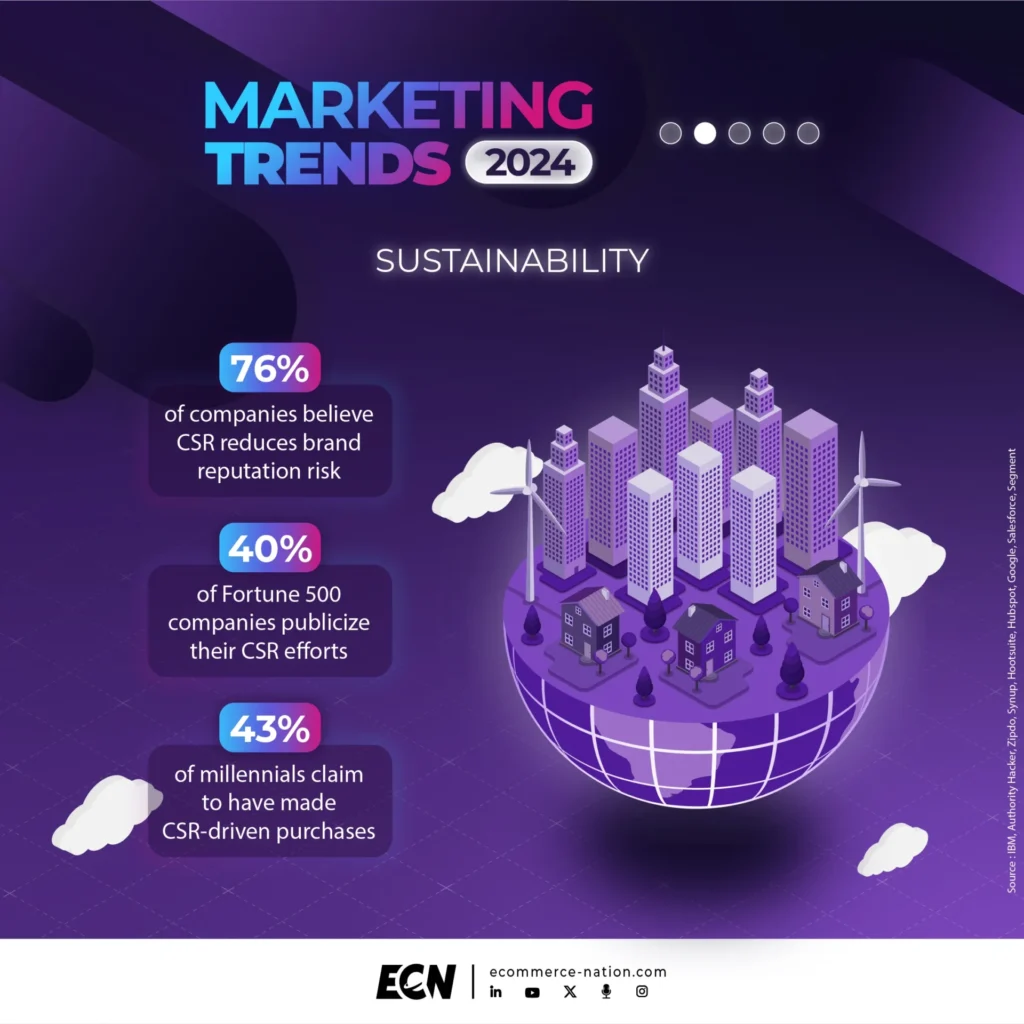
2. Sustainability as a Core Brand Value
Sustainability has transitioned from a niche concern to a non-negotiable pillar of brand strategy. Today’s consumers—particularly Gen Z and Millennials—actively seek out companies that reflect their environmental and social values.
Communicating Sustainable Value
Marketing is no longer just about features; it is about the "story of origin." Companies are now utilizing social media, blogs, and high-production video content to document their supply chain transparency. By highlighting the sustainable lifecycle of a product, brands create an emotional connection that resonates with the eco-conscious consumer.
The Role of Technology in Traceability
Blockchain technology is becoming a powerful marketing tool for proving sustainability. By providing a decentralized, immutable record of a product’s journey from raw material to final sale, brands can eliminate "greenwashing" accusations. Furthermore, mobile applications that track carbon footprints allow brands to turn environmental data into a loyalty-driving experience.

Influencer Synergy
Collaborating with influencers who are genuinely aligned with sustainability goals allows brands to access niche communities. These partnerships are more effective than traditional celebrity endorsements because they are built on shared values rather than mere transactional visibility.
3. Conversational Search: The Rise of Voice and Intent
The way users search for information has fundamentally changed. The era of typing keywords into a search bar is giving way to the era of the "conversational query."
The Shift to Natural Language
Voice search, powered by smart assistants like Alexa, Siri, and Google Assistant, has conditioned users to speak in full sentences rather than disjointed fragments. This requires a shift in SEO strategy:
- Semantic Search Optimization: Brands must now focus on "long-tail" questions and intent-based phrasing.
- Content Relevance: If a user asks their smart speaker, "What are the most sustainable running shoes?", the content that ranks will be the one that provides a direct, helpful, and human-sounding answer.
AI-Driven Anticipation
Advanced AI algorithms now understand context. If a user previously searched for hiking gear, their next interaction with a smart assistant will be tailored to that history. Marketing teams must ensure that their digital ecosystem is "AI-ready," meaning that structured data and schema markup are in place to help these sophisticated assistants process brand information accurately.

4. Short-Form Video and Immersive Experiences
In the attention-deficit economy, video is the ultimate currency. Two distinct trends are currently dominating the digital video landscape: the "snackable" short-form video and the immersive interactive experience.
The Power of Short-Form Content
Platforms like TikTok, Instagram Reels, and YouTube Shorts have shortened the consumer attention span to mere seconds. To succeed, marketers must employ:
- The Hook: Capturing the viewer’s attention within the first three seconds is mandatory.
- Storytelling vs. Sales: High-performing short videos focus on entertainment or education, with the "product push" remaining subtle and secondary.
Immersive Tech: VR and AR
Beyond short clips, immersive technologies like Augmented Reality (AR) are transforming e-commerce. Virtual "try-on" features for apparel and beauty products reduce the uncertainty of online shopping, leading to lower return rates and higher conversion rates. By allowing users to interact with a brand in a 360-degree environment, companies create memorable, high-impact experiences that standard media cannot match.
5. The Era of Hyper-Personalization
Hyper-personalization is the pinnacle of modern marketing. It is the transition from "segmenting" customers into broad groups to treating every individual as a unique demographic of one.

Data-Driven Individualization
Using Machine Learning (ML), brands can now analyze vast datasets to predict what a customer wants before they even realize it. This involves:
- Behavioral Triggering: Sending specific emails or offers based on exact browsing behavior, not just past purchases.
- Dynamic Website Content: A landing page that changes its imagery and copy based on the visitor’s location, weather, and previous brand interactions.
The Privacy Trade-off
The primary challenge of hyper-personalization is the tension between data gathering and user privacy. Successful brands handle this by offering a "value exchange": if the user provides their data, they receive an undeniably superior, customized experience that simplifies their life.
Chronology and Evolution of Marketing Trends
To understand where we are, we must look at how we arrived here:
- 2010–2015: The Digital Migration. The focus was on establishing a social media presence and moving traditional advertising budgets online.
- 2016–2020: The Data Boom. The rise of Big Data allowed for basic segmentation. E-commerce platforms exploded, and influencers became a standard part of the marketing mix.
- 2021–2023: The Pandemic Pivot. Accelerated the shift to e-commerce and normalized digital-first experiences, from remote customer service to virtual events.
- 2024 and Beyond: The Ethical/AI Convergence. The current era is defined by the integration of AI as a standard tool, the demand for radical transparency in sustainability, and the push for total personalization.
Supporting Data and Industry Implications
The investment landscape supports these trends. Market research indicates that companies leveraging AI-driven personalization see a 10% to 15% lift in revenue. Furthermore, reports show that 73% of consumers would change their consumption habits to reduce their environmental impact—a massive mandate for brands to adopt the sustainability trends discussed above.

Official Responses and Industry Outlook
Leading marketing associations and technology conglomerates (such as Adobe, Salesforce, and Google) have signaled that the "third-party cookie" era is ending, further cementing the need for First-Party Data strategies. This shift confirms that hyper-personalization and direct-to-consumer engagement are not just trends, but necessities for business survival.
Implications for the Future
The implications for modern businesses are clear:
- Agility is the new scale. Being a large brand is no longer an advantage if you cannot pivot your strategy to match the speed of a viral TikTok trend or an AI-driven search algorithm update.
- Ethics define the bottom line. Transparency is no longer a PR function; it is a financial one. Consumers will abandon brands that are perceived as unethical or opaque.
- Humanity in the Machine. As AI takes over the mechanical parts of marketing, the human element—creativity, empathy, and brand purpose—will become the primary differentiator for success.
In conclusion, the marketing trends of 2024 are not merely passing fads; they represent a fundamental realignment of the relationship between businesses and consumers. By embracing responsible AI, committing to sustainability, optimizing for conversational search, mastering short-form video, and investing in hyper-personalization, brands can build a resilient foundation for the digital decade ahead.