Main Facts: The Evolution of a Computing Revolution
Twenty years ago, a single blog post penned by Jeff Barr quietly reshaped the technological landscape. On that day, the Amazon Elastic Compute Cloud (EC2) Beta was introduced to the world, offering something that had previously been unimaginable: resizable, pay-as-you-go Linux virtual servers hosted in the cloud. At its inception, EC2 was remarkably modest. It offered a single instance type (m1.small) restricted to a single geographic region (US East). Yet, this minimal-yet-useful offering laid the psychological and technical groundwork for modern cloud computing, fundamentally altering how organizations approach infrastructure, capital expenditure, and software scalability.
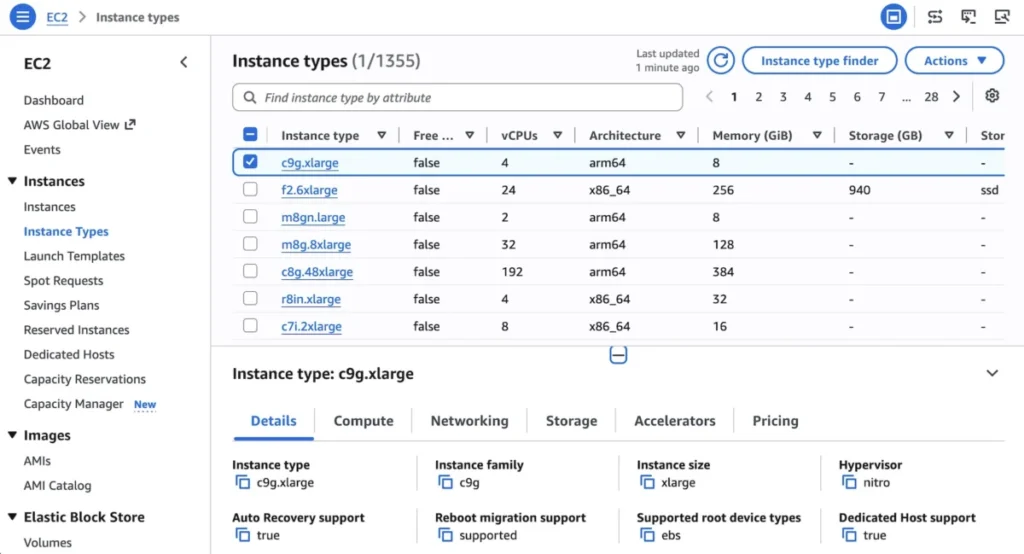
Fast forward to the present day, and Amazon EC2 has transcended its humble origins to become the invisible engine driving a massive portion of the global internet. What began as a solitary virtual machine option has exploded into a staggering portfolio of more than 1,200 distinct instance types. These configurations span general-purpose, compute-optimized, memory-optimized, storage-optimized, high-performance computing, and heavily accelerated hardware optimized for artificial intelligence workloads.
Furthermore, EC2’s geographical footprint has expanded far beyond its initial single-region boundary. Today, the service operates across 39 AWS Regions globally. It has also broken through traditional data center walls via hybrid and edge architectures like AWS Outposts, AWS Local Zones, and AWS Wavelength—the latter bringing ultra-low-latency computing directly into 5G telecommunications carrier networks.
Despite these radical advancements, the core value proposition of Amazon EC2 has remained steadfast: it delivers secure, resizable compute capacity in minutes, allows customers to pay strictly for what they consume, and removes the burden of long-term hardware commitments. Whether powering a simple blog or training trillion-parameter artificial intelligence foundation models, EC2 remains the foundational compute layer upon which higher-level AWS services—including Amazon ECS, EKS, Lambda, SageMaker, and Bedrock—ultimately depend.
Chronology: Key Milestones in the Life of Amazon EC2
To understand how Amazon EC2 evolved from a basic virtualization experiment into the backbone of global enterprise IT, it is essential to trace the major engineering and architectural milestones that mark its twenty-year history.
The Foundation Era (2006–2009)
August 2006: Jeff Barr launches the Amazon EC2 Beta, introducing on-demand, hourly billed Linux instances (m1.small) in the US East Region.
2008: The introduction of Amazon Elastic Block Store (EBS) solves a critical persistence problem, providing block-level storage volumes for use with EC2 instances.
2009: AWS dramatically increases application resilience and management capabilities with the launch of Elastic Load Balancing (ELB), Auto Scaling, and Amazon CloudWatch.
2009:Amazon Virtual Private Cloud (VPC) launches, giving customers the ability to provision logically isolated, custom-defined virtual networks that they control.
The Custom Silicon and Enterprise Scale Era (2017–2018)
2017: The AWS Nitro System debuts, representing a fundamental shift in how virtualization is engineered. By offloading I/O virtualization to dedicated hardware and software, Nitro enhances security, reduces overhead, and accelerates the pace of new instance delivery.
2018: AWS launches AWS Graviton processors, marking the company’s entry into custom ARM-based silicon designed specifically for cost-sensitive, scale-out cloud workloads.
2018:AWS Outposts brings native AWS infrastructure and operating models directly to on-premises data centers, bridging the hybrid cloud divide.
The Edge and Accelerated Computing Era (2019–Present)
2019:AWS Local Zones and AWS Wavelength are introduced, pushing compute resources closer to end-users and integrating directly into 5G mobile networks to support ultra-low-latency applications like autonomous driving and real-time gaming.
2021: AWS celebrates the 15th anniversary of EC2, noting how custom silicon and advanced networking have shifted the boundaries of what cloud workloads can achieve.
2026: EC2 marks its 20th anniversary, now supporting hyper-scale AI model training, massive distributed training clusters, and specialized hardware accelerators that were unimaginable in 2006.
Supporting Data: Scaling Beyond Imagination
The sheer scale of Amazon EC2’s growth over the past two decades can be measured through quantitative leaps in variety, performance, and geographic reach.
Metric / Dimension
2006 (At Launch)
Present Day (20th Anniversary)
Instance Types
1 (m1.small)
Over 1,200 specialized variants
Geographic Footprint
1 Region (US East)
39 AWS Regions globally
Deployment Form Factors
Regional data centers only
Regions, Outposts, Local Zones, Wavelength (5G edge)
Processor Architecture
Standard x86 (Intel/AMD initially)
x86, Custom ARM (Graviton), and AI-specific accelerators
These numbers tell a story of relentless diversification. While the original m1.small instance was designed to handle generalized, light-duty web hosting and script execution, modern EC2 fleets cater to extreme computing niches. Customers can now provision instances with hundreds of virtual CPUs, terabytes of memory, and multi-terabit network throughput. Furthermore, the introduction of AWS Nitro has allowed AWS to iterate faster than ever, releasing new generations of hardware without sacrificing hypervisor performance or security isolation.
Official Responses and Reflections
Reflecting on the milestone, prominent voices within AWS have emphasized the guiding philosophy that enabled the service to survive and thrive for two decades.
Channy Yun, writing on the AWS News Blog, highlighted the enduring wisdom of the platform’s early design choices:
"We made strong foundational decisions in 2006, and we left room for the service to grow. Twenty years later, that strategy of creating services that are minimal-yet-useful, launching quickly, and iterating rapidly in response to your feedback continues to guide how we build. The next twenty years of cloud computing will demand capabilities we have not yet imagined. Amazon EC2 will continue to be the foundation where your workloads run."
Jeff Barr, whose original 2006 blog post set the wheels in motion, has frequently noted that the cloud was born not out of a desire to build a massive enterprise empire, but out of an internal need to streamline Amazon’s own retail infrastructure. By turning internal technical capabilities into external services, Amazon inadvertently created a completely new economic sector.
Industry analysts and long-time enterprise customers have echoed these sentiments, pointing out that EC2’s ability to remain backward-compatible while aggressively innovating forward has given organizations the stability they need to plan decades ahead, rather than hardware refresh cycles measured in mere years.
Implications: The Next Era of Cloud and Artificial Intelligence
As Amazon EC2 enters its third decade, its implications for the future of enterprise technology and artificial intelligence are profound. When EC2 was launched in 2006, "big data" was still an emerging concept, and enterprise machine learning as we know it today did not exist. Today, EC2 sits at the epicenter of the global generative AI boom.
The AI Infrastructure Backbone
Training trillion-parameter foundation models requires massive, tightly coupled clusters of accelerated computing hardware with ultra-low-latency networking. Modern EC2 instances equipped with specialized AI accelerators and high-bandwidth networking fabrics (such as Elastic Fabric Adapter) form the hidden infrastructure powering today’s most advanced large language models and cognitive systems. Every major AI service on AWS—whether managed platforms like Amazon Bedrock or custom model-training pipelines on Amazon SageMaker—ultimately resolves down to raw EC2 capacity.
The Hybrid and Edge Reality
The expansion of EC2 into Local Zones, Wavelength, and Outposts signifies a permanent shift away from the centralized-only cloud model. Enterprises no longer view the cloud as a distant destination; instead, they view it as an operating model that can be deployed wherever data is generated. Whether running low-latency financial trading algorithms inside a stock exchange data center or powering computer vision on a factory floor via 5G, EC2 has evolved into a ubiquitous fabric that spans the globe and stretches to the edge.
Enduring Architectural Patterns
For software architects and developers, the fundamental lesson of EC2’s twenty-year reign is the power of composability and on-demand resource allocation. The architectural patterns pioneered in the late 2000s—such as separating stateless compute (EC2) from persistent storage (EBS) and dynamic load distribution (ELB)—remain the blueprints for cloud-native software design today.
As the tech industry looks toward an uncertain horizon filled with quantum computing, edge proliferation, and increasingly autonomous AI agents, one thing remains certain: the foundational blueprint established twenty years ago will continue to support the digital infrastructure of tomorrow.