U.S. Suspends Major IT Giants, Including Infosys, TCS, Wipro, and Microsoft, from Permanent Labour Certification Programme
WASHINGTON, D.C. — In a sweeping policy shock that threatens to upend the traditional business models of the global technology and outsourcing sectors, the United States government announced the immediate suspension of several major multinational IT firms and software giants from the Permanent Labour Certification Programme (PERM).
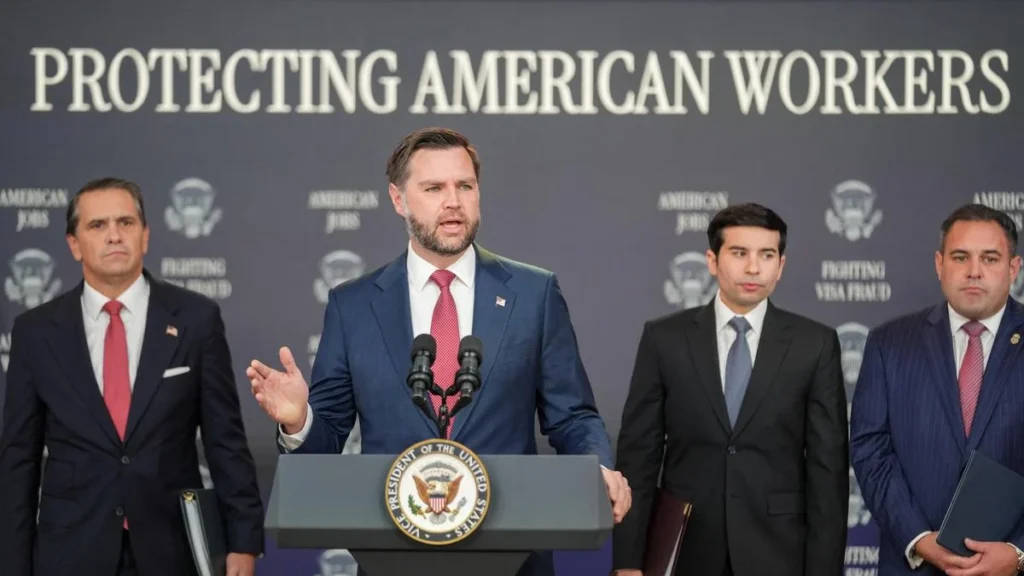
The announcement, delivered on Thursday, October 8, 2026, by U.S. Labour Secretary Keith Sonderling alongside Vice-President J.D. Vance—who leads the U.S. Anti-Fraud Task Force—bars eight prominent technology and consulting corporations from utilizing the federal program that facilitates green card applications for foreign workers holding H-1B visas.
The blacklisted firms include prominent Indian IT powerhouses Tata Consultancy Services (TCS), Infosys, Wipro, HCL Technologies, and Cognizant, alongside European multinational professional services firm Capgemini and U.S. software behemoths Microsoft and Adobe.
1. Main Facts
The latest administrative action represents one of the most aggressive crackdowns on high-skilled corporate immigration in recent U.S. history. Under the directive, the U.S. Department of Labour (DoL) has halted the intake of all new applications and frozen the processing of any pending PERM applications involving the named companies.
The PERM system is the critical first step for employers seeking to sponsor foreign national employees—frequently H-1B visa holders—for permanent residency (green cards) in the United States. Without access to this program, companies lose a vital mechanism for retaining top-tier engineering and technical talent long-term, potentially triggering a massive talent drain and shifting strategic priorities toward offshore operations.
According to data cited by the Department of Labour, the targeted companies have deeply penetrated the U.S. high-tech labor ecosystem over the past decade and a half. Since 2009 alone, the eight suspended firms collectively requested nearly three million foreign workers, securing over 230,000 H-1B visa approvals and more than 100,000 permanent labor certifications.
Administration officials framed the suspension as a decisive defense of domestic employment. Speaking at a press conference at the Eisenhower Executive Office Building on the White House campus, Labour Secretary Sonderling argued that the scale of foreign worker utilization has systematically disadvantaged American professionals.
"We will not accept any new or process any pending permanent labour certification applications involving these companies," Mr. Sonderling declared. "That’s hundreds of thousands of jobs that were taken from American workers."
2. Chronology of Events
To understand how the current regulatory freeze materialized, it is necessary to examine the escalating policy trajectory regarding U.S. work visas and outsourcing practices over recent years:
- Pre-2026: For over two decades, Indian IT services giants and global tech conglomerates heavily utilized the H-1B non-immigrant visa program to bring specialized tech talent into the U.S., subsequently transitioning thousands of these workers to permanent residency through the PERM process. Critics, however, frequently raised concerns over wage levels, displacement of domestic tech workers, and the extensive use of third-party placement models.
- Early 2026: Following the consolidation of the U.S. Anti-Fraud Task Force under Vice-President J.D. Vance, federal agencies ramped up audits and investigations into employment-based visa compliance, scrutinizing offshore outsourcing firms and software vendors for potential regulatory loopholes and systemic labor market imbalances.
- October 8, 2026 (Morning to Afternoon): Federal regulatory bodies finalize findings concerning large-scale visa and labor certification sponsors. The White House schedules a high-profile press briefing at the Eisenhower Executive Office Building.
- October 8, 2026 (09:17 PM IST / Afternoon EDT): Labour Secretary Keith Sonderling, flanked by Vice-President J.D. Vance, officially announces the immediate suspension of Cognizant, Infosys, Tata (TCS), Wipro, HCL, Capgemini, Microsoft, and Adobe from the PERM program, halting millions of dollars worth of immigration pipeline processing.
3. Supporting Data & Statistics
The rationale behind the administration’s decision rests heavily on quantitative metrics regarding labor utilization, visa allocations, and market penetration by outsourcing and software giants.

An analysis of DoL and immigration data underscores the sheer volume of foreign worker programs managed by the eight suspended corporations:
- Scale of Requests: Since 2009, the targeted firms have collectively submitted requests for nearly 3 million foreign workers under various employment-based frameworks.
- H-1B Visa Approvals: The group has amassed more than 230,000 H-1B visa approvals, underscoring their reliance on temporary high-skilled foreign labor to service corporate American clients.
- Permanent Labour Certifications: Beyond temporary visas, these companies have successfully secured over 100,000 permanent labor certifications, marking the foundational pathway to U.S. green cards for their engineering, consulting, and administrative staff.
- Industry Concentration: While traditional outsourcing firms like TCS, Infosys, Wipro, HCL, Cognizant, and Capgemini dominate the system in terms of volume due to their large consulting footprints, the inclusion of software giants Microsoft and Adobe signals a broader regulatory willingness to scrutinize native U.S. tech titans that rely heavily on global talent pools.
4. Official Responses and Stakeholder Reactions
The announcement has triggered shockwaves across global financial markets, diplomatic circles, and corporate boardrooms in both the United States and India.
The White House and Department of Labour Perspective
The administration maintains that the suspension is necessary to restore economic fairness and protect domestic labor pools. Vice-President J.D. Vance, acting in his capacity as head of the U.S. Anti-Fraud Task Force, has consistently championed economic nationalism and tighter controls on corporate immigration policies. By tying the actions of major outsourcing firms and software enterprises to domestic job displacement, the executive branch is seeking to signal a hardline stance on corporate compliance and local hiring preferences.
Industry Associations and Corporate Silence
As of late Thursday, the targeted corporations—including Infosys, TCS, Wipro, HCL, and Microsoft—were reviewing the legal and operational implications of the order. Major industry bodies, such as India’s National Association of Software and Service Companies (NASSCOM), are expected to issue formal assessments regarding the legality and potential retaliatory or remedial steps available to affected members.
Early commentary from legal experts suggests that the suspension could face intense legal challenges in federal courts, particularly regarding administrative overreach, due process, and the statutory authority of the Department of Labour to issue blanket bans against specific corporate entities without individualized adjudication.
5. Implications for the Global IT and Tech Ecosystem
The suspension of eight premier technology players from the Permanent Labour Certification Programme carries profound ramifications across multiple fronts:
Operational Disruption for IT Services Firms
For Indian IT titans like TCS, Infosys, Wipro, and HCL, the inability to sponsor green cards for H-1B visa holders severely undercuts their talent retention strategies. Many foreign engineers choose to work for these firms precisely because of the pathway to permanent residency. Without this benefit, these companies may struggle to attract top engineering talent to their U.S. operations, driving up local wage costs or forcing accelerated localization of their American workforce.
Shift Toward Offshore Delivery Models
To circumvent persistent regulatory friction in the United States, affected IT service providers may accelerate the shift toward "nearshoring" and "offshoring." Rather than deploying engineers on-site in the U.S., clients may be encouraged to execute digital transformation, cloud migration, and software development projects out of delivery centers in India, Eastern Europe, and Latin America.
Impact on U.S. Tech Giants (Microsoft and Adobe)
The inclusion of Microsoft and Adobe highlights that the administration’s crackdown is not exclusively aimed at traditional outsourcing agencies. Product-based software giants also rely on the H-1B and PERM pipelines to recruit specialized researchers, developers, and data scientists from global talent hubs. Halting their PERM access could constrain their ability to secure critical artificial intelligence and core engineering talent in a hyper-competitive global market.
Long-Term Economic and Geopolitical Repercussions
The policy shift risks introducing friction into bilateral economic relations between the United States and major tech-exporting nations, particularly India. As compliance costs rise and traditional pathways for skilled migration narrow, global corporations will be forced to re-engineer their workforce planning, compliance architectures, and geographic footprints to adapt to an increasingly protectionist regulatory landscape in Washington.