UPI Reaches Record Highs in August: Sachin Bansal’s Navi Gains Momentum as Market Giants See Minor Dips
NEW DELHI — India’s Unified Payments Interface (UPI) ecosystem achieved another monumental milestone in August, processing a record-shattering 24.51 billion transactions. This figures represents a robust 3.6% month-on-month growth compared to the 23.66 billion transactions recorded in July.
Amid this broader market expansion, structural shifts are slowly taking shape beneath the surface of India’s digital payments landscape. While dominant players like PhonePe and Google Pay continue to command an overwhelming share of the market, their footprints have experienced marginal contractions. Capitalizing on this incremental movement is the Sachin Bansal-led fintech platform, Navi, which has continued its steady ascent, cementing its position as a serious contender in India’s fiercely competitive digital payments arena.
The latest performance metrics, drawn from data released by the National Payments Corporation of India (NPCI), arrive at a pivotal juncture for the fintech sector. The data precedes a sweeping regulatory shift—the upcoming implementation of a new Merchant Discount Rate (MDR) framework set for October 15. This upcoming policy shift is expected to fundamentally alter how third-party application providers (TPAPs) monetize their UPI infrastructure, moving the industry away from a reliance purely on cross-selling toward direct transaction-based revenues.
Main Facts: Navi’s Steady Climb and the Market Landscape in August
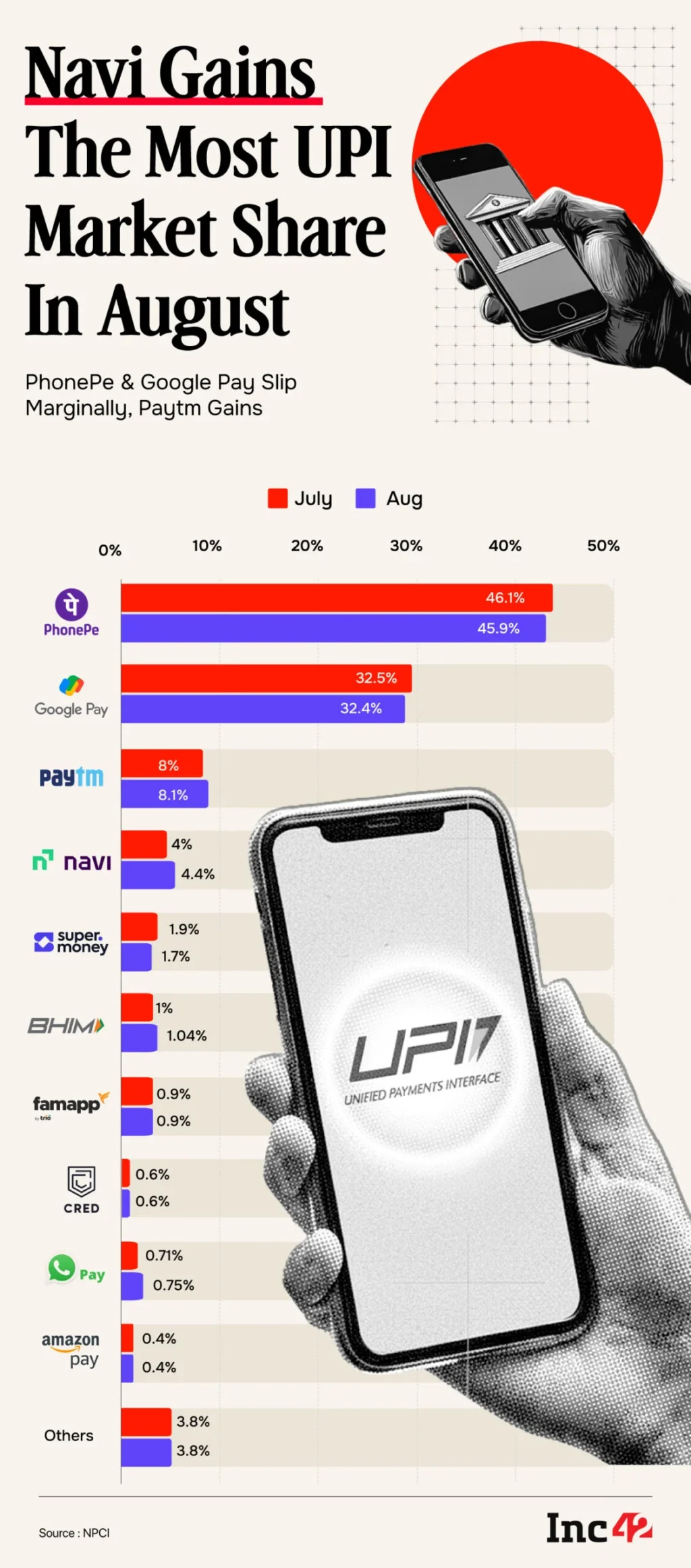
The August data highlights a persistent, albeit slow-moving, diversification of India’s digital payments ecosystem. Navi, spearheaded by entrepreneur Sachin Bansal, has steadily inched upward over the past quarter. According to calculations based on NPCI metrics, Navi’s share of total UPI transaction volumes climbed to 4.4% in August, up from 4% in July and 3.7% in June.
In concrete terms, Navi processed approximately 1.08 billion UPI transactions during August, amounting to a staggering total value of ₹52,512.85 crore. This marks a substantial leap from July, during which the platform handled around 947 million transactions valued at ₹48,318 crore.
Despite Navi’s steady gains, the broader UPI market remains exceptionally top-heavy. The duopoly of PhonePe and Google Pay continues to control nearly four-fifths of all transaction volumes nationwide. However, the August figures reveal a slight cooling off for the two market leaders:
- PhonePe processed roughly 11.25 billion transactions totaling ₹14.26 lakh crore in August. Its volume market share slipped marginally to 45.9%, down from 46.1% in July.
- Google Pay saw its market share dip slightly to 32.4%, down from 32.5% the previous month, processing approximately 7.9 billion transactions.
Combined, the two tech titans accounted for 78.3% of the market in August, down from 78.6% in July. While a 0.3 percentage point drop may seem minor on paper, within a multi-billion-transaction economy, it represents millions of routine user interactions shifting toward alternative applications.
Chronology: The Trajectory of Growth Over the Past Quarter
To understand Navi’s upward trajectory and the subtle shifts within the top tier, it is instructive to trace the chronological evolution of the UPI market over the trailing three-month window spanning June, July, and August:
June: The Baseline of Contraction and Expansion
At the outset of the summer quarter, the UPI network was already posting high-volume numbers. During June, established applications navigated a competitive environment where user acquisition strategies were heavily tied to ecosystem lock-ins. Navi registered a modest 3.7% market share, laying the groundwork for aggressive scaling through July and August. Concurrently, PhonePe and Google Pay maintained their ironclad grip, though challenger applications began testing the resilience of their user bases by offering streamlined credit, reward structures, and intuitive user interfaces.
July: The First Visible Dips
By July, total UPI transactions across all platforms scaled to 23.66 billion. It was during this month that the cracks in the duopoly’s absolute dominance became statistically apparent. PhonePe slipped from its previous higher pedestals to 46.1%, while Google Pay ticked downward as well. Capitalizing on this minor vacuum, Navi’s market share expanded to 4%, crossing critical transaction volume thresholds and proving that consumer adoption of alternative apps was no longer merely episodic. Other players, such as Paytm and Flipkart-backed super.money, also vied aggressively for mid-tier supremacy.
August: Setting Record Highs and New Milestones
August proved to be a watershed month for the infrastructure as a whole, breaching the 24.5 billion transaction mark for the first time. Navi accelerated its growth curve to capture 4.4% of the volume, fueled by aggressive push strategies in lending, financial services, and seamless onboarding. Meanwhile, the combined market share of PhonePe and Google Pay compressed further to 78.3%. This chronological progression highlights a slow but unmistakable democratization of consumer preference within a market historically dominated by just two entities.

Supporting Data: Comprehensive Breakdown of App-Wise Performance
A granular analysis of the NPCI data for August reveals how individual players performed across transaction volumes and financial values:
| Fintech App / Platform | August 2024 Market Share (%) | July 2024 Market Share (%) | Estimated Transaction Volume (August) | Estimated Transaction Value (August) |
|---|---|---|---|---|
| PhonePe | 45.9% | 46.1% | ~11.25 Billion | ₹14.26 Lakh Crore |
| Google Pay | 32.4% | 32.5% | ~7.90 Billion | Not disclosed / Scaled |
| Paytm | 8.1% | 8.0% | ~1.98 Billion | ₹2.04 Lakh Crore |
| Navi | 4.4% | 4.0% | ~1.08 Billion | ₹52,512.85 Crore |
| super.money | 1.7% | 1.9% | ~421.87 Million | ₹20,363.26 Crore |
| BHIM | 1.04% | ~1.0% | ~253.00 Million | Not disclosed |
| FamApp by Trio | 0.9% | 0.9% | ~223.00 Million | Not disclosed |
Mid-Tier and Emerging Competitors
- Paytm: Retaining its spot as the third-largest UPI application, Paytm saw a minor uptick in its volume market share, moving from 8% in July to 8.1% in August. The digital payments pioneer processed roughly 1.98 billion transactions worth ₹2.04 lakh crore during the month, demonstrating resilient consumer loyalty despite regulatory headwinds faced by its banking arm earlier in the year.
- super.money: Backed by e-commerce giant Flipkart, super.money experienced a minor contraction, with its market share slipping from 1.9% in July to 1.7% in August. The neo-banking challenger processed approximately 421.87 million transactions, amounting to ₹20,363.26 crore.
- BHIM and FamApp: The government-backed BHIM application saw its share edge up marginally to 1.04%, translating to approximately 253 million transactions. Meanwhile, FamApp by Trio maintained a stable 0.9% market share, processing roughly 223 million transactions.
Official Responses and Market Perspectives
Industry analysts and market participants have offered varied interpretations of these shifting numbers. While tech giants like PhonePe and Google Pay have downplayed fractional dips in market share—attributing them to normal statistical variance in a rapidly scaling market—challenger platforms view these trends as validation of their long-term diversification strategies.
Representatives from scaling fintechs point out that acquiring market share in a mature, habit-driven ecosystem requires more than just baseline payment utility. For Navi, leveraging Sachin Bansal’s financial services umbrella—spanning mutual funds, insurance, and personal loans—has provided a distinct advantage. Users onboarded for UPI transactions are increasingly funnelled into high-margin lending and investment products.
Conversely, legacy leaders have doubled down on technological resilience, fraud mitigation, and merchant acquisition. As transaction volumes regularly cross the 24-billion threshold, maintaining zero-downtime infrastructure remains an existential priority, one that favors players with deep institutional capital reserves.
Implications: The Looming MDR Regime and Future Monetization
The release of the August UPI data carries profound strategic implications, arriving just weeks before the implementation of a landmark regulatory framework that could reshape the financial economics of digital payments in India.
The New MDR Framework Explained
Starting October 15, a new Merchant Discount Rate (MDR) regime will come into force for specific categories of UPI transactions:
- The Threshold: Merchants receiving eligible UPI payments exceeding ₹2,000 will be subjected to an MDR charge of 0.4%.
- The Cap: For transactions exceeding ₹75,000, this fee will be capped at a maximum of ₹300.
- P2P Protection: Person-to-Person (P2P) payments will remain entirely free of charge for everyday consumers.
- Sector-Specific Rules: Payments exceeding ₹2,000 within high-volume sectors—such as railways, fuel, telecom, insurance, and select utilities—will attract a flat charge of ₹5.
- Capital Markets: Payments linked to capital market transactions will carry a significantly lower MDR of 0.02%, capped at ₹300.
A New Era of Monetization for TPAPs
For years, third-party application providers (TPAPs) operating within the UPI ecosystem have grappled with a significant structural challenge: the absence of direct monetization avenues. Because basic UPI transactions have remained free for consumers and largely zero-MDR for merchants, apps like PhonePe, Google Pay, Navi, and Paytm have relied almost exclusively on cross-selling. They used payments data as a top-of-funnel acquisition tool to pitch lucrative financial products such as credit cards, personal loans, and insurance policies.
The introduction of the October 15 MDR framework alters this dynamic fundamentally. By opening up direct revenue streams from high-value merchant transactions and specific commercial sectors, the new policy provides TPAPs with a predictable, transaction-linked income source.
This shift could level the playing field to an extent, giving well-capitalized challengers like Navi, Paytm, and newer entrants additional capital to reinvest in user acquisition, rewards programs, and technological infrastructure. However, it may also increase the cost of doing business for large-scale merchants, prompting a close watch on how businesses pass on or absorb these costs.
As India’s digital payments juggernaut marches toward even higher transaction milestones in the final quarter of the year, the interplay between regulatory change, merchant economics, and challenger-brand momentum will dictate the next chapter of the fintech revolution.