Wildlife Trafficking at Public Events: Indian Rock Python Rescued from Hyderabad Ganesh Procession
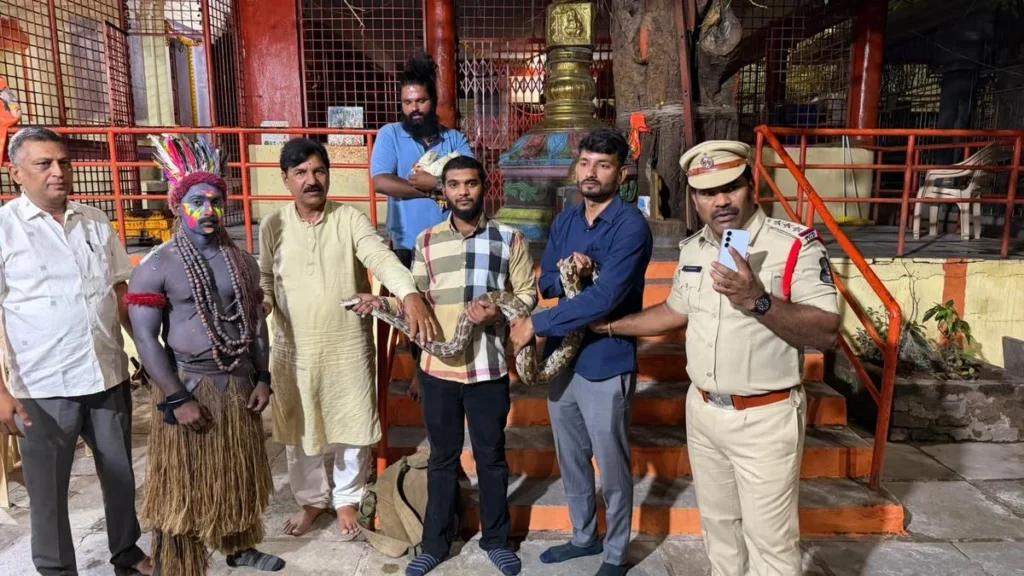
HYDERABAD – In a disturbing incident that has highlighted the persistent challenges of wildlife exploitation in urban public spaces, an Indian rock python—a species afforded the highest level of protection under Indian law—was rescued from a dance troupe during a Ganesh immersion procession in Hyderabad. The rescue, which took place on Sunday, September 20, 2026, marks the culmination of a five-day intelligence-led operation by animal welfare activists and local law enforcement.
The Incident: Exploitation Under the Guise of Celebration
The incident occurred amidst the high-energy atmosphere of the Ganesh Chaturthi immersion festivities. According to officials from the Greater Hyderabad Society for the Prevention of Cruelty to Animals (GHSPCA), a dance troupe traveling from Visakhapatnam had been incorporating a live Indian rock python into their public performances.
The sight of a wild, predatory reptile being paraded through crowded streets, handled by untrained individuals, and subjected to the cacophony of loud music and chaotic crowds has sparked widespread outrage. Beyond the obvious danger posed to the public, the incident underscores the severe psychological and physical trauma inflicted upon wildlife used for "entertainment" purposes. Alongside the python, a live hen—presumably intended as food or as part of a ritualistic display—was also seized by authorities.
A Five-Day Pursuit: The Chronology of the Rescue
The rescue was not a chance encounter but the result of a coordinated effort by the GHSPCA. The timeline of the intervention reveals the persistence required to tackle wildlife crime in highly mobile settings.
Initial Intelligence (September 15–18, 2026)
The GHSPCA received credible reports regarding a performance group operating out of Visakhapatnam that was utilizing a live snake as a prop. For several days, activists tracked the troupe’s movements across the city, identifying their transit patterns and performance schedule.
The Near-Miss at Kondapur (September 19, 2026)
On the eve of the rescue, the GHSPCA team located the group at a Ganesh immersion procession in the Kondapur area. As the activists moved in to intervene and secure the animal, the handler, sensing the presence of authorities, managed to evade capture by disappearing into the dense crowds, taking the python with him. This initial failure highlighted the difficulty of enforcing wildlife protection laws in the midst of massive, uncontrolled public gatherings.
The Jawaharnagar Breakthrough (September 20, 2026)
Undeterred, the GHSPCA continued monitoring the group’s trajectory. Their persistence paid off the following day when the troupe was spotted at another immersion procession in the Jawaharnagar area. Recognizing the opportunity, the GHSPCA immediately alerted the Madhura Nagar Police. A joint team was dispatched to the location, successfully cornering the handler. During the search, both the Indian rock python and the hen were recovered, and the individual in possession of the animals was apprehended for further questioning.
The Plight of the Python: Veterinary Findings
Following the rescue, the Indian rock python was immediately transported to a secure facility for urgent medical assessment. The initial veterinary report painted a grim picture of the animal’s condition.
Oral Cavity and Dental Infections
The most concerning finding was a significant infection affecting the snake’s oral cavity and teeth. Such conditions are common in captive snakes subjected to poor handling, unsanitary conditions, and high-stress environments. In the wild, pythons rely on their ability to strike and constrict prey; dental health is therefore critical to their survival. The infection likely originated from physical trauma caused by forced handling or the consumption of improperly managed food sources.
Long-term Rehabilitation
The GHSPCA has confirmed that the python is currently undergoing intensive care. "The python will continue to receive treatment," a spokesperson for the society stated. "After the animal shows signs of recovery and is cleared by veterinary experts, we plan to facilitate its release back into its natural habitat, pending formal approval from the competent wildlife authorities."
Legal Framework: The Wild Life (Protection) Act, 1972
The Indian rock python (Python molurus) is listed under Schedule I of the Wild Life (Protection) Act, 1972. This classification grants the species the same level of legal protection as tigers and elephants. Under the Act, any form of trapping, keeping, or using these animals for commercial display or public entertainment is a non-bailable, cognizable offense.

The exploitation of such an animal during a public procession is a clear violation of:
- Section 9: Prohibiting the hunting/capturing of any wild animal.
- Section 39: Stating that every wild animal seized under the Act is the property of the State Government.
- Section 48A: Restrictions on the transportation of wildlife.
The handler faces potential imprisonment ranging from three to seven years, along with significant monetary fines. The involvement of the Madhura Nagar police ensures that the case is being processed through the standard criminal justice system, signaling a zero-tolerance approach toward wildlife trafficking in the state.
Implications for Public Safety and Wildlife Ethics
The case of the "performing python" raises profound ethical and safety questions that extend beyond the specific individuals involved.
Public Safety Risks
Large constrictors, while generally not aggressive toward humans unless provoked, are unpredictable when stressed. The environment of a Ganesh immersion procession—characterized by deafening firecrackers, massive crowds, and vibrating sound systems—is an environment of extreme sensory overload for a reptile. A stressed python is a defensive python, and the potential for a bite or a constriction incident in a crowded street could have led to a public health emergency.
The "Entertainment" Industry
The use of wildlife in street performances is a vestige of outdated practices that have no place in modern urban society. Animal welfare experts argue that the normalization of these displays in religious or cultural processions creates a market for wildlife smugglers. When members of the public treat these performances as entertainment rather than animal cruelty, they inadvertently incentivize the continued capture and trade of protected species.
The Role of Civil Society and Law Enforcement
The success of this operation underscores the vital importance of collaboration between NGOs like the GHSPCA and local police forces. Wildlife crimes are often treated as low-priority by law enforcement agencies, who are already burdened with maintaining public order during major festivals. However, the GHSPCA’s ability to track, report, and facilitate the arrest serves as a blueprint for how wildlife crime can be tackled in dense urban centers.
Conclusion: A Call for Vigilance
As the Indian rock python continues its recovery, the incident remains a stark reminder of the hidden costs of human festivities. While cultural and religious traditions are a vital part of the fabric of Indian society, they cannot and should not be used as a cover for the illegal exploitation of wildlife.
The GHSPCA has urged the public to remain vigilant. "If you see any animal being used in a performance, being paraded on the streets, or kept in unnatural conditions, do not hesitate to contact local wildlife authorities or NGOs," the society emphasized.
The recovery of this single python is a victory for animal welfare, but it is also a call to action. As Hyderabad continues to grow and urbanize, the pressure on local wildlife increases. Only through rigorous enforcement of the Wild Life (Protection) Act and a heightened societal awareness can we ensure that such incidents become a relic of the past, rather than a recurring feature of our city streets.
The path ahead for the python is one of rehabilitation, but the path ahead for the city is one of accountability. The authorities are currently investigating the origins of the snake to determine the network involved in the illegal trade, hoping to identify the source of the trafficking chain that enabled this animal to be transported from Visakhapatnam to Hyderabad.