Beyond the Model: The Architecture of Production AI Agents
In the current landscape of enterprise software, the "AI Agent" has shifted from a theoretical research concept to the primary vehicle for automation. According to recent projections from Gartner, enterprise integration of task-specific AI agents is set to surge, with 40% of applications expected to feature these systems by the end of 2026—a monumental leap from less than 5% in 2025.
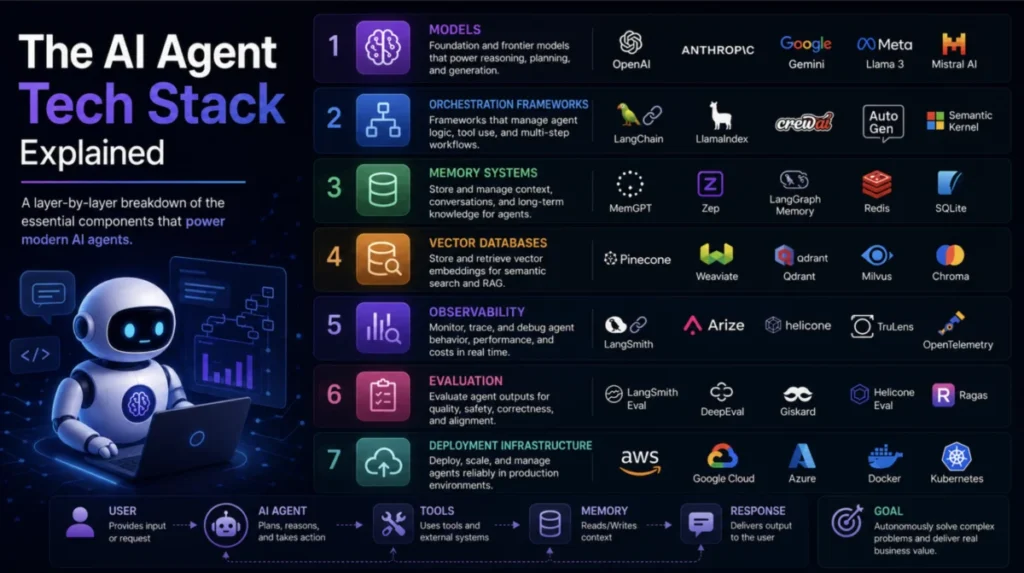
However, a dangerous misconception persists among technical leads: the belief that the foundation model is the sole determinant of an agent’s success. While models like OpenAI’s GPT-5.5 or Anthropic’s Claude Opus 4.8 provide the cognitive horsepower, they are merely the "brain." An agent is a multi-layered ecosystem. If one of the seven foundational layers—orchestration, memory, retrieval, tools, observability, or infrastructure—is misconfigured, the entire system collapses.
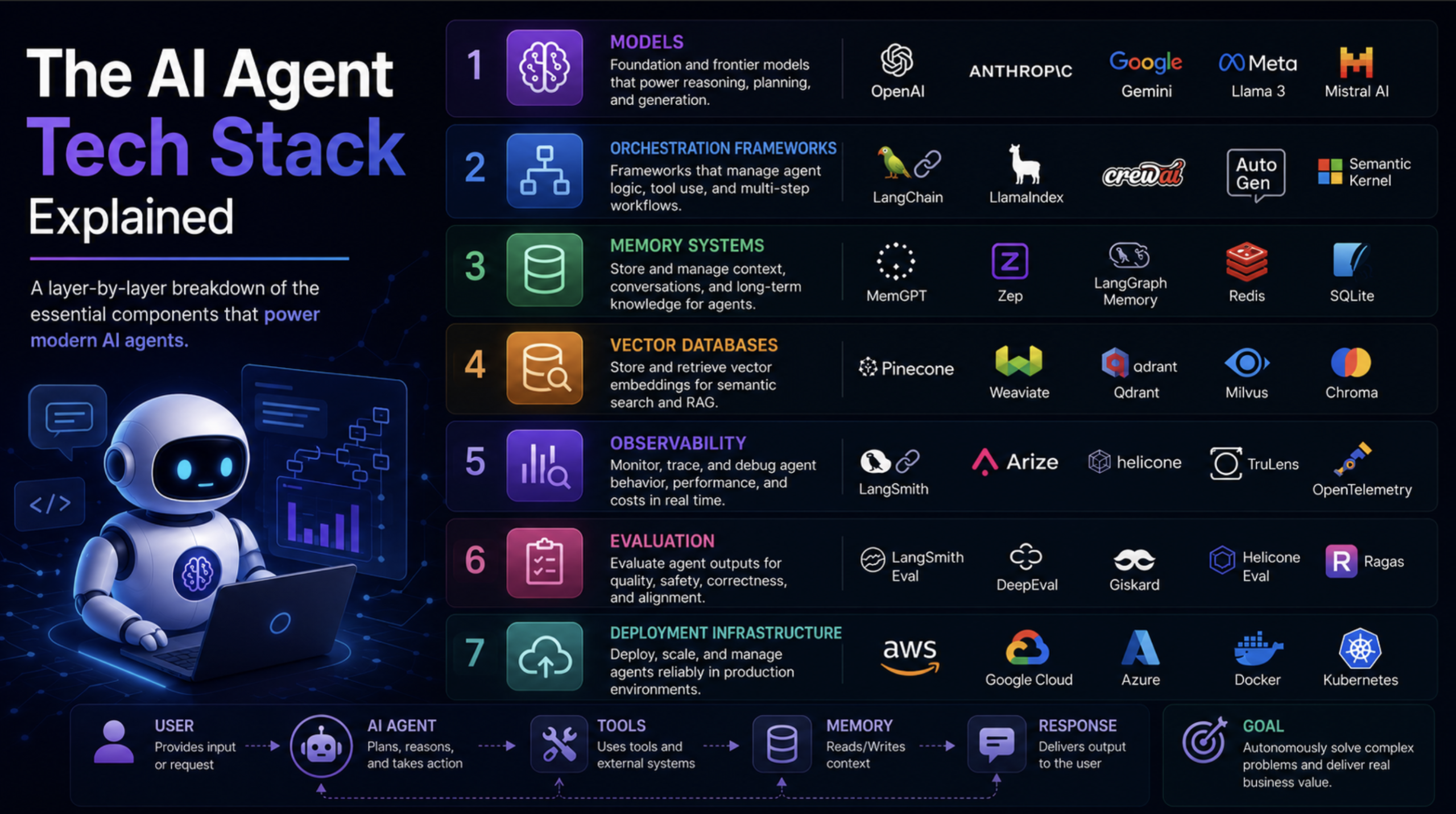
The Seven Layers of the AI Agent Stack
To build agents that move beyond the "demo phase" and provide actual business value, engineers must move away from viewing the LLM as the silver bullet and instead treat it as one component in a complex, seven-tier pipeline.
Layer 1: The Foundation Model (The Brain)
The foundation model is the cognitive core, responsible for reasoning and language understanding. As of 2026, the industry has largely abandoned the split between "reasoning" and "standard" models. Modern models, such as GPT-5.5 and Gemini 3.1 Pro, now allow developers to toggle "reasoning effort," effectively balancing latency and cost against the complexity of the task.
- GPT-5.5: The gold standard for tool-calling reliability.
- Claude Sonnet 4.6: Optimized for long-context document analysis.
- Llama 4: The go-to for organizations requiring strict data residency and control.
Layer 2: The Orchestration Framework (The Nervous System)
The orchestration framework governs the ReAct (Reasoning and Acting) loop. This is where the agent decides when to "think," when to "act," and when to "stop." Frameworks like LangGraph or CrewAI provide the necessary control flow to keep agents from falling into infinite loops or hallucinating task completion.
Layer 3: Memory Systems (Context Retention)
LLMs are stateless by design. Without a dedicated memory layer, an agent has no recollection of past interactions or user preferences. Production-grade agents utilize a bifurcated memory approach:
- Working Memory: In-session, ephemeral context stored in active memory.
- Episodic Memory: Long-term storage (using databases like Postgres or Redis) that allows the agent to recall specific details from previous days or weeks.
Layer 4: Vector Databases and Retrieval (RAG)
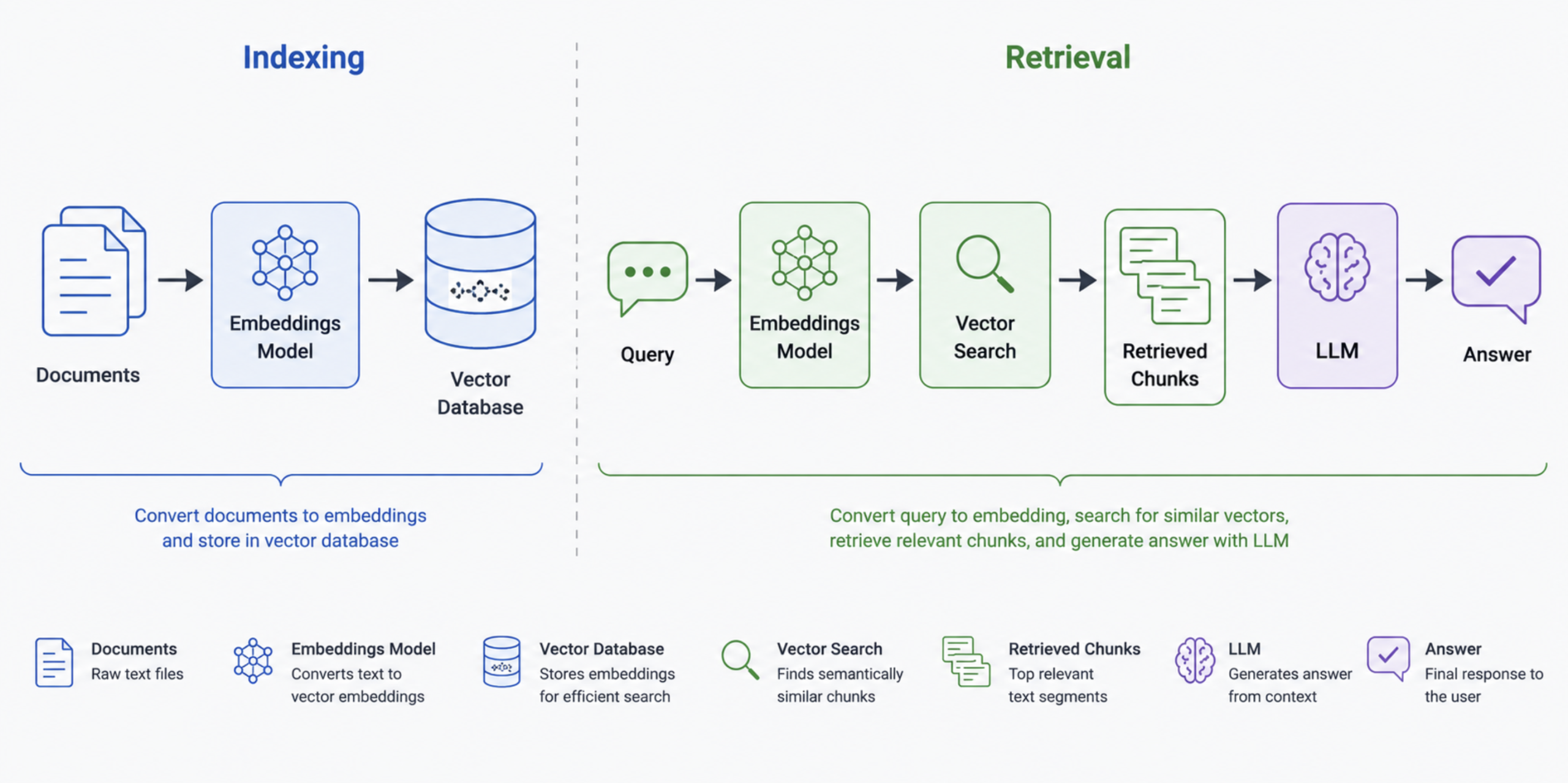
Retrieval-Augmented Generation (RAG) is the bridge between the model’s static training data and your proprietary knowledge base. By embedding documents into vector databases like Chroma, Pinecone, or Weaviate, agents can pull highly relevant snippets of information, grounding their output in reality and drastically reducing hallucination rates.
Layer 5: Tools and External Integrations
An agent without tools is merely an expensive text predictor. Tools allow agents to execute code, query APIs, or browse the web. The emergence of the Model Context Protocol (MCP) has revolutionized this layer, providing a universal standard for models to interface with external data without requiring bespoke code for every connection.
Layer 6: Observability and Evaluation
This is the most overlooked layer in early-stage deployments. LLMs are notoriously prone to "silent failures"—where the system returns a valid HTTP 200 code despite the content being factually incorrect. Observability platforms like Langfuse or Arize Phoenix are essential for tracking token usage, latency, and, most importantly, semantic correctness.
Layer 7: Deployment Infrastructure
The final layer dictates the agent’s stability. Whether deploying via Docker containers on Kubernetes or utilizing managed services like AWS AgentCore or Google Vertex AI Agent Builder, the infrastructure must handle the asynchronous nature of agentic workflows, where a single request may take 60 seconds to process through multiple tool calls.
Chronology of Agentic Evolution
- 2024 (The Emergence): The industry focused on simple chatbot wrappers. The term "Agent" was largely aspirational, with most systems lacking persistent memory or reliable tool use.
- 2025 (The Reliability Crisis): Research from Atlan indicated that 95% of enterprise generative AI pilots failed to deliver ROI. The industry realized that better models were not the answer; architectural rigour was.
- 2026 (The Production Era): The focus has shifted to "Agentic Orchestration." Companies are now treating agents as autonomous software engineers, prioritizing standard protocols (MCP), rigorous evaluation, and robust infrastructure.
Supporting Data: Why Projects Fail
The primary reason for the high failure rate in early AI adoption is the "Hallucination-as-Success" problem. Because traditional monitoring tools focus on uptime rather than semantic accuracy, developers often remain blind to degradation.
| Feature | Prototype | Production Startup | Enterprise |
|---|---|---|---|
| Model | GPT-5.5 | GPT-5.5 + Claude 4.6 | Azure OpenAI / Bedrock |
| Orchestration | LangGraph | CrewAI | Semantic Kernel |
| Memory | In-Context | Postgres/Redis | Managed/Auditable |
| Observability | Basic Tracing | Langfuse Self-Hosted | Datadog/Enterprise Suite |
Official Responses and Industry Outlook
The sentiment from major cloud providers is clear: the era of "standalone models" is ending. During the 2026 Q2 earnings calls, leadership at both AWS and Microsoft emphasized that the "Agentic Stack" is the next frontier of cloud consumption.
"We are moving from a world where AI is a service you call, to a world where AI is a worker you deploy," stated a lead architect at a major cloud provider. This sentiment is echoed by the rapid adoption of managed agent builders, which aim to bake governance and compliance directly into the infrastructure layer, addressing the primary concerns of C-suite executives regarding security and auditability.
Implications for Engineers and Technical Leads
The shift toward the full-stack agent model has profound implications for the engineering workforce:
- The Death of the "Prompt Engineer": The focus is shifting from crafting the perfect prompt to designing the perfect tool schema and orchestration flow. Reliability is now an architectural challenge, not a linguistic one.
- Infrastructure as a Moat: As models become commoditized, the ability to maintain a robust RAG pipeline, efficient memory management, and rigorous evaluation metrics will become the primary differentiator between successful products and failed experiments.
- The Governance Mandate: As Gartner predicts, the risk of project cancellation is high. Technical leads must prioritize "observability-first" development. If you cannot measure the quality of an agent’s reasoning, you cannot safely deploy it to production.
Conclusion
The seven layers of the AI agent stack represent the bridge between a promising prototype and a resilient production system. The foundation model at the top is the "face" of the agent, but the infrastructure, memory, and observability layers are its backbone.
Engineers who master the entire stack—understanding not just how to call an API, but how to manage state, evaluate accuracy, and govern tool execution—will define the next generation of enterprise software. The goal is no longer to build an agent that can answer a question; it is to build an agent that can reliably operate within the complex, messy, and high-stakes environment of modern business. By focusing on the architecture rather than just the model, organizations can move past the hype and into a phase of genuine, agent-driven automation.