The Scalability Paradox: Mastering Agentic Tool Selection in Complex AI Systems
In the rapidly evolving landscape of Large Language Model (LLM) applications, the "Agent" has emerged as the definitive unit of productivity. By granting an AI the ability to interact with external APIs, databases, and software tools, developers have moved beyond simple chatbots into the realm of autonomous problem solvers. Yet, many teams encounter a frustrating developmental ceiling: the agent that performed brilliantly during the initial prototype—armed with a lean set of five tools—begins to flounder as it matures.
Once an agent’s tool catalog expands to 40 or 50 integrations, performance typically nosedives. The agent begins calling the wrong functions, hallucinating parameters from unrelated schemas, or entering infinite loops while awaiting data from irrelevant API calls. This degradation is not a failure of the model’s inherent intelligence; it is a failure of architectural design. To maintain precision at scale, developers must stop treating the tool catalog as a static dump of capabilities and start treating it as a dynamic, retrieval-augmented data structure.
The Anatomy of Agentic Failure
The root cause of agent degradation at scale is the "Context Overload" phenomenon. Every tool definition—including its name, detailed description, and complex JSON schema—must be injected into the model’s system prompt so the LLM knows how to use it. When this list grows, it consumes an increasing percentage of the available context window.
The "Lost in the Middle" Effect
Research into transformer-based architectures has consistently shown that LLMs exhibit a "U-shaped" recall pattern. They are highly effective at processing information at the very beginning and the very end of a prompt but suffer from a significant decline in attention toward information buried in the middle. As tool lists grow, the correct tool is frequently relegated to this "dead zone," causing the model to hallucinate or ignore the tool entirely.
The Cost of Tool Hallucination
Beyond simple performance drops, there is the issue of "hard failure." When an LLM is presented with dozens of similar-sounding tools, it often suffers from cross-talk—accidentally applying a parameter structure from a "Calendar" tool to a "Database Query" tool. Because there is no "mostly correct" way to execute a function call, these errors result in complete task abandonment.
Recent industry data suggests that most production-grade agents begin to show measurable accuracy degradation once the tool count crosses the 15-to-20 threshold. The solution is not to seek a larger context window, but to implement a smarter filtering layer that ensures the model only sees the specific tools required for the task at hand.
Six Pillars of Scalable Tool Selection
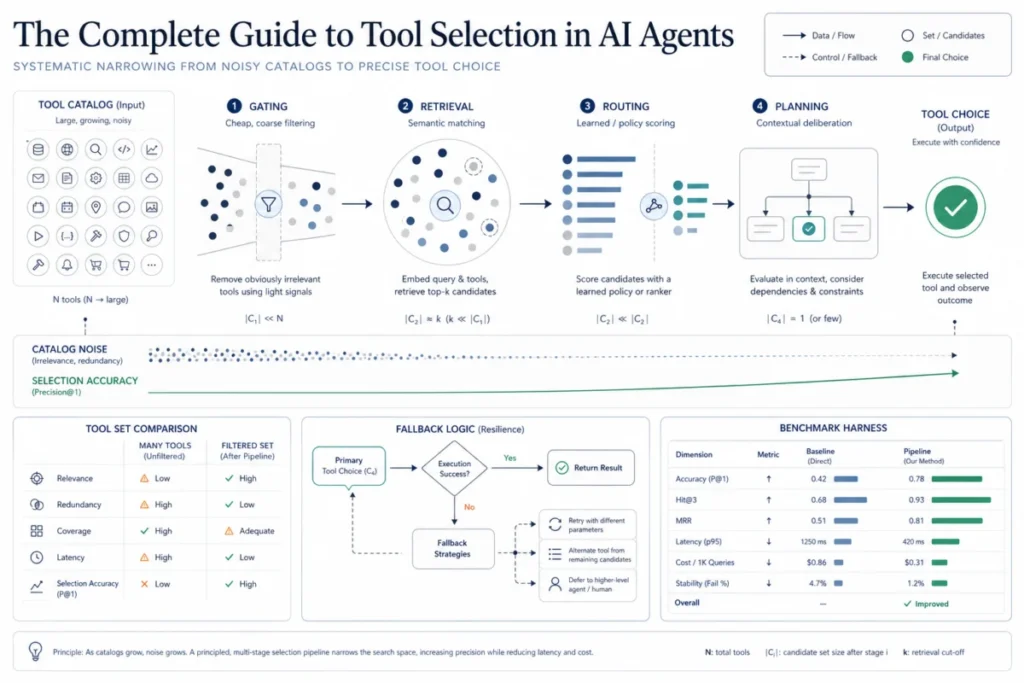
To navigate the complexity of a large-scale tool ecosystem, developers should deploy a multi-layered architecture. These six techniques are designed to be implemented in sequence, moving from low-latency filters to sophisticated planning logic.
1. Gating: The Cheap Pre-Filter
Before an agent engages in expensive LLM reasoning, it should run a "gate." A significant percentage of user interactions—such as "thanks," "hello," or "what do you mean by that"—do not require any tool intervention.
By implementing a lightweight classifier (using regex patterns or a tiny, low-latency model), developers can intercept these conversational turns. If the gate determines that no action is required, the query never hits the primary agent pipeline. This saves significant token costs and latency, providing a cleaner experience for the end-user.
2. Retrieval-Based Selection (RAG-MCP)
The most significant breakthrough in recent years is the application of Retrieval-Augmented Generation (RAG) to tool selection. Instead of providing the model with the full catalog, developers can store tool descriptions in a vector database.
When a user query arrives, the system embeds the query and retrieves the "Top-K" most semantically relevant tools. As demonstrated in the seminal RAG-MCP paper (May 2025), this approach tripled tool selection accuracy—from 13.62% to over 43%—while simultaneously cutting prompt token usage by more than 50%.
3. Semantic Routing
Routing serves as a higher-level organizational strategy. Rather than searching for a specific tool, the system determines which "toolbox" or category a request belongs to. For instance, a query about a "Q3 revenue report" would be routed to the "Data & Analytics" category, while a request to "notify the team" is routed to "Communication." By limiting the agent’s scope to a specific subset of tools based on domain, you reduce the noise that the model must process.
4. Planner-Based Decomposition
For multi-step tasks, the "God Agent" anti-pattern—where one agent attempts to handle a long-running process with all tools available at once—is highly prone to error. Instead, developers should implement a Planner.
The Planner first breaks a complex request into a sequence of sub-tasks. Each step is then assigned a "capability tag." The agent only receives the specific tools mapped to that capability for that specific step. This keeps the prompt lean and ensures that the model remains focused on the immediate objective.
5. Fallback Logic
No system is perfect. Ambiguous queries will always bypass filters. A robust system requires a tiered fallback strategy:
- Tier 1: High-confidence resolution using the primary retriever.
- Tier 2: If confidence is low, the system reformulates the query (e.g., stripping filler words) and tries again.
- Tier 3: If the system still lacks clarity, it triggers an explicit clarification request to the user.
It is better for an agent to admit ignorance than to execute an incorrect, potentially destructive tool call.
6. Rigorous Benchmarking
Finally, architectural improvements must be validated against a labeled test set. The MCPToolBench++ framework offers a gold standard for this, utilizing thousands of real-world interactions. By maintaining a suite of (query, expected_tool) pairs, developers can measure accuracy, latency, and token cost objectively, ensuring that every update to the pipeline produces a net gain.
Implications for Future Development
The evolution of agentic systems is mirroring the evolution of web search. In the early days of the internet, simple directories were enough; eventually, we required sophisticated indexing and ranking algorithms. We are now at that same inflection point for AI agents.
The data is clear: the path to scaling AI agents lies in abstraction and curation. By treating the "tool definition" as a piece of data to be retrieved rather than a permanent fixture in the prompt, developers can build systems that remain performant regardless of how many thousands of tools they eventually support.
As we look toward the future, the integration of these techniques will likely become standard practice in agentic frameworks. The shift from "monolithic prompts" to "dynamic tool retrieval" marks the maturation of AI agents from experimental scripts into enterprise-grade software. The developers who win in the coming years will not be those who build the most complex agents, but those who build the most disciplined systems for managing the information those agents consume.