The Architecture of Intelligence: How the Model Context Protocol (MCP) is Standardizing AI Integration
In the rapidly evolving landscape of artificial intelligence, a fundamental tension has emerged: while Large Language Models (LLMs) have achieved remarkable linguistic fluency and reasoning capabilities, they remain fundamentally "trapped" in a state of temporal isolation. Their knowledge is frozen at the moment their training concludes, rendering them unable to access the dynamic, private, or real-time data that defines modern enterprise operations.
For developers, bridging this gap has historically been a fragmented, manual, and high-maintenance ordeal. The introduction of the Model Context Protocol (MCP) by Anthropic represents a pivotal shift in this paradigm. By creating a universal standard for how AI applications interface with external tools and data, MCP is moving the industry away from a "spaghetti" of custom-coded integrations toward a scalable, modular architecture.
The Core Challenge: The "N x M" Integration Crisis
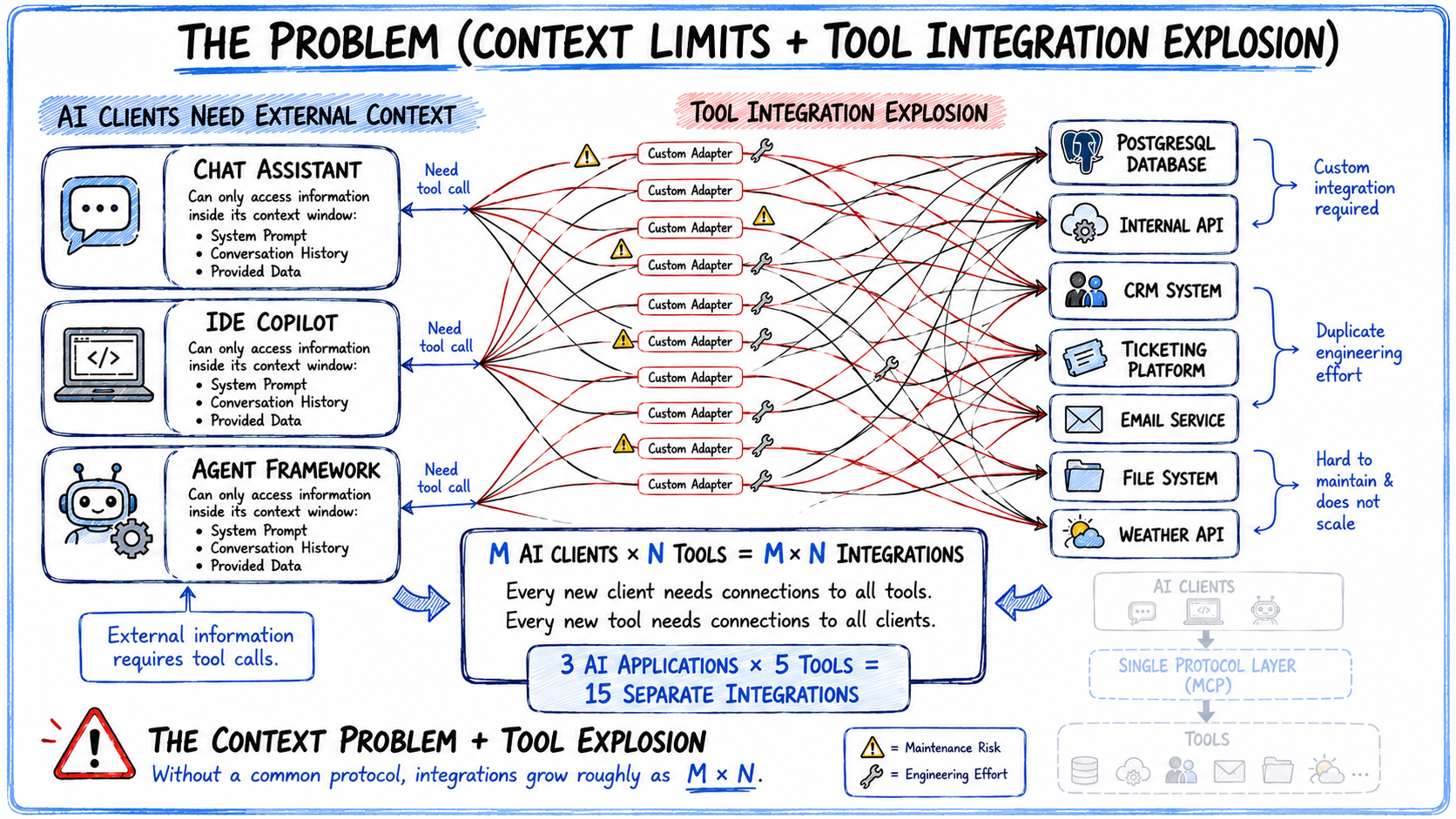
To understand why MCP is considered a breakthrough, one must first look at the state of AI integration before its inception. In a typical development environment, an AI application—such as a coding assistant or a data analysis bot—needs to connect to a variety of services: databases (PostgreSQL, MongoDB), version control systems (GitHub), communication platforms (Slack, Teams), and internal proprietary APIs.
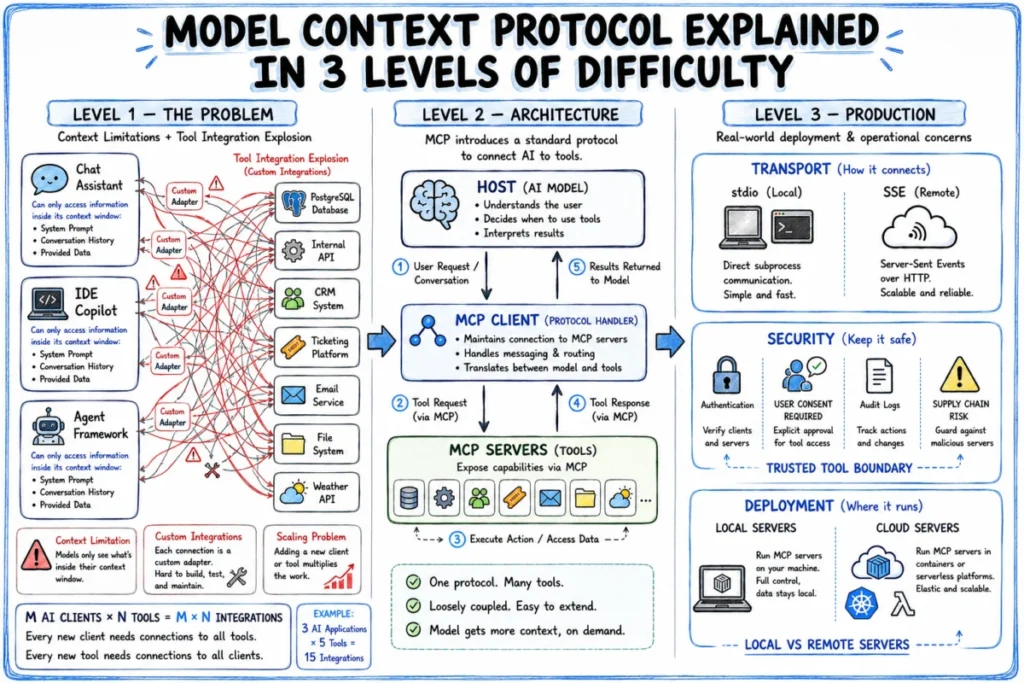
In the pre-MCP era, developers were forced to build bespoke connectors for every single pairing. If you had three AI agents and five data sources, you were essentially maintaining fifteen distinct integration points. Each of these required its own authentication logic, schema mapping, and error-handling protocols. As the ecosystem grew, this "M x N" complexity became a significant technical debt. Whenever a vendor updated an API or a new AI model was introduced, the entire matrix of adapters risked collapse.
The Model Context Protocol solves this by decoupling the AI "Host" (the application) from the "Server" (the data source). By establishing a shared language, an MCP server—whether it connects to a SQL database or a file system—can be instantly compatible with any MCP-compliant client. The complexity is reduced from an exponential matrix to a linear, additive model: M+N.
Chronology: From Proprietary Silos to Open Standards
The journey toward MCP was not instantaneous; it was the result of a maturation phase in AI agentic workflows.
- The Primitive Era (2022–2023): Developers utilized rudimentary "function calling" capabilities provided by individual model providers. These were highly proprietary; code written to connect a model to a database for one provider often had to be rewritten to function with another.
- The Rise of Agentic Frameworks (Early 2024): Frameworks like LangChain and AutoGPT emerged to simplify these connections, but they often imposed their own heavy abstractions, creating new forms of vendor lock-in.
- The Standardization Phase (Late 2024–2025): Recognizing that the lack of a universal interface was the primary bottleneck for enterprise AI adoption, Anthropic spearheaded the development of the Model Context Protocol. By releasing it as an open standard, they invited the community to contribute to a shared, vendor-neutral specification.
- The Ecosystem Expansion (Present): Today, MCP is seeing rapid adoption. Major IDEs, such as Visual Studio Code, and agentic platforms are building native support for the protocol, allowing developers to plug in pre-built MCP servers for common tools like Slack, GitHub, and Jira without writing custom glue code.
Supporting Data: The Efficiency of Protocol-Based Architecture
The economic and technical advantages of moving to a standardized protocol are measurable in developer hours and system stability.
- Integration Velocity: Internal benchmarks suggest that moving from proprietary adapters to MCP-based connections can reduce the initial integration time of a new data source by 60–80%.
- Maintenance Overhead: By abstracting the "transport" layer away from the "tool" layer, maintenance is centralized. A security update or a schema change made to an MCP server is immediately inherited by all connected AI agents, eliminating the need to update individual client-side code.
- Composability: The "Lego-brick" nature of MCP means that an agent designed for data analysis in January can, with a single configuration change, gain the ability to query a new internal ticketing system in February, provided that system is exposed via an MCP-compliant server.
Official Perspectives and Industry Implications
Industry leaders have lauded the protocol as a "critical piece of the plumbing" for the next generation of AI. Unlike previous attempts at standardization that focused purely on model weights or training data, MCP focuses on the utility of the model.
Anthropic’s Stance: The creators of MCP emphasize that the protocol is not just about connectivity; it is about safety and transparency. By defining how tools are described and how data is requested, MCP provides a structured way to implement fine-grained access control.
Security Implications: As models gain the ability to "act" on the world—writing code, sending emails, or updating database rows—the risks of "prompt injection" or unauthorized data exposure grow. MCP addresses this by enforcing clear boundaries. Because the server is an independent entity, organizations can place it behind their own firewalls, apply strict OAuth2 authentication, and log every interaction, ensuring that the AI agent only has access to the specific resources it has been granted permission to touch.
Architecture Deep-Dive: How MCP Works
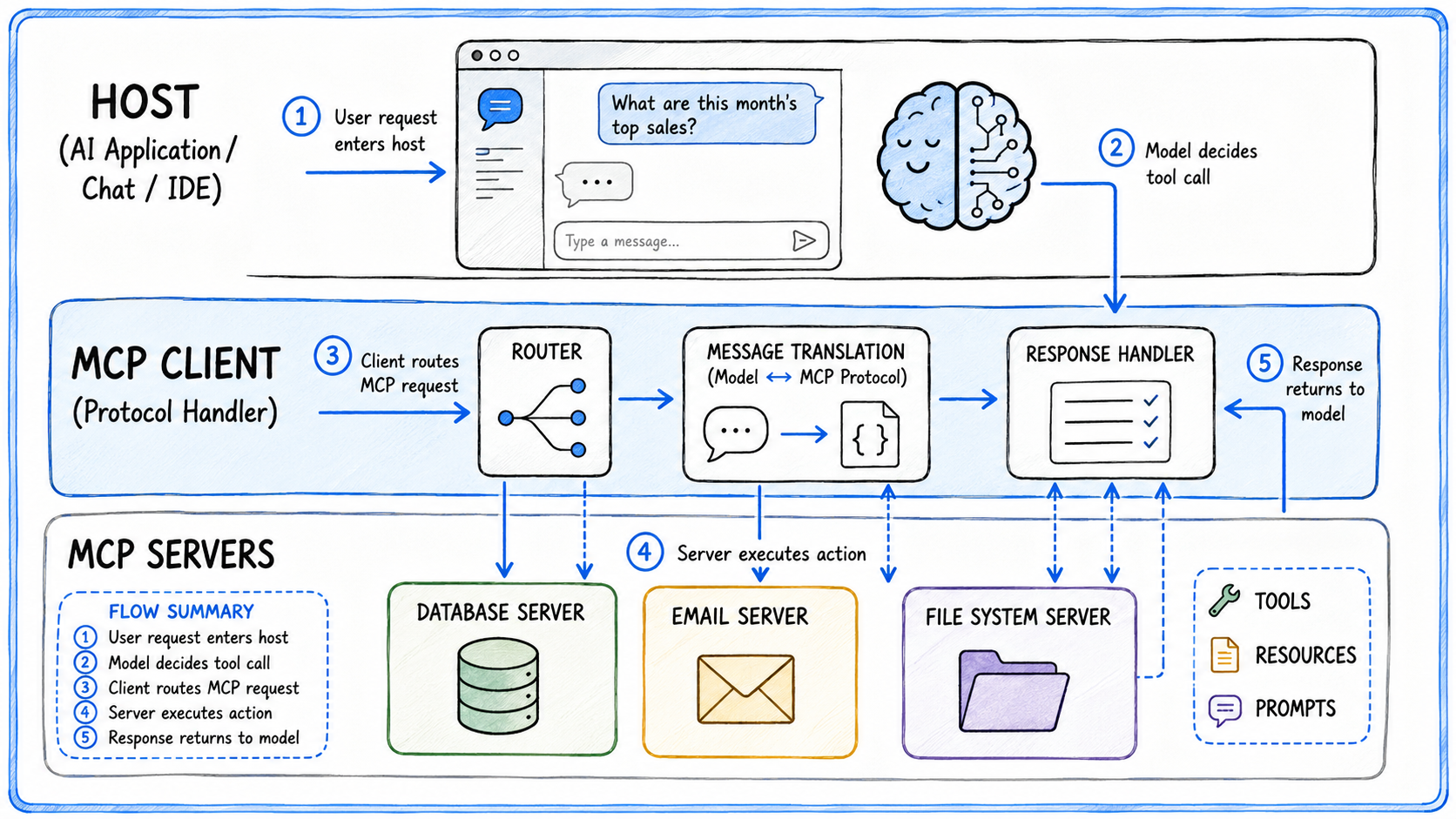
The architecture of MCP is divided into three distinct roles, each serving a specific function:
1. The Host (The Application)
The Host is the user-facing application (e.g., an AI chat interface). It is responsible for orchestrating the conversation and maintaining the state of the interaction. When the user asks a question requiring external data, the Host delegates the request to the Client.
2. The Client (The Protocol Handler)
The Client acts as the translator. It maintains a registry of available MCP servers and manages the communication flow. When the LLM decides it needs a specific tool, the Client translates that intention into a JSON-RPC request, sends it to the appropriate server, and packages the result back into a format the model understands.
3. The Server (The Capability Provider)
The Server is the "bridge" to the external world. It exposes three core capabilities:
- Resources: Static data (logs, files, or documentation) that the model can read.
- Tools: Executable functions (database queries, API calls) that the model can invoke to change the state of an external system.
- Prompts: Pre-defined, reusable templates that help the model interact with the system more effectively.
Security, Transports, and Future-Proofing
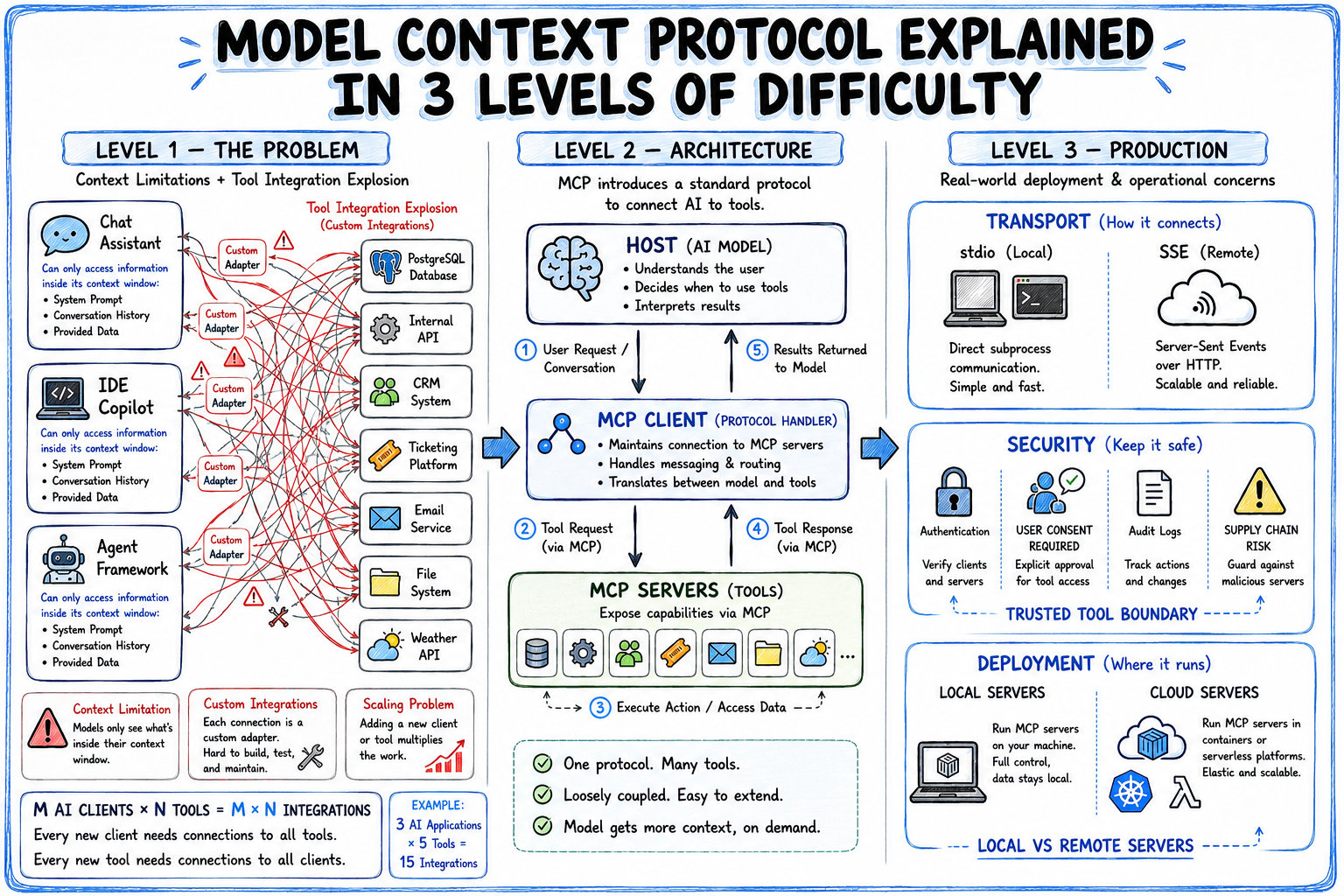
The strength of MCP lies in its transport-agnostic design. It currently supports two primary transport mechanisms: Standard I/O (stdio), which is ideal for local, secure communication between a process and its child (like an IDE running a local script), and HTTP with SSE (Server-Sent Events), which is designed for remote, scalable, and cloud-native deployments.
Best Practices for Production
As organizations move to integrate MCP into production environments, three pillars of security must be prioritized:
- Identity Propagation: Never rely on hard-coded API keys within the server. Use OAuth2 flows to ensure the model acts on behalf of the user, with the specific permissions that user possesses.
- Strict Scoping: Apply the "Principle of Least Privilege." If an MCP server provides access to a database, it should ideally use a read-only connection unless write access is explicitly required for a specific tool.
- Auditing and Logging: Since the MCP server is the gateway, it is the natural place to log every request. Keeping a detailed audit trail of what the AI agent has requested, when it requested it, and what data it received is vital for regulatory compliance.
Conclusion: The Path Forward
The Model Context Protocol is more than just a technical specification; it is the bridge between the "intelligence" of the LLM and the "reality" of the enterprise data stack. By standardizing the way AI interacts with external systems, MCP is effectively turning isolated models into connected, functional agents.
For the developer community, the message is clear: the era of building custom, fragile integration adapters is coming to an end. By adopting MCP, teams can spend less time writing "glue code" and more time building intelligent, agentic workflows that leverage the full power of their organization’s data. As the ecosystem matures and more pre-built servers become available, the barrier to entry for building complex, AI-powered applications will drop significantly, ushering in a new wave of autonomous, data-aware software.
The future of AI is not just about smarter models; it is about better-connected ones. MCP provides the framework to make that connection a reality.