Architects of Intelligence: Navigating the Divide Between Tools and Subagents
In the rapidly evolving landscape of Large Language Model (LLM) application development, architects face a pivotal crossroads: how to best extend the capabilities of an AI agent. As developers move beyond simple chatbots into the realm of autonomous agents capable of performing work, they inevitably reach a fundamental design inflection point. You have a complex task—such as executing an API call, searching a massive database, or performing a multi-step analytical workflow—and you must decide: should this functionality be implemented as a "Tool" or as a "Subagent"?
Choosing the wrong path leads to either a bloated, dysfunctional monolith that collapses under the weight of its own context window, or a fragmented, over-engineered system that suffers from excessive coordination overhead, latency, and nightmarish debugging cycles. This article provides a comprehensive framework for navigating this decision, ensuring your agent architecture remains performant, scalable, and manageable.
The Core Distinction: Execution vs. Reasoning
To build effective AI systems, one must first grasp the ontological difference between the two primary methods of task delegation.
What Tools Are
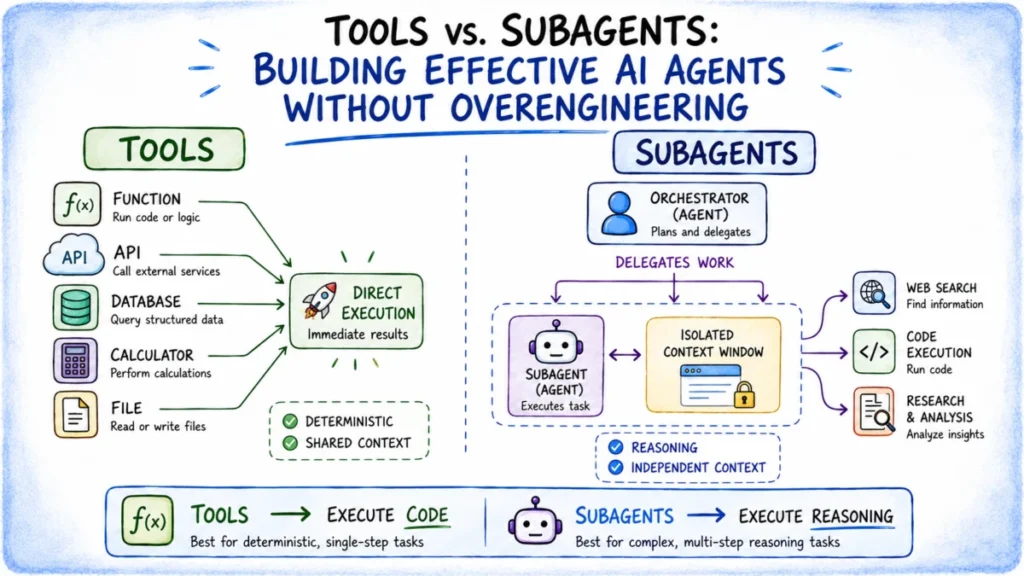
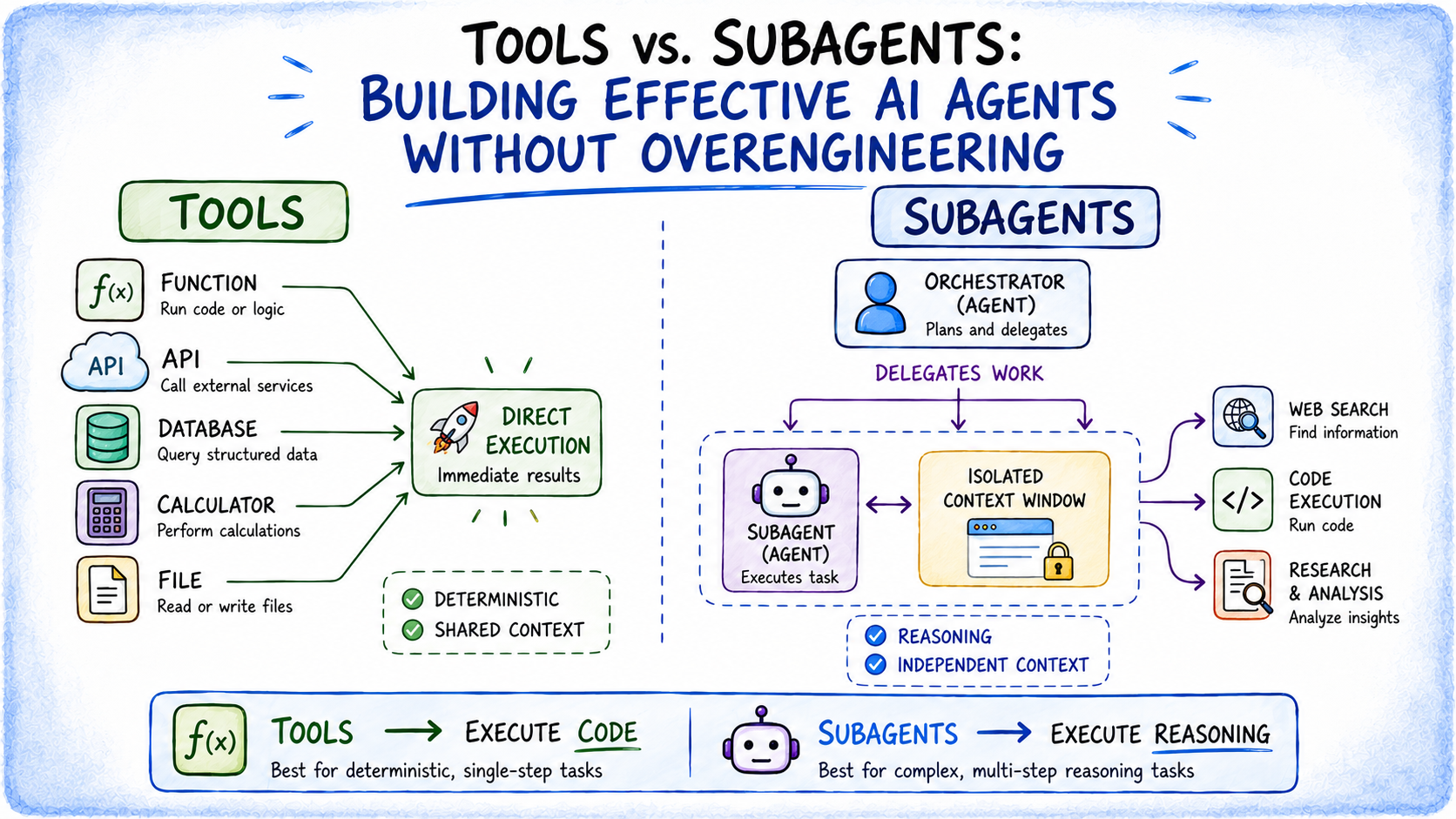
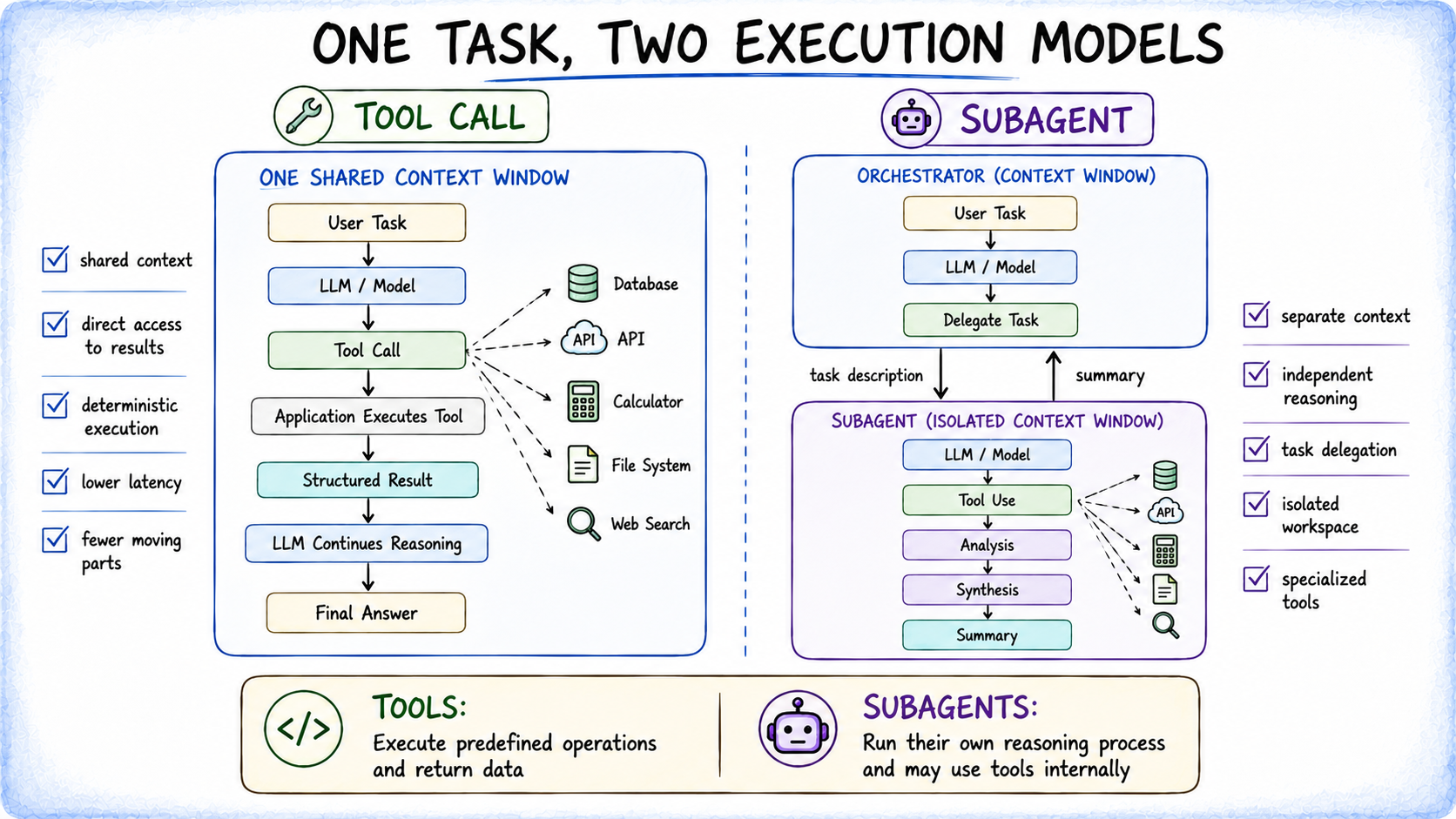
A Tool is a functional extension that allows an agent to interact with external systems. In essence, tools are "dumb" interfaces—functions, API wrappers, database queries, or file operations—exposed to the model through a rigid schema. When an agent calls a tool, it is not performing reasoning; it is triggering a deterministic execution. The model dictates when to pull the trigger, but the code defines how the action occurs. Because tools execute code directly, they are high-speed, cost-effective, and transparent.
What Subagents Are
A Subagent is a distinct, autonomous entity. When an orchestrating agent triggers a subagent, it is not simply executing a function; it is invoking an entirely separate LLM instance. This instance comes with its own system prompt, a dedicated context window, and its own unique set of tools. From the perspective of the "Manager" (the orchestrator), the subagent is a black box. You provide a prompt or a task description, and you await a synthesized conclusion. The subagent manages its own reasoning loop, its own state, and its own error-handling logic.
Chronology of an Architectural Decision
When designing an agentic system, the lifecycle of the architecture typically follows a predictable trajectory.
1. The Monolithic Start
Most projects begin with a single, highly capable agent. Developers start by adding tools to this agent’s repertoire. For a time, this is sufficient. The agent maintains a clean, singular context window where it can reason, execute a tool, and interpret the results.
2. The Complexity Threshold
As the requirements grow—perhaps the agent now needs to perform deep-web research or generate complex codebases—the agent’s context window begins to fill with "noise." The LLM struggles to maintain focus because the intermediate, high-volume data from multiple tool calls begins to drown out the original user objective. This is the moment the architect realizes that the "all-in-one" approach is failing.
3. The Shift to Delegation
This is the transition point where subagents are introduced. By offloading specific, high-reasoning tasks to a dedicated "expert" subagent, the orchestrator is freed from the burden of managing intermediate steps. The system transforms from a single-actor monologue into a multi-agent dialogue.
Supporting Data: When to Choose Which
The decision between tools and subagents should be governed by data-backed architectural principles rather than intuition. The following table highlights the objective trade-offs:
| Aspect | Tools (Deterministic) | Subagents (Reasoning-Based) |
|---|---|---|
| Primary Driver | Code execution | LLM inference |
| Context | Shared with orchestrator | Isolated (Clean) |
| Complexity | Low; single function call | High; multi-step loop |
| Latency | Minimal | Significant (multi-inference) |
| Transparency | Full; logs are granular | Partial; summarized output |
The "Python Function" Test
The most reliable heuristic for architectural design is the Python Function Test. If you can define the task as a standard Python function with clearly typed inputs and outputs, and the operation requires zero "thought" or subjective judgment, it should always be a tool. If the task requires a "Chain of Thought" or multiple iterative steps to reach a conclusion, it is a candidate for a subagent.
Official Perspectives: Avoiding the Overengineering Trap
Industry leaders in agentic development, including teams at Microsoft (AutoGen) and Anthropic (Claude Code), consistently warn against premature modularization. The "Overengineering Trap" occurs when developers fragment their systems into dozens of subagents before a legitimate need for isolation exists.
Every subagent you introduce adds a new point of failure. If you have ten subagents, you have ten times the surface area for "hallucinations," coordination errors, and context-loss bugs.
The Rule of Thumb:
- Default to Tools: Start with a lean architecture.
- Isolate to Scale: Introduce subagents only when you reach a specific limitation, such as:
- Context Saturation: When intermediate research data obscures the main objective.
- Tool Overload: When an agent has too many tools to effectively choose the right one (accuracy degrades as the "search space" of tools increases).
- Parallelism: When a task can be broken into independent, concurrent threads.
Implications for System Design
The "Task-In, Summary-Out" Contract
The secret to a stable multi-agent system is the definition of the communication contract. When passing tasks to a subagent, the orchestrator must provide a perfectly scoped instruction set. When the subagent returns a result, it should be a finalized, distilled summary.
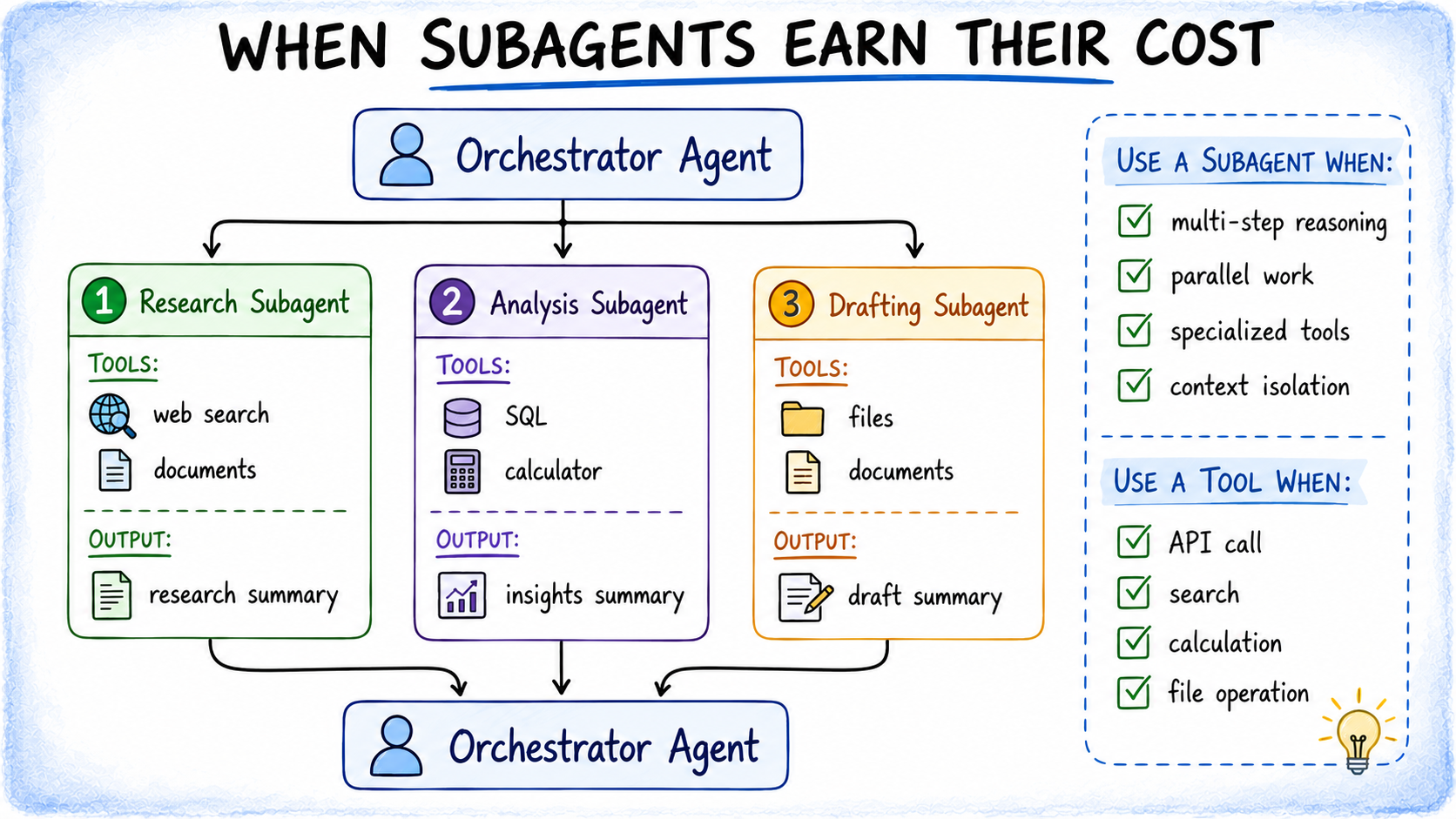
Systems that allow subagents to share mutable state or pass raw, un-synthesized logs back to the orchestrator are fundamentally broken. They recreate the very "context clutter" that subagents were meant to solve. Keep the boundaries rigid: Pass tasks down; pass conclusions back up.
Debugging and Observability
One of the most significant implications of this architecture is how you monitor performance. With tools, debugging is a matter of inspecting the execution logs of your code. With subagents, you are essentially debugging a "manager" and its "employees." You must implement rigorous logging at the handoff points to ensure that if a task fails, you can identify whether the failure was in the orchestrator’s instruction or the subagent’s internal reasoning.
The Future of Agentic Orchestration
As the industry matures, we are moving toward "Agentic Workflows" where the decision of whether to use a tool or a subagent may soon be handled by an orchestrator LLM itself. However, for current production-grade systems, the human architect must remain the primary arbiter of these boundaries.
Conclusion
The choice between a tool and a subagent is not merely a technical preference; it is an architectural commitment to the long-term maintainability of your AI system. By favoring tools for deterministic execution and reserving subagents for high-level reasoning and complex delegation, you build systems that are not only powerful but also resilient, debuggable, and scalable.
Avoid the allure of complex multi-agent "swarms" until your system demands them. Start simple, prioritize clear communication contracts, and remember that the most effective agent architectures are those that hide their complexity, not those that multiply it.