Beyond the Prompt: Mastering the Architecture of Context and Memory Engineering in Agentic AI
As artificial intelligence shifts from simple "question-and-answer" chatbots to autonomous, multi-step agents, the industry is encountering a recurring bottleneck. Developers are finding that their agents—even those powered by state-of-the-art Large Language Models (LLMs)—frequently lose the thread of complex tasks, hallucinate based on outdated information, or suffer from "context bloat" that degrades reasoning capabilities.
The source of these failures is rarely a single bug. Instead, it is a structural disconnect between two critical disciplines: Context Engineering and Memory Engineering. While often conflated, these two domains represent distinct architectural layers. Mastering the synergy between them is now the primary differentiator between experimental prototypes and production-grade agentic systems.
The Architectural Divide: Defining the Disciplines
To understand why agents fail, one must first distinguish between the ephemeral and the persistent.
Context Engineering: The Art of the Inference Window
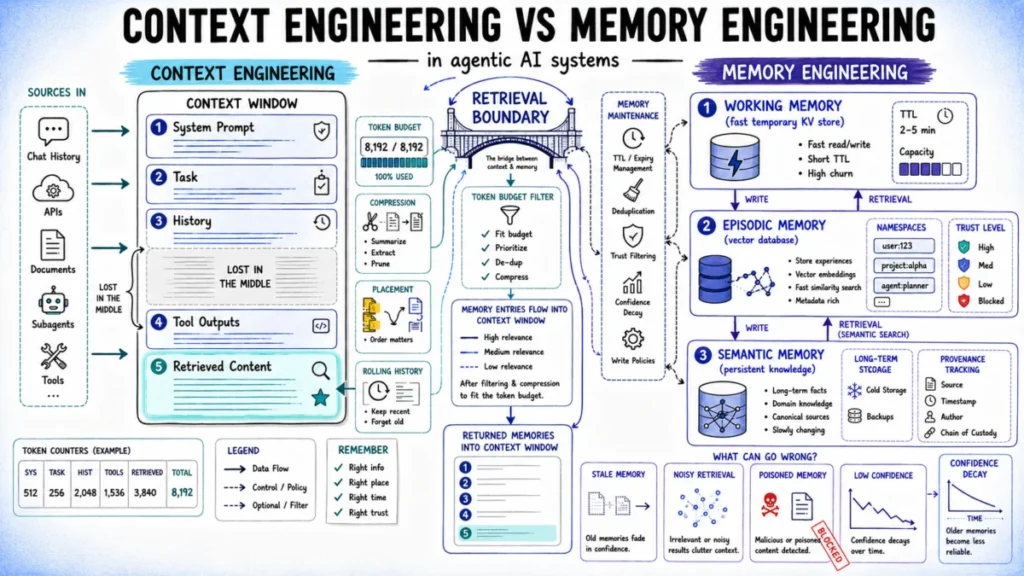
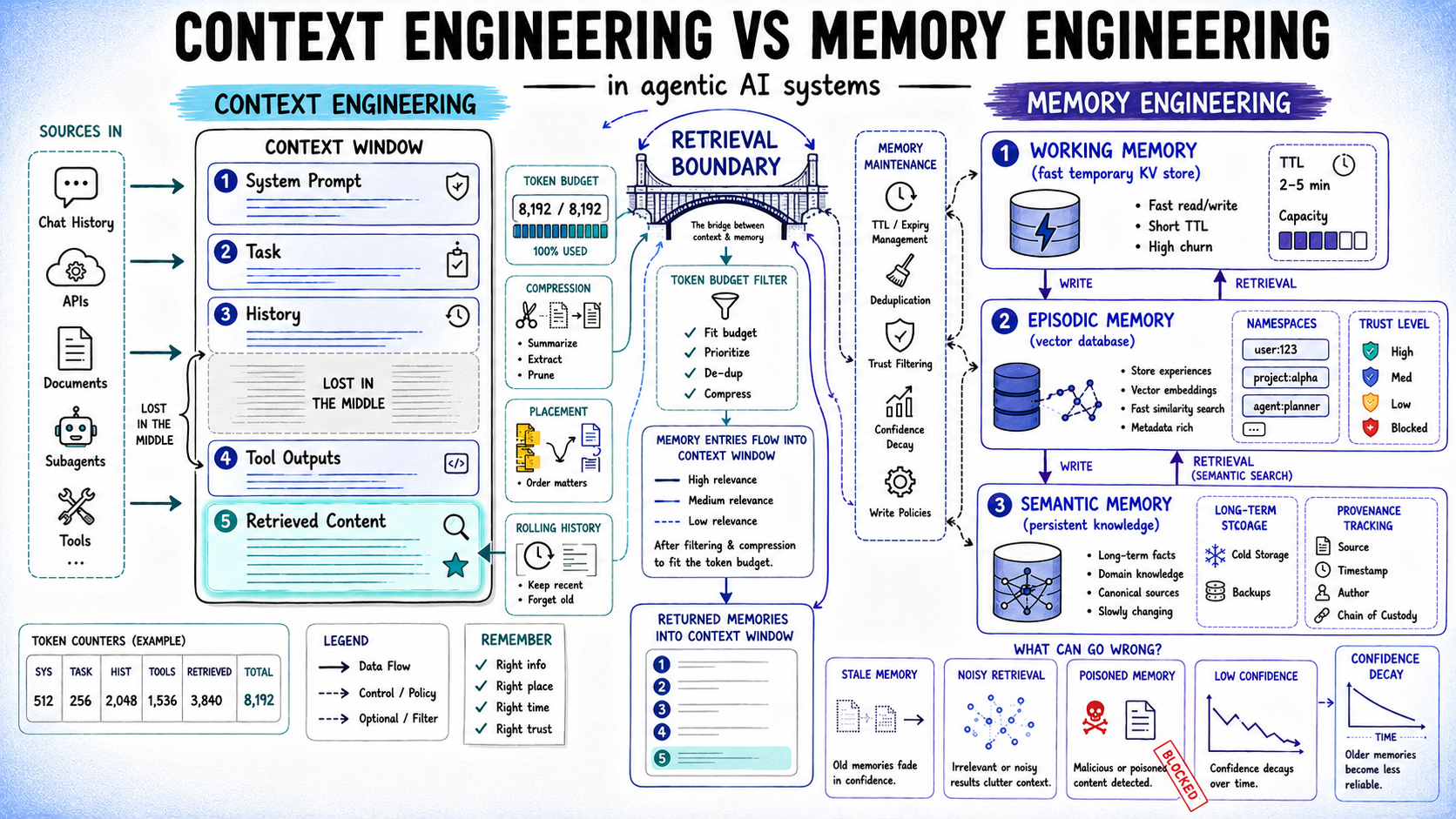
Context engineering is the science of the "now." It focuses exclusively on the design of a single inference call—the specific window of data an LLM processes to generate a response. Because every token sent to a model incurs a cost and consumes a finite "context window," every inclusion is a strategic trade-off. Context engineering dictates what information is prioritized, how it is compressed, and where it is positioned to ensure the model’s attention is focused exactly where it needs to be. It is an ephemeral process; once the model generates its output, the window effectively clears.
Memory Engineering: The Infrastructure of Persistence
In contrast, memory engineering governs the "long game." It deals with the systems and policies that allow an agent to retain information across sessions, days, or even weeks. This involves the architecture of external storage—vector databases, key-value stores, and relational caches—and the rigorous policies required to manage them. If an agent remembers a user’s preference from three weeks ago or references a document it synthesized yesterday, it is utilizing a sophisticated memory engineering stack.
The Chronology of Failure: Why Systems Break
The degradation of agentic systems typically follows a predictable lifecycle, starting from the point of deployment.
- Phase 1: The Honeymoon Period. The agent is built with basic RAG (Retrieval-Augmented Generation). It performs well because the data volume is small and the tasks are simple.
- Phase 2: The Bloat. As interaction frequency increases, the memory store grows. Without a maintenance policy, "noise" begins to accumulate.
- Phase 3: The Retrieval Conflict. The system retrieves more data than the context window can handle. The context assembler, lacking a budget, either truncates information arbitrarily or forces the model to process too much, leading to the "lost in the middle" phenomenon.
- Phase 4: Systemic Drift. The agent begins to hallucinate based on stale memories or conflicting facts, as there was no governance mechanism to prune or update entries.
Supporting Data: Comparative Framework
| Aspect | Context Engineering | Memory Engineering |
|---|---|---|
| Scope | Single inference call | Cross-call, session, and agent |
| Primary Goal | Optimal reasoning efficiency | Reliable persistence and recall |
| Key Metric | Token budget and attention weight | Signal-to-noise ratio (Precision/Recall) |
| Failure Mode | "Lost in the middle" attention loss | Poisoning, staleness, and memory bloat |
| Data Lifecycle | Volatile; discarded after request | Managed; governed by TTL and confidence |
Strategic Implementation: Best Practices
The Mechanics of Contextual Assembly
Effective context engineering requires a "Selective Inclusion" philosophy. Engineers must treat the context window as a luxury resource.
- Compression at Source: Rather than truncating long documents when the window is full, raw data (such as API logs or search results) should be summarized or abstracted before being injected into the prompt.
- Structural Hierarchy: Research confirms that LLMs prioritize information at the beginning and the end of the context window. Critical instructions and the current objective should be anchored at the top, while supporting retrieved context should be placed near the end, immediately preceding the generation point.
Designing a Resilient Memory Pipeline
Memory engineering must move beyond simple "store and fetch" patterns. A robust system requires a formal Write Policy.
- Confidence Scoring: Each memory entry should include a confidence score that decays over time, allowing the system to naturally "forget" facts that may no longer be true.
- Typed Memory Stores: Not all data is equal. Distinguishing between Working Memory (short-lived task state), Episodic Memory (past interaction records), and Semantic Memory (validated facts/preferences) allows for specialized retrieval strategies.
- Provenance Tracking: By attaching metadata to entries (source, timestamp, agent ID), developers can debug hallucinations by tracing a specific piece of information back to its origin.
Implications: The Retrieval Boundary
The "Retrieval Boundary" is the critical intersection where these two disciplines meet. It is the point where the memory system presents data to the context assembler.
The most common failure in modern agents is Retrieval Without a Context Budget. Many developers design retrieval systems that return a fixed number of documents (e.g., "top 5 results") without checking if those documents fit within the available token space of the current request. This leads to erratic behavior, where the agent is sometimes fed a full document and other times a truncated fragment, leading to inconsistent outputs.
The Solution: Implement Retrieval-Aware Context Assembly. The retrieval layer must be subservient to the context budget. Before fetching data, the system should calculate the remaining tokens available in the context window and limit the retrieval query to fit that exact space.
Implications for Future Agentic Workflows
As we move toward multi-agent systems, where one agent may act as a "manager" and another as a "worker," the requirements for memory become even more complex. Shared namespaces for cross-agent facts must be balanced against scoped namespaces to prevent "context pollution," where one agent’s internal state is accidentally exposed to another.
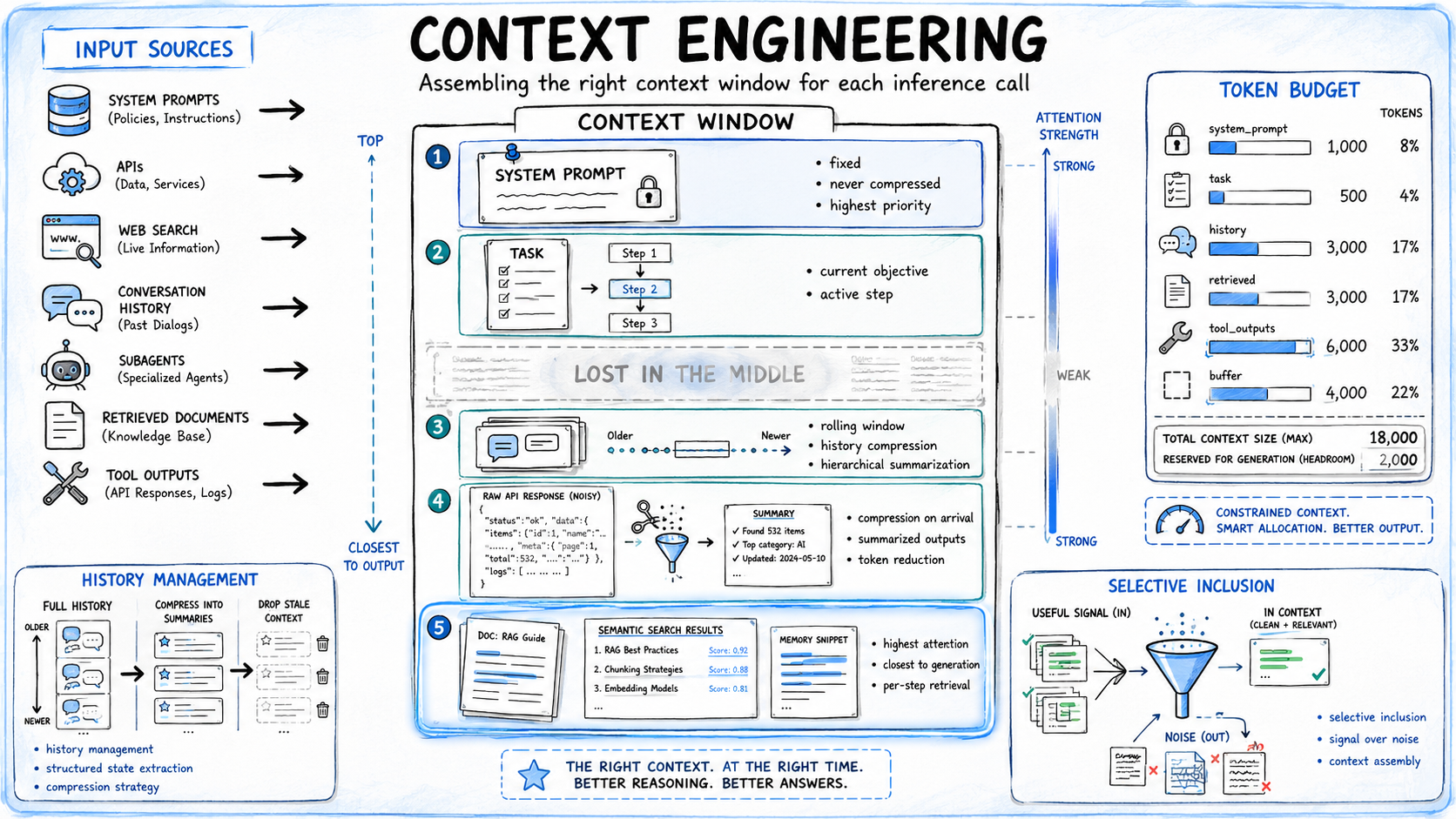
Furthermore, the industry is trending toward Structured State Extraction. Instead of storing raw conversation logs, advanced agents are now summarizing interactions into structured, typed objects. This reduces the dependency on fuzzy semantic search and increases the reliability of information recall.
Conclusion: Orchestrating the System
Context engineering and memory engineering are not separate silos; they are two gears in the same transmission. Context engineering is the precision instrument that guides the model’s immediate reasoning, while memory engineering provides the long-term intelligence that makes an agent useful over time.
For developers, the mandate is clear: Stop treating memory as a "dumping ground" for data and stop treating context as an "unlimited buffer." By implementing formal write policies, strict token budgeting at the retrieval boundary, and intentional structural placement, you can build agents that remain coherent, reliable, and capable of scaling across the most complex workflows.
The future of agentic AI does not lie in simply adding more data to the prompt; it lies in the elegant, disciplined management of what the agent sees, what it stores, and how those two worlds communicate.