The Architecture of Failure: Why AI Agent Projects Stumble and How to Engineer Resilience
In the rapidly evolving landscape of artificial intelligence, the transition from simple chat-based interfaces to autonomous AI agents represents a significant leap in utility—and a profound shift in risk. While large language models (LLMs) have become remarkably adept at generating text, an "agentic" system is expected to do much more: it must assess complex tasks, autonomously select tools, execute multi-step workflows, and recover from failures in real-time.
However, industry data reveals a sobering trend: most AI agent projects fail before they reach meaningful production scale. The culprit is rarely the underlying model itself; instead, it is a series of structural, architectural, and operational "anti-patterns." By examining why these systems collapse and how to rectify these common missteps, engineering teams can build agents that are not only powerful but also reliable and maintainable.
The Anatomy of Agentic Failure: Why Challenges Hit Harder
To understand why agents fail, one must distinguish them from standard LLM implementations. A traditional chatbot operates on a "prompt-and-response" cycle; if the output is incorrect, the interaction simply concludes. In contrast, an agentic system operates in a continuous loop.
When an agent falters mid-task, the failure propagates. If an agent calls a tool with incorrect parameters, that faulty output can corrupt subsequent steps or trigger an infinite loop of erroneous logic. Because agents accumulate state, a minor error in step two can lead to catastrophic failure by step five. This "blast radius" effect makes agent debugging inherently more complex than traditional software development, requiring a shift in how we perceive and mitigate risk.
Chronology of Common Anti-Patterns
The path to an ineffective AI agent is often paved with good intentions—specifically, the desire to build highly sophisticated systems from day one.
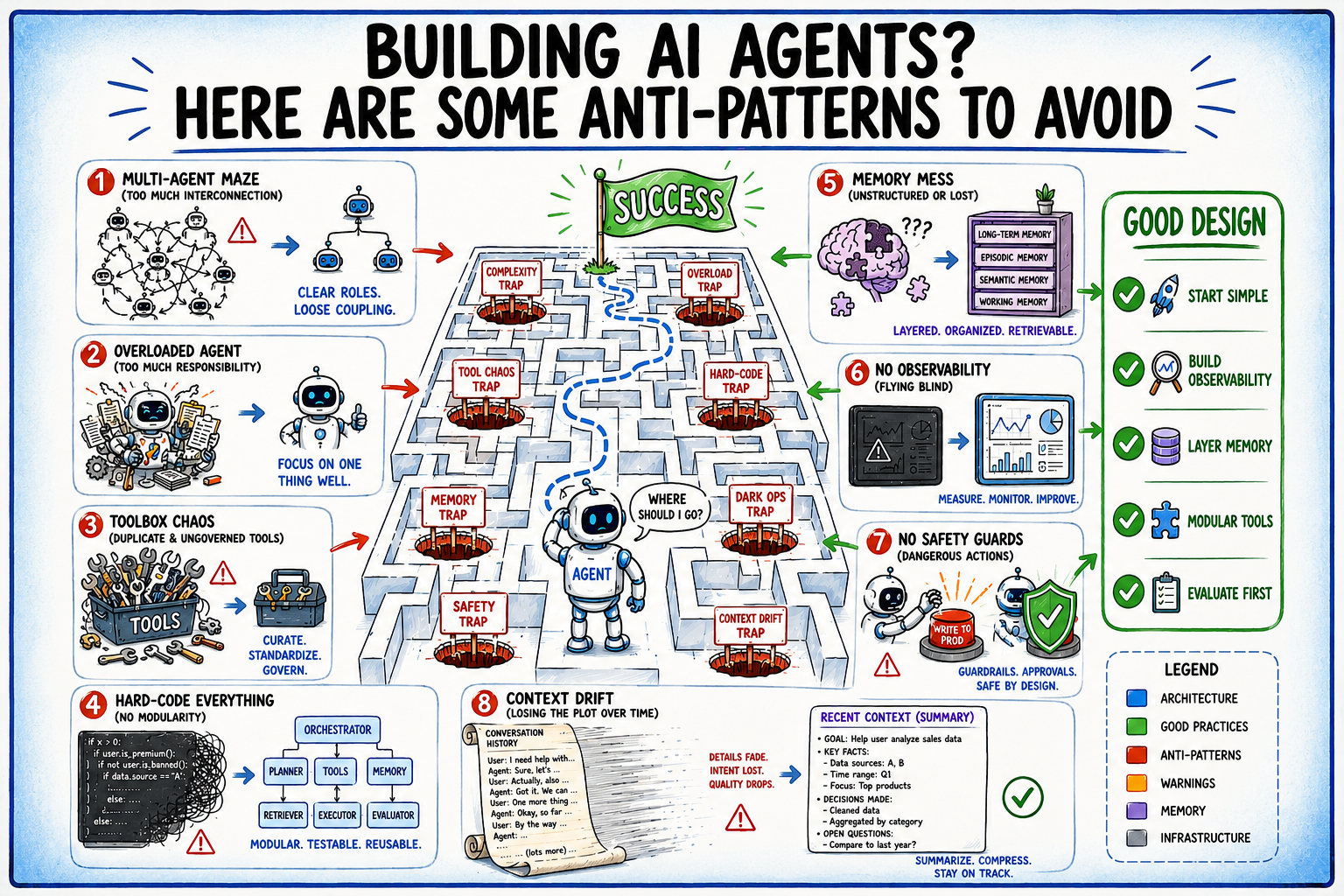
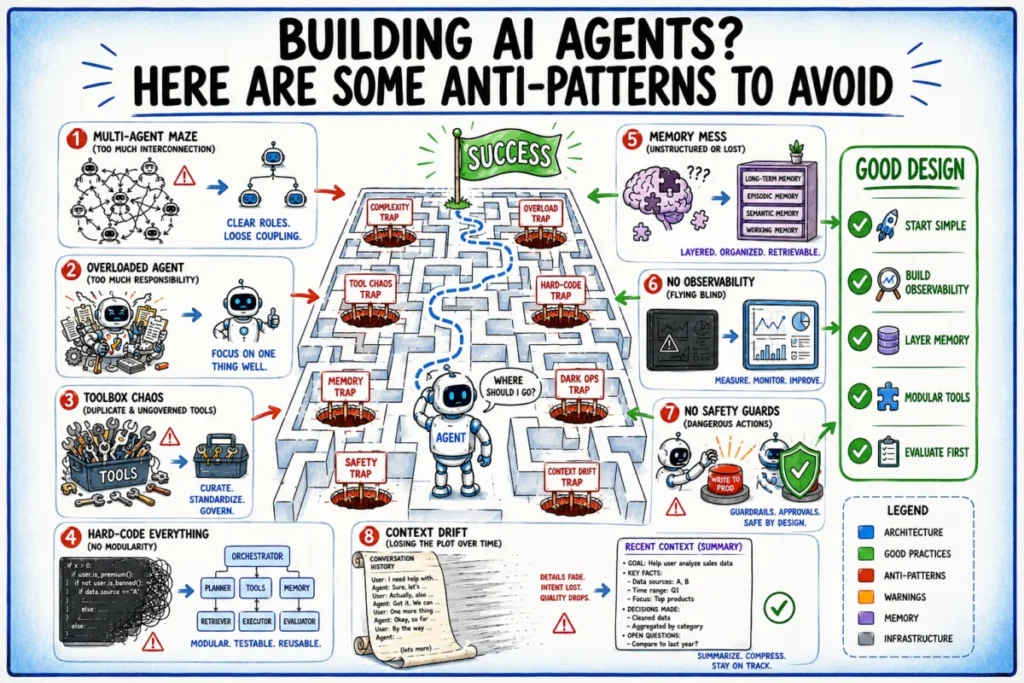
1. The Multi-Agent Trap: Complexity Before Validation
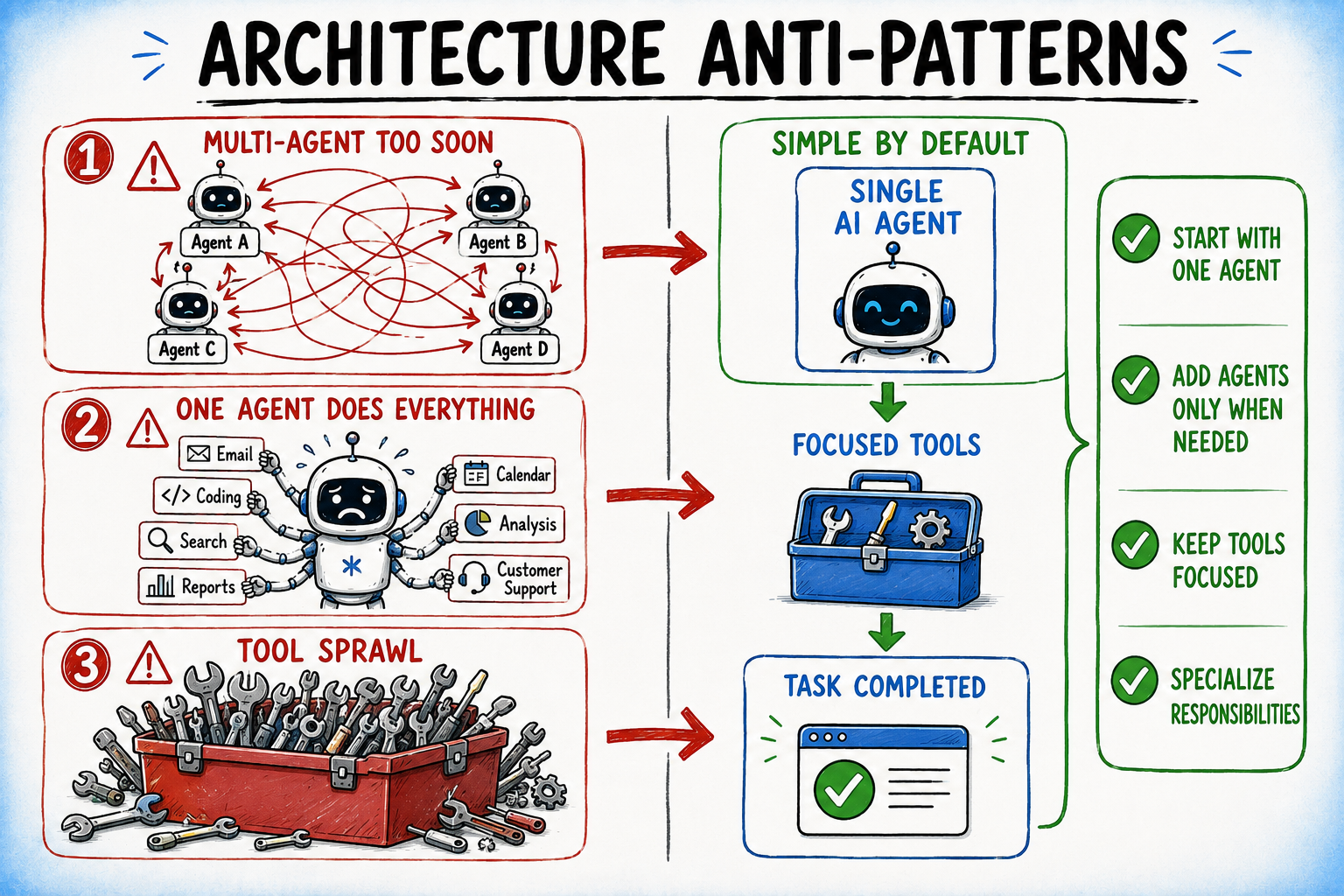
Many development teams, eager to emulate cutting-edge research, jump straight into complex multi-agent architectures, hierarchical orchestrators, and peer-to-peer collaboration frameworks. This is premature. Multi-agent systems introduce massive coordination overhead, exponentially increasing debugging difficulty and infrastructure costs.
- The Fix: Start with a single, highly refined agent. Only move to a multi-agent structure when specific sub-tasks have been identified that require distinct specialized reasoning paths.
2. The "Jack-of-All-Trades" Bloat
Another common failure is the "everything agent"—a single system burdened with fifteen disparate tools and sprawling instructions. When an agent is tasked with handling wildly different input types, its performance degrades across the board.
- The Fix: Optimize for specialization. By routing inputs to smaller, task-specific agents, you improve both accuracy and maintainability. Narrowing the scope of an agent’s responsibilities is the single most effective way to improve its reasoning capabilities.
3. Tool Sprawl: Distracting the Model
Every tool added to an agent’s manifest increases the "noise" the model must filter through during the reasoning phase. Too many tools, or tools with overlapping functionality, lead to confusion and poor decision-making.
- The Fix: Curate a minimal, purpose-specific tool set. If a tool isn’t necessary for the primary task, remove it.
Supporting Data: Architectural Integrity
Modern production environments demand modularity. A common point of failure is hardcoding logic directly into the agent’s core, which makes the system brittle and impossible to update without extensive refactoring.
Modular Design as a Foundation
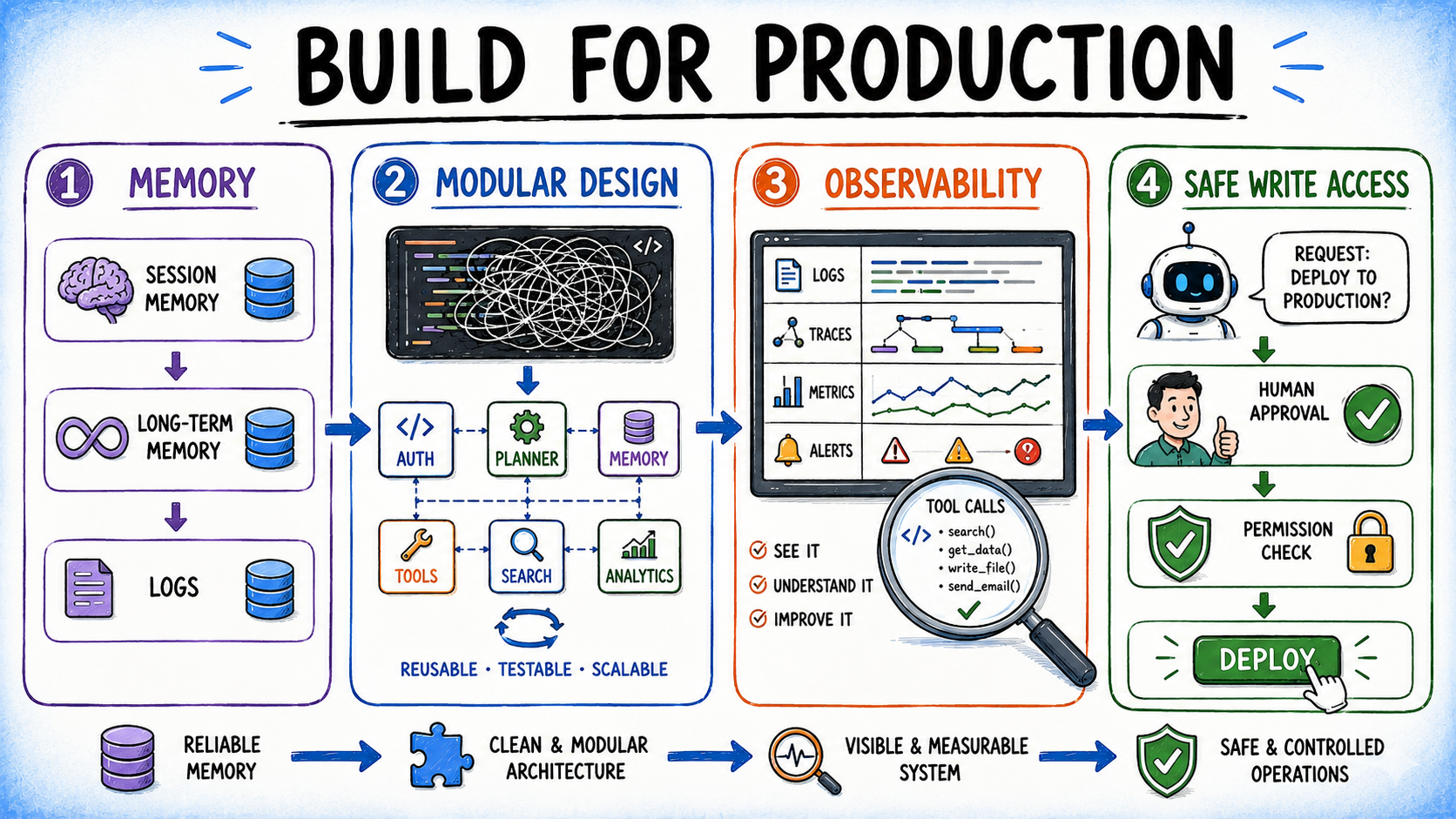
Effective agents are composed of discrete, swappable components. By keeping prompts in centralized configurations and treating tools as independent units, developers can update parts of the system without breaking the whole. This modularity is essential for long-term survival in production, where model updates and tool refactoring are constant.
The Necessity of Memory Architecture
Too many teams treat agent memory as a simple FIFO (First-In, First-Out) list of previous messages. This is insufficient for complex tasks. An agent requires a sophisticated memory hierarchy:
- Short-term memory (Session): For the immediate task at hand.
- Long-term memory (Knowledge base/Vector DB): For recalling past successes or historical data.
- Logs/Telemetry: For auditing the agent’s decision-making trail.
Without a deliberate memory design, context window overflow becomes a recurring production incident, leading to degraded performance and hallucination.
Official Perspectives and Industry Standards
Leading AI engineering research—from organizations like Anthropic and IBM—emphasizes that "observability" is not optional; it is the heartbeat of a stable agent.
When an agent is a black box, a production failure is a mystery. Developers need granular visibility into:
- The Prompt Chain: What instructions led to this decision?
- Tool Parameters: Exactly what was sent to the API?
- Reasoning Paths: How did the model arrive at this conclusion?
Without these insights, teams spend weeks debugging issues that could be resolved in minutes. Observability must be instrumented from the very first line of code.
Implications: The High Stakes of Autonomous Action
As agents gain more autonomy, the "ungoverned write access" problem becomes critical. If an agent has the ability to modify a database or communicate directly with users, its potential for harm is significant.
Guardrails and Permissioning
Development teams must distinguish between read-only operations and write-heavy actions. A best practice is to implement a "Human-in-the-Loop" (HITL) requirement for high-stakes actions, such as executing financial transactions or updating production records. By creating a clear permission boundary, developers can prevent "hallucinated" actions from causing real-world damage.
Addressing Context Drift
In long-running tasks, "context rot" is a silent killer. As the agent interacts with external systems, the data it holds may become stale. The context window should be treated as a finite, precious resource, not a bottomless bucket.
- Mitigation Strategies: Implement periodic summarization of long contexts, use response pagination to manage output size, and enforce strict token limits to prevent the model from losing its thread.
Conclusion: The Path Forward
Building successful AI agents is an exercise in restraint and rigorous engineering. The most effective agents are not those that attempt to be everything to everyone, but those that are designed with clear boundaries, robust memory, and comprehensive observability.
Summary Table: From Anti-Pattern to Best Practice
| Anti-Pattern | Strategic Fix |
|---|---|
| Multi-agent premature scaling | Start with a single agent; add complexity only upon data-driven justification. |
| General-purpose bloat | Specialize agents; route tasks based on intent. |
| Tool list sprawl | Keep toolsets lean, non-overlapping, and task-specific. |
| Hardcoded monolithic logic | Use modular, configuration-driven component design. |
| Lack of memory design | Implement layered memory (Session, Long-term, Logs). |
| Zero observability | Deploy with structured logging and distributed tracing. |
| Ungoverned write access | Implement permission boundaries and human-in-the-loop checkpoints. |
| Context rot | Use summarization and context editing to maintain accuracy. |
| Deployment without evaluation | Build rigorous adversarial testing frameworks before going live. |
The transition from a prototype to a production-grade agent requires moving away from the "magic" of LLMs and toward the discipline of traditional systems engineering. By avoiding these common architectural pitfalls and prioritizing observability and modularity, organizations can harness the true potential of agentic AI while mitigating the risks inherent in their autonomy. The goal is not just to build an agent that works, but to build one that continues to work as the environment around it changes.