The Agentic Shift: How Multi-Agent Swarms and MCP Protocols Are Redefining AI Engineering (Mid-2026)
The landscape of artificial intelligence has shifted beneath our feet. Only eighteen months ago, the prevailing wisdom in AI development centered on the "monolithic agent"—a singular, massive language model tasked with managing everything from complex planning and real-time reasoning to granular tool execution. Today, as we reach the midpoint of 2026, that paradigm has been largely discarded.
We are now witnessing the maturity of "Agentic AI" as a formal engineering discipline. The industry has moved away from brittle, manually orchestrated reasoning loops toward highly specialized, multi-agent swarms governed by standardized communication protocols. This evolution represents a maturation of the technology, moving from experimental "chat-bots that do things" to robust, enterprise-grade AI infrastructure.
1. The Death of Brute-Force Orchestration
In early 2025, engineers spent the vast majority of their time "prompt-engineering" their way out of logic failures. We relied on complex, hand-crafted ReAct (Reasoning and Acting) loops—external Python scripts that forced models to "think out loud," critique their own output, and iterate until a result was achieved.
These loops were notoriously fragile. They were high-latency, expensive in terms of token usage, and prone to "infinite loops" where an agent would become trapped in a recursive cycle of self-correction.
The Rise of Native "System 2" Thinking
The most significant change in 2026 is the integration of "System 2" thinking—the ability for a model to pause, deliberate, and explore multiple branches of logic before outputting a single token—directly into the base architecture of foundation models.
Modern models no longer require an external framework to force them to plan. They generate hidden "reasoning tokens" that handle the heavy lifting of self-reflection and error checking natively. For the software engineer, this is a massive win: the code we write no longer needs to be the "brain" of the operation. Instead, our role has shifted toward designing the "sandbox"—the environment in which these reasoning-capable models operate.
2. Chronology: From Scripted Agents to Swarms
The transition to the current architecture did not happen overnight. It followed a distinct, three-phase evolution:
- Phase 1: The Monolithic Era (2023–Early 2024): Developers attempted to build "God Agents." These were single, giant models tasked with dozens of tool calls. The result was frequent "context drift," where the agent would forget its primary objective after a few tool interactions.
- Phase 2: The Orchestration Era (Mid-2024–Early 2025): The rise of frameworks like LangChain and early iterations of AutoGPT. This was the era of "brittle chains," where developers manually stitched together prompts to compensate for the limitations of then-current models.
- Phase 3: The Swarm and Protocol Era (Late 2025–Present): The current industry standard. By decomposing tasks into small, specialized agents (micro-agents), developers have created systems that are easier to test, debug, and scale.
3. The Multi-Agent Swarm Architecture
The most successful production systems today are built as "swarms." By breaking a complex workflow into smaller pieces, developers avoid the bottleneck of a single model attempting to manage too many variables.
The Anatomy of a Swarm
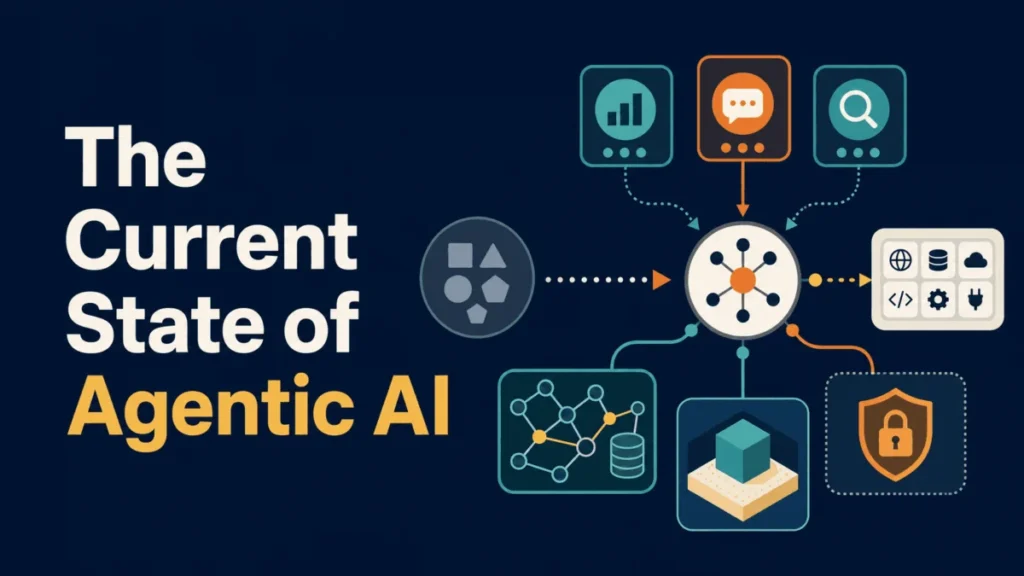
In a modern swarm architecture, you typically find three tiers of agents:
- The Triage Agent: A high-level router that interprets the user’s intent and delegates the task to the appropriate specialist.
- Specialist Agents: Highly focused entities that possess a minimal set of tools. For example, a "Data Fetcher" agent only has access to database read-queries, while an "Analysis Agent" only has access to a Python sandbox.
- The Memory Agent: An asynchronous background process that monitors the interaction and updates a persistent graph database (like Neo4j) to ensure the system "learns" from past executions.
This structure allows for "stateless-per-agent" design. Each agent is lightweight and disposable, while the "state" is managed by the system-level memory graph. This significantly reduces token overhead and improves response times, as each agent only needs to hold the context relevant to its specific mission.
4. Standardizing Connectivity: The Model Context Protocol (MCP)
Perhaps the most transformative development for AI engineers is the widespread adoption of the Model Context Protocol (MCP). Before MCP, connecting an agent to a real-world system—like a Slack channel, a Jira board, or a PostgreSQL database—was a bespoke nightmare. Every integration required custom JSON schema definitions and unique API wrappers.
MCP acts as a universal adapter. An agent built to the MCP standard can interface with any MCP-compliant server without the engineer needing to rewrite the underlying plumbing.
Implications for Enterprise Security
The standardization provided by MCP has also introduced new security challenges. Because agents can now pass context and control to one another through standardized interfaces, the "lateral movement" of a malicious prompt injection is a genuine concern.
Current industry best practices for securing these swarms include:
- Scoped Access Control: Ensuring that an agent interacting with a database cannot initiate transfers to agents that have access to external communication channels (like email).
- Human-in-the-Loop (HITL) Gateways: Requiring explicit human authorization for any action that crosses a defined "security boundary" within the swarm.
- Execution Sandboxing: Using containerization (Docker or similar) for every tool execution, ensuring that even if an agent is hijacked, it cannot interact with the host infrastructure.
5. Implications for the Future of AI Development
What does this mean for the future of the profession? First, the demand for "Prompt Engineers" is rapidly evaporating, replaced by the need for "AI Systems Architects."
From Prompting to Context Engineering
As models become more capable of reasoning, the value of the "prompt" diminishes. The real leverage now lies in Context Engineering. How do you structure the memory graph so that the swarm retrieves the right information at the right time? How do you define the swarm topology to minimize latency? These are traditional software engineering problems applied to a new medium.
The Competitive Advantage
Companies that are succeeding in 2026 are not those that are using the "smartest" model available. They are the ones with the most resilient, modular architectures. A swarm of thirty small, specialized agents that are well-orchestrated will outperform a single "frontier" model every time.
The modularity of these systems means that if a new, more efficient model is released, you can swap it into one of your specialist agents without needing to rebuild the entire swarm. This "hot-swappable" architecture is the key to maintaining a competitive edge in a fast-moving field.
Conclusion: The Path Ahead
We have reached a point where Agentic AI is no longer a research curiosity; it is a mature, deployable technology. The transition from monolithic agents to swarms represents a shift from "AI as a feature" to "AI as an infrastructure."
For teams just starting their journey, the advice remains consistent: do not attempt to build a monolithic agent. Start by designing a simple three-agent swarm—a triage agent, a data agent, and an analysis agent. By building small, instrumenting your systems, and utilizing standardized protocols like MCP, you will develop the architectural intuition necessary to build large-scale, intelligent systems that can operate reliably in production. The era of the "God Agent" is over; the era of the swarm has arrived.