Navigating the LLM Evaluation Landscape: A Strategic Guide to Quality Assurance in 2026
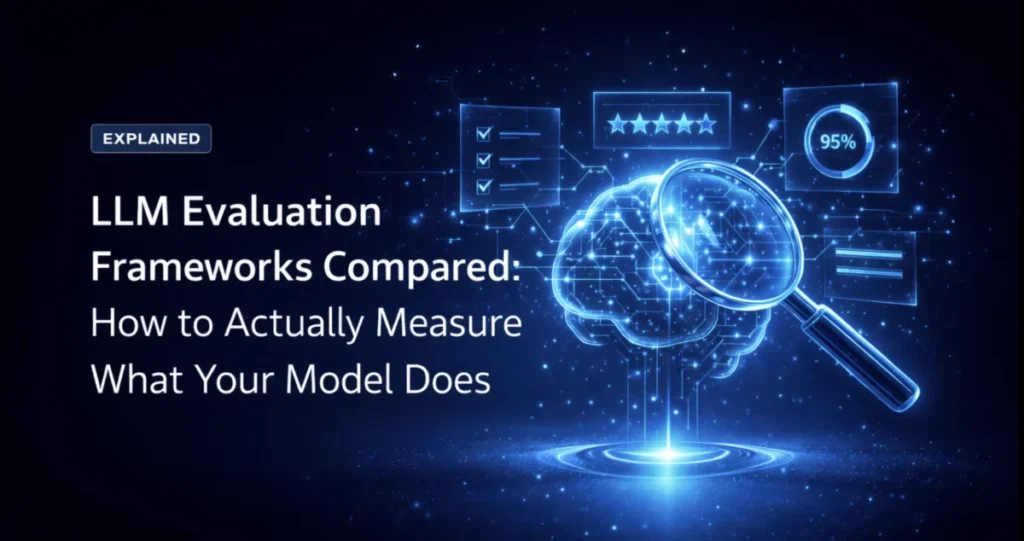
In the early days of generative AI, shipping a feature was often a "vibes-based" process. Developers would test a few prompts, observe that the output looked coherent, and push to production. Today, that approach is recognized as the single greatest risk to enterprise AI adoption. In 2026, the industry has matured, and the standard failure mode for LLM applications is no longer a crashing server or a stack trace—it is the "confidently incorrect" output that satisfies a human glance but fails in business logic or factual accuracy.
To solve this, the developer ecosystem has coalesced around three dominant open-source frameworks: RAGAS, DeepEval, and Promptfoo. While they are often discussed as competitors, the reality is more nuanced: they serve different phases of the software development lifecycle. This article explores how to deploy these tools, how to integrate them into a robust CI/CD pipeline, and—critically—how to audit the "LLM-as-a-judge" mechanism that powers them to avoid the inherent biases that plague automated evaluation.
The Core Problem: Why Traditional Testing Fails LLMs
Traditional software testing relies on deterministic assertions. If you expect an API to return a specific JSON object, you write a test that checks for that exact structure. LLMs, however, are probabilistic. They operate in a space of infinite variety, making binary pass/fail checks insufficient.
When an LLM hallucinates, it often does so with a tone of authority. A quick manual review by a product manager might miss a subtle factual error in a 500-word summary, but that error could be catastrophic in a legal or medical context. To mitigate this, the industry has adopted "LLM-as-a-judge," where a secondary, highly capable model evaluates the output of the primary model against a predefined rubric. While powerful, this mechanism is essentially "grading homework with another student," and it introduces its own set of statistical pitfalls that teams must manage.
Defining the Evaluation Stack: RAGAS, DeepEval, and Promptfoo
Before selecting a tool, teams must distinguish between three distinct types of evaluation:
- Retrieval-Augmented Generation (RAG) Evaluation: Measuring how well your system retrieves relevant information and incorporates it into the final answer.
- Application Logic Testing: Ensuring the LLM follows specific constraints, such as tone, length, or policy adherence.
- Red-Teaming and Security: Testing the model against adversarial prompts designed to elicit toxic content, jailbreaks, or data leakage.
The Specialized Trio
- RAGAS (RAG Assessment): This framework is the gold standard for RAG-specific pipelines. It focuses on metrics like Faithfulness (is the answer grounded in context?) and Context Recall (did we retrieve the right information?). It is highly research-oriented and academic in its rigor.
- DeepEval: Designed to feel like a native unit testing suite. It integrates seamlessly with
pytest, allowing developers to write "quality gates" that literally block a merge request if an LLM’s performance drops below a set threshold. - Promptfoo: The ultimate tool for iterative prompt engineering. It excels at running matrix-style tests where you compare multiple model versions or prompt variations across thousands of test cases. It is the preferred choice for red-teaming and security audits.
Chronology of an Evaluation Workflow
For a mature AI team, the evaluation process should follow a structured timeline:
- Development Phase (Promptfoo): Before code reaches the repository, developers use Promptfoo to run hundreds of variations. This allows for rapid A/B testing of system prompts and model configurations (e.g., GPT-4o vs. Claude 3.5 Sonnet).
- Continuous Integration (DeepEval): Once a prompt is "good enough," it is locked into a
pytestfile. Every time a developer pushes code, the CI pipeline triggers DeepEval to ensure that changes to the system haven’t degraded the model’s ability to follow core business policies. - Deployment and Retrieval (RAGAS): For RAG systems, RAGAS is used to continuously sample production traces. It calculates the fidelity of the retrieval pipeline, ensuring that the vector database is returning relevant chunks.
- Monitoring (LangSmith/Braintrust): Finally, production monitoring tools capture real-user interactions. These tools act as the "catch-all" for edge cases that never appeared in the lab.
Supporting Data: Implementing the "Faithfulness" Check
A common failure in RAG is the "plausible hallucination." The model provides a fact that sounds correct but is not in the source documents. To catch this, we decompose the answer into atomic claims.
Example Code: Atomic Claim Verification
import re

def decompose_claims(answer: str) -> list[str]:
    # Splits answer into independent statements
    sentences = re.split(r'(?<=[.!?])s+', answer.strip())
    return [s.strip() for s in sentences if s.strip()]

# In a real scenario, an LLM judge would verify these claims against
# the source context. The goal is to reach a faithfulness score
# calculated as: (supported_claims / total_claims).
When this logic is implemented via RAGAS, it provides a mathematical basis for trust. If a model adds a "plausible-sounding" detail about a population size that wasn’t in the context, the faithfulness score drops, signaling a hallucination that would have easily passed a human-eye test.
The "LLM-as-a-Judge" Bias: A Critical Warning
The most significant danger in current evaluation strategies is the assumption that the "judge" model is objective. Research has consistently shown that LLM judges suffer from three specific biases:
- Position Bias: Judges often prefer the answer that appears first (or last) in the list, regardless of quality.
- Verbosity Bias: Judges tend to rate longer, more verbose answers as "better," even if they are less accurate or concise.
- Self-Preference Bias: A model is statistically more likely to rate outputs generated by its own model family (e.g., GPT-4 rating GPT-4) as superior.
Mitigating Bias: The Audit Habit
To combat these, teams must implement a "Position Swap Audit." By running the same evaluation twice—swapping the order of the two candidate responses—you can measure the inconsistency rate. If the verdict flips when the order changes, your evaluation framework is providing "noise" rather than "signal."
The Golden Rule: If you are evaluating a specific model, do not use that same model as the judge. Use a stronger, more capable model (or a different family of models) to conduct the assessment.
Implications for Future Engineering
As AI systems become more autonomous, the distinction between "software engineer" and "AI quality engineer" will continue to blur. The implications for teams are clear:
- Stop Relying on Intuition: If you haven’t automated your evaluation, you are effectively flying blind. Manual review is a bottleneck that cannot scale.
- Invest in Synthetic Data: Creating high-quality "Golden Datasets" (question-answer pairs that serve as the ground truth) is more valuable than any specific framework. The quality of your evaluation is strictly limited by the quality of your test dataset.
- Build for Failure: Your system will hallucinate. Your goal is not to eliminate hallucinations entirely (an impossible task) but to ensure they are caught by automated gates before they reach the end user.
Conclusion
The selection of an evaluation framework is less about finding a "winner" and more about finding a workflow that fits your team’s velocity. Most mature teams will find that a hybrid approach—using DeepEval for its developer-friendly CI integration and RAGAS for its deep-dive into RAG fidelity—offers the best coverage.
Ultimately, the most important component of your evaluation strategy isn’t the software library you install; it is the skepticism you bring to the results. By acknowledging that LLM judges are biased and building in safeguards like position-swap audits, you move from a fragile "vibes-based" system to a rigorous, engineering-led AI production environment. The tools are ready—the question is whether your team is ready to hold them to a standard of measurable excellence.