Tool Calling vs. Code Execution: The Architectural Evolution of AI Agents
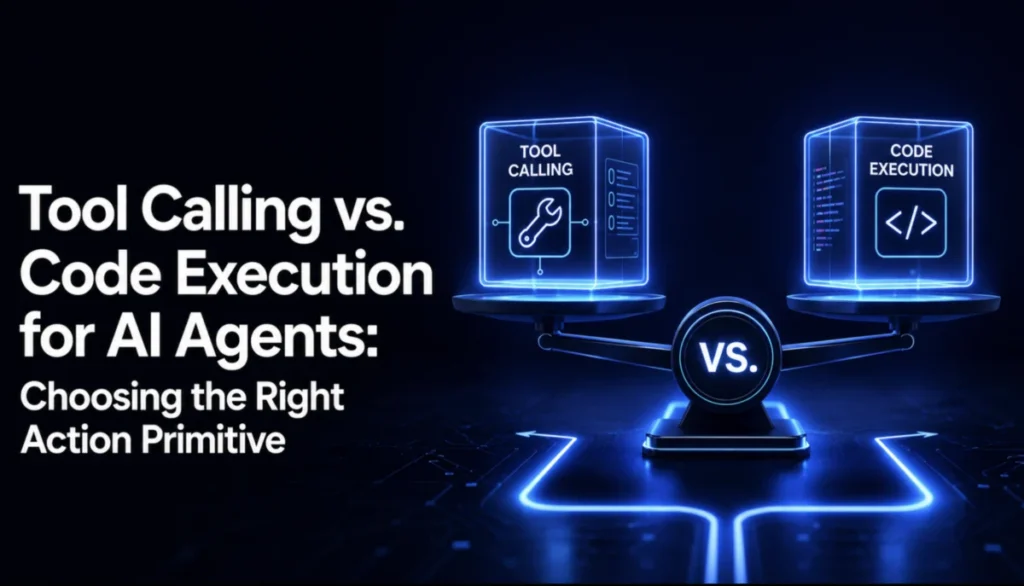
In the rapidly maturing field of agentic AI, the bridge between a model’s "thought process" and its real-world impact is defined by a critical architectural choice: the action primitive. Whether an agent is automating complex financial audits, managing cloud infrastructure, or simply fetching weather data, it must eventually interact with external systems.
Historically, developers have treated "tool calling" as the universal default. However, as agentic workflows grow in complexity, the limitations of this approach—specifically regarding latency, cost, and contextual "noise"—have become glaring. This article explores the fundamental divide between traditional tool calling and modern code execution, providing a definitive framework for engineers to choose the right mechanism for their specific use cases.
The Core Problem: Context Bloat and Efficiency
To understand the necessity of this choice, consider a practical scenario: an agent tasked with auditing Q3 travel expenses for twenty employees. To provide an accurate summary, the agent must process expense line items for each individual, including flights, hotels, and meals, cross-referencing them against departmental budget limits.
If designed using standard tool calling, the agent would execute twenty separate tool calls. Each call returns between fifty and one hundred line items, all of which must be injected into the model’s context window. This process generates over 2,000 line items and roughly 50KB of raw data. The model does not need to "read" this data in a human sense; it simply needs to calculate a sum. Yet, in a standard tool-calling architecture, the model is forced to digest every byte, driving up token costs and increasing latency.
This is the hidden cost of agent design: when the mechanism for taking action is inefficient, the "intelligence" of the model is wasted on data processing rather than reasoning.
What Is an Action Primitive?
An action primitive is the fundamental mechanism that allows a large language model (LLM) to bridge the gap between digital reasoning and real-world execution. It is the conduit for database writes, API requests, and file system operations.
Chronology of Development
- The Era of Prompt-Based Actions (2022-2023): Early agents relied on natural language outputs that were parsed via regex or basic text processing to trigger functions. This was brittle and prone to hallucination.
- The Rise of Tool Calling (2023-2024): Frameworks standardized the process. The model produces a structured JSON payload bounded by special tokens. The host application intercepts these tokens, executes the code, and feeds the result back into the chat history.
- The Emergence of Code Execution (2025-Present): Pioneered by patterns like Anthropic’s "Programmatic Tool Calling," this approach allows the model to write and execute entire scripts within a sandboxed environment, returning only the final, processed output to the model.
Understanding Tool Calling: The Auditable Loop
Tool calling remains the industry standard for a reason: transparency. When a model generates a tool call, it creates a discrete, loggable event.
The Mechanics
When a model determines that an external function is required, it outputs a specific JSON object. The orchestration layer—the "host"—pauses the generation, parses the schema, executes the function, and injects the output back into the conversation context as if the user had provided it.
Strengths:
- Simplicity: It is easy to implement and debug.
- Auditability: Every action is a distinct step, making it trivial to trace why an agent took a specific path.
- Contextual Awareness: The model sees every result, which is ideal when the agent needs to analyze intermediate findings to decide its next move.
Limitations:
- High Token Overhead: Since every intermediate result is injected into the prompt, context windows fill up rapidly.
- Latency: Each tool call requires a full round-trip of request-response cycles between the model and the environment.
Code Execution: The Power of Programmatic Abstraction
Code execution represents a paradigm shift. Rather than requesting one action at a time, the model writes a complete script—incorporating loops, logic, and error handling—that runs in a secure, isolated sandbox.
The Mechanism of Programmatic Tool Calling
With the introduction of the allowed_callers field, developers can define tools that are accessible to the code-execution environment. When the agent is tasked with a complex problem, it writes a Python script that calls these tools internally. The orchestration layer runs the code, and the LLM sees only the final result of that script.
Implications:
- Data Privacy: Large datasets or sensitive PII (Personally Identifiable Information) can be processed within the sandbox without ever being exposed to the model’s primary context window.
- Efficiency: Complex aggregations that would require dozens of model-orchestrated steps are compressed into a single, high-speed execution.
Supporting Data: The Case for Efficiency
The transition to code execution is not merely a stylistic choice; it is backed by empirical performance data.
- Token Reduction: Anthropic reported that migrating a standard document-processing workflow from a multi-step tool-calling approach to a code-execution pattern resulted in a 98.7% reduction in token usage (from 150,000 to 2,000 tokens).
- Improved Accuracy: According to data from the GAIA (General AI Assistants) benchmark, agents utilizing code execution showed a marked improvement in success rates, climbing from 46.5% to 51.2%.
- Academic Validation: The CodeAct research paper (Wang et al., 2024) demonstrated that agents using executable code as a primary primitive succeeded up to 20% more often on complex, multi-step reasoning tasks compared to those relying on standard tool-use patterns.
Decision Framework: Choosing Your Primitive
When architecting an agent, the following table serves as a guide for selecting the appropriate primitive based on the specific task requirements.
| Factor | Favors Tool Calling | Favors Code Execution |
|---|---|---|
| Call Frequency | Low (Single-shot) | High (Fan-out/Aggregations) |
| Result Usage | Model needs to "reason" over results | Results are purely functional/data-driven |
| Sensitivity | Low | High (Requires isolation) |
| Infrastructure | Minimalist/Standard | Robust Sandboxing Required |
| Auditability | High (Step-by-step logs) | Low (Aggregate focus) |
Official Perspectives and Industry Trends
Major AI labs, including Anthropic and OpenAI, have signaled that the future of agentic AI is hybrid. Anthropic’s latest documentation suggests that developers should not view these primitives as mutually exclusive.
Instead, the modern agentic stack utilizes a "layered" approach:
- Tool Search: Identifying the correct function from a vast library.
- Tool Use Examples: Providing "few-shot" guidance for the model to understand complex schemas.
- Dynamic Selection: Using standard tool calls for simple queries and escalating to code execution for complex, data-intensive tasks.
The consensus among researchers is that the bottleneck for modern agents is no longer the model’s intelligence, but the orchestration logic. By offloading the "heavy lifting" of data manipulation to code, developers allow the model to dedicate its computational resources to higher-level decision-making.
Conclusion: The Infrastructure of Tomorrow
The choice between tool calling and code execution is an infrastructure decision that dictates the scalability, cost, and reliability of your agent. While tool calling remains the gold standard for simple, transparent interactions, code execution is the necessary evolution for agents operating at scale.
As we move toward more autonomous systems, the "best" agent will be the one that knows when to act as a human-like communicator (using tool calls to reason) and when to act as a software engineer (using code execution to process). By mastering both primitives, developers can build agents that are not only more efficient and cost-effective but also capable of tackling the complex, multi-layered tasks that define the next generation of AI software.
The goal is not to force every task into a single mold, but to recognize that the most sophisticated agent is the one that uses the right tool—and the right primitive—for the job.