Temporal Intelligence: Mastering Fact Freshness in Graph-RAG Architectures
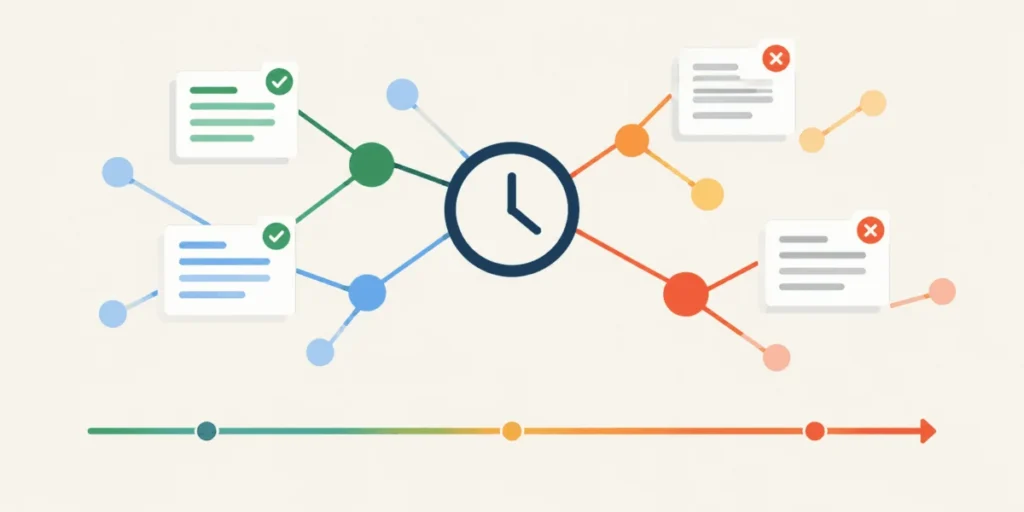
In the rapidly evolving landscape of Retrieval-Augmented Generation (RAG), the ability to retrieve information is no longer the primary bottleneck. The true challenge lies in the "temporal validity" of that information. As Large Language Models (LLMs) are deployed in increasingly dynamic environments—ranging from corporate intelligence to real-time market analysis—the inherent "timelessness" of standard knowledge graphs has become a significant liability.
In this deep dive, we explore how to move beyond static, context-independent triples by implementing a lightweight temporal reasoning layer. This architecture allows a Graph-RAG system to distinguish between obsolete data and current reality, effectively neutralizing the risk of LLM hallucinations caused by stale facts.
The Problem: The "Timeless" Fallacy in Knowledge Graphs
Standard Knowledge Graphs (KGs) are built upon the foundation of Subject-Predicate-Object (SPO) triples, such as (TechCorp, HAS_CEO, Alice). While elegant in their simplicity, these triples exist in a vacuum. They carry no inherent notion of duration or expiration.
In the real world, entities are fluid. Executives change, policy stances shift, and market conditions fluctuate. When an LLM is presented with conflicting information—for instance, three different CEOs for the same corporation—without a temporal filter, it often defaults to a stochastic guess. This is the primary driver of hallucinations in enterprise RAG systems. To build a robust system, we must treat information not as static truth, but as a time-bound observation.
A New Framework: The Temporal Quadruple
The transition from a static system to a dynamic one begins by upgrading SPO triples to "Temporal Quads." By appending a timestamp to every fact, we transform our data structure into a temporal graph: (Subject, Predicate, Object, Timestamp).
Implementing the TemporalGraph Class
To operationalize this, we define a Python structure capable of maintaining a historical ledger of facts. This class does not merely store the latest truth; it preserves the evolution of the entity over time, allowing the system to "time travel" to any point in the past.
import datetime
import math

class TemporalGraph:
    def __init__(self):
        # Data is stored as: Subject -> Predicate -> List of (Object, Date)
        self.knowledge_base =

    def add_fact(self, subject, predicate, obj, date_string):
        """Adds a time-stamped fact to the knowledge base."""
        fact_date = datetime.datetime.strptime(date_string, "%Y-%m-%d").date()
        if subject not in self.knowledge_base:
            self.knowledge_base[subject] =
        if predicate not in self.knowledge_base[subject]:
            self.knowledge_base[subject][predicate] = []

        self.knowledge_base[subject][predicate].append((obj, fact_date))
        print(f"Added: subject predicate obj (as of date_string)")
This class acts as the ingestion layer. By capturing the date_string, we create a longitudinal record of every assertion, which is essential for auditability and reasoning.
Chronology and Data Dynamics: The Case Study
To test our system, we simulate a period of corporate instability. Consider a tech company where leadership roles shift rapidly.
- January 15, 2021: Alice is appointed CEO.
- November 17, 2023: Bob is appointed CEO.
- November 19, 2023: Charlie is appointed CEO.
- November 21, 2023: Bob returns as CEO.
In a traditional database, querying "Who is the CEO?" would return all four results, creating ambiguity. Our TemporalGraph allows us to filter these based on the query context.
Supporting Data: Mathematical Weighting via Exponential Decay
How do we rank these facts? Simply picking the most recent fact is often too aggressive; sometimes, older facts provide context that is still relevant. We utilize an exponential decay function to calculate "recency weights."
The logic is straightforward: a fact’s weight follows the formula $w = 0.5^(age / half_life)$. If we set a half-life of 365 days, a fact exactly one year old retains 50% of its "truth weight." A fact from today is weighted at 1.0.
def calculate_recency_weight(fact_date, query_date, half_life_days=365):
    """Calculates a score between 0 and 1 based on temporal decay."""
    age_in_days = (query_date - fact_date).days
    if age_in_days < 0:
        return 1.0
    return round(0.5 ** (age_in_days / half_life_days), 4)
This ensures that while the most recent information is prioritized, the system acknowledges the entire history of the entity, providing a nuanced perspective to the LLM.
Implications for RAG Architecture
Integrating this temporal layer into a 3-tiered Graph-RAG system changes the retrieval pipeline from a passive search to an active reasoning process.
1. Pre-Prompt Filtering
Before a query is ever sent to the LLM, the retriever interacts with the TemporalGraph. It sorts candidate facts by their weight. Instead of the LLM receiving a "noisy" context full of outdated information, it receives a curated set of high-confidence, temporally relevant facts.
2. Eliminating Guesswork
By handling the temporal logic at the retrieval level, we shift the burden away from the LLM. The LLM no longer needs to deduce which fact is the "latest" based on linguistic cues in the source text; it is provided with the filtered, ranked truth. This drastically reduces the computational cost and the surface area for hallucinations.
3. Parameter Sensitivity
The half_life_days parameter is the system’s "temporal sensitivity." In highly volatile environments (like crypto-markets or live incident response), a short half-life (e.g., 7 days) is essential. In stable environments (like historical archives), a long half-life (e.g., 10 years) is more appropriate. Fine-tuning this parameter allows the system to be calibrated for the specific domain it serves.
Future Outlook: Beyond Simple Decay
While the exponential decay model provides a robust baseline, future iterations of this system could incorporate confidence scores derived from the reliability of the source. For example, a fact extracted from a primary regulatory filing should hold more weight than one from a secondary news article, regardless of the date.
Furthermore, this architecture can be extended to handle "temporal intervals" rather than just points in time. For example, tracking when an executive’s contract began and ended allows for more complex reasoning, such as identifying the specific individual responsible for a policy decision during a specific fiscal quarter.
Conclusion: A New Standard for Enterprise RAG
The transition from static knowledge to temporal intelligence is a necessary evolution for any organization relying on AI to interpret complex, shifting data. By implementing a lightweight temporal reasoning layer, we turn our Graph-RAG systems into reliable, "time-aware" agents.
As we continue to push the boundaries of what LLMs can achieve, we must move away from the assumption that the world is a static set of facts. Instead, we must embrace the fluidity of information. By treating time as a first-class citizen in our data architecture, we ensure that our AI models remain grounded, relevant, and accurate—regardless of how fast the world changes around them.
Technical Implementation Summary:
- Data Structure: Upgraded from SPO to Temporal Quads.
- Reasoning Engine: Implemented via exponential decay weighting.
- Integration: Designed to act as a pre-LLM filter in 3-tiered RAG architectures.
- Performance: Low-latency; suitable for real-time inference in production environments.