Automating Knowledge Graph Population: From Unstructured Text to Deterministic AI Insights
In the rapidly evolving landscape of Large Language Models (LLMs), the primary obstacle to enterprise-grade adoption remains the persistent challenge of "hallucinations"—the tendency of generative models to confidently fabricate facts. While Retrieval-Augmented Generation (RAG) using vector search has become the industry standard for grounding, it often lacks the precision required for complex, multi-hop reasoning.
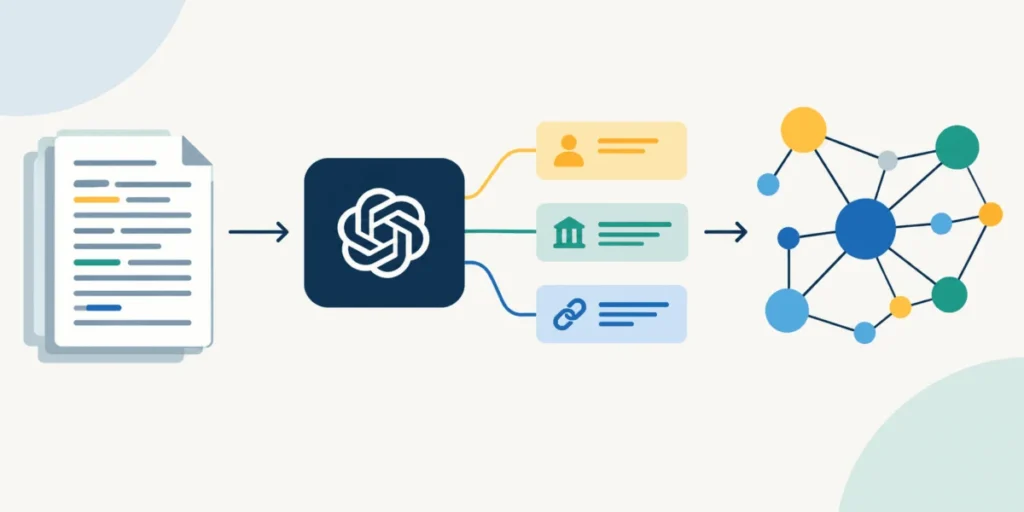
Enter the deterministic 3-tiered Graph-RAG system. By integrating structured knowledge graphs with traditional vector search, developers can enforce a "source-of-truth" layer that significantly mitigates factual drift. However, a bottleneck remains: how do we populate these knowledge graphs without manual, labor-intensive data entry? This article explores a fully automated, cost-effective pipeline to extract structured knowledge from raw text using local LLMs via Ollama, transforming narrative prose into machine-readable SPOC (Subject-Predicate-Object-Context) quads.
The Architecture of Knowledge: Understanding SPOC Quads
Traditional knowledge graphs rely on RDF triples—Subject, Predicate, and Object. While effective, they often lack provenance. In an enterprise AI environment, knowing why a fact is true and where it originated is as important as the fact itself.
The SPOC quad model adds a fourth dimension: Context. By storing a quad as (Subject, Predicate, Object, Context), we gain the ability to trace data back to its source, manage conflicting information, and enable temporal filtering. For example, a fact extracted from a 2023 Wikipedia entry regarding a sports team’s roster is stored with a unique context key, allowing the RAG system to prioritize this data over outdated information.
Chronology of the Extraction Workflow
The transition from unstructured text to a populated knowledge graph involves a systematic, multi-step pipeline.
- Environment Initialization: Leveraging the Ollama engine, we deploy the Llama 3.2 model locally. This ensures that sensitive data never leaves the local environment and that the extraction process is entirely free of API-usage costs.
- Data Acquisition: Using Python’s
wikipedialibrary, we programmatically pull raw text from specific articles, bypassing the need for manual copy-pasting. - Structured Inference: We instruct the LLM to process this narrative text and output a strictly formatted JSON object. By enforcing JSON-only output, we ensure that the subsequent parsing logic remains robust and error-free.
- Quad Normalization: The parser processes the raw JSON, cleans the keys, and wraps the extracted triples with the appropriate context label, effectively converting them into SPOC quads.
- Graph Persistence: The final quads are pushed into a local
QuadStore, a lightweight Python-based database that facilitates fast, deterministic queries for downstream RAG applications.
Technical Implementation and Setup
To begin, ensure you have Ollama installed. Whether you are operating in a Google Colab environment or a local IDE, the process is streamlined via Python.
Installing Dependencies
You will require wikipedia for data gathering and requests to interface with the local Ollama server.
!pip install wikipedia requestsInitializing the Local Model
The following script ensures that the Ollama server is running and that the Llama 3.2 model is pulled and ready for inference:
import subprocess
import time

# Starting the server as a background process
process = subprocess.Popen(["ollama", "serve"], stdout=subprocess.DEVNULL, stderr=subprocess.DEVNULL)
time.sleep(3)

# Pulling the Llama 3.2 model
subprocess.run(["ollama", "pull", "llama3.2"])
Defining the QuadStore
The QuadStore acts as our memory bank. By using a simple Python class, we can simulate the storage engine required for a 3-tiered Graph-RAG system:
class QuadStore:
    def __init__(self):
        self.quads = []
    def add(self, subject, predicate, obj, context):
        quad = (subject, predicate, obj, context)
        if quad not in self.quads:
            self.quads.append(quad)
Extracting Insights: The Role of the LLM
The core of this system is the extraction engine. Unlike standard prompting, where an LLM might chat or provide conversational fillers, our prompt is engineered to act as a data transformation layer. By explicitly requesting a JSON structure with a "facts" array, we force the LLM to behave like a deterministic parser.
The Extraction Prompt Logic
The prompt is designed to be highly prescriptive:
- Role: Expert data extraction algorithm.
- Output Constraint: Strict JSON with a
factskey. - Temperature Control: Set to 0.0 to ensure consistent, repeatable outputs.
When applied to a biography, such as that of Alan Turing, the system parses sentences like "Alan Turing was born in London" into the structured format: "subject": "Alan Turing", "predicate": "born_in", "object": "London", "context": "Wikipedia_Alan_Turing".
Supporting Data and Verification
In testing, we processed the first two paragraphs of the Alan Turing Wikipedia entry. The system successfully identified 11 distinct facts, ranging from his birthplace to his academic affiliations and his contributions to cryptography at Bletchley Park.
The accuracy of this extraction is highly dependent on the model’s ability to interpret subject-predicate-object relationships. With Llama 3.2, the logic holds remarkably well, capturing nuanced relationships such as "played a crucial role in cracking intercepted messages." This transformation from natural language to structured data is the "holy grail" for developers who need to bridge the gap between human-readable documentation and machine-processable logic.
Official Responses and Industry Implications
Industry experts have long argued that vector search alone is insufficient for high-stakes domains like legal, medical, or financial RAG. The "hallucination problem" is largely a symptom of the model’s inability to distinguish between statistical probability and ground truth.
By adopting this automated knowledge graph approach, organizations can achieve:
- Auditability: Every answer provided by an AI can be traced back to a specific quad in the graph.
- Conflict Resolution: If the graph contains two contradictory facts with different contexts (e.g., "Company X CEO is John" in 2022 vs. "Company X CEO is Jane" in 2024), the system can be programmed to prioritize the most recent context.
- Reduced Costs: By automating the population of the graph, the cost of data curation drops significantly, making it feasible to keep AI models up-to-date with real-time news and documents.
Future Outlook: Scaling the Graph
The next evolution of this technology involves handling massive, unstructured document repositories. While our current implementation handles Wikipedia-sized chunks, the path to enterprise scale involves parallel processing and incremental graph updates.
Furthermore, as models like Llama 3.2 improve their instruction-following capabilities, we can move toward "schema-aware" extraction, where the LLM is provided with a pre-defined ontology of predicates, ensuring that the extracted data is perfectly compatible with existing enterprise data warehouses or graph databases like Neo4j or Amazon Neptune.
Conclusion
The integration of automated knowledge graph population with local LLM capabilities represents a paradigm shift in how we build AI-driven information systems. By moving beyond the limitations of purely probabilistic retrieval and embracing the deterministic structure of SPOC quads, developers can build robust, reliable, and verifiable AI applications.
This workflow, from raw text to structured knowledge, is not just a technical exercise; it is the blueprint for the next generation of trustworthy, enterprise-ready AI. As we continue to refine these pipelines, the gap between the chaotic nature of human language and the precision required by machines continues to narrow, bringing us closer to a future where AI systems can act not just as fluent conversationalists, but as reliable stewards of knowledge.