Beyond Concrete Jungles: Chandrababu Naidu Calls for Paradigm Shift to ‘Green Growth’ at Bengaluru Landmark Inauguration
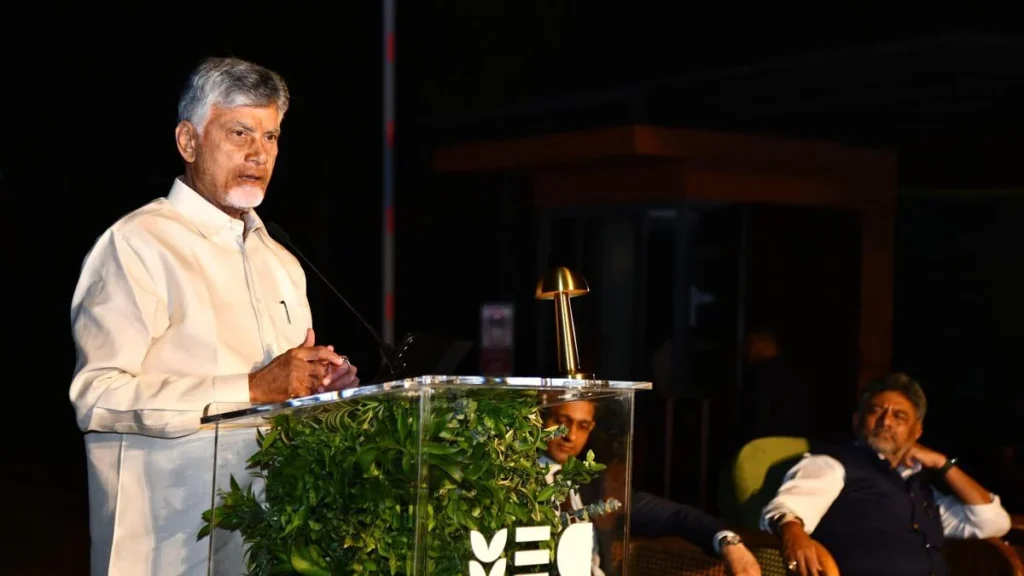
BENGALURU – In a clarion call for architectural reform, Andhra Pradesh Chief Minister N. Chandrababu Naidu has urged urban planners, developers, and citizens to abandon the era of “concrete jungles” in favor of sustainable, eco-friendly infrastructure. Speaking at the inauguration of ‘The Earth Center – Vista Spaces’ in Whitefield, Bengaluru, on Sunday, Mr. Naidu underscored the existential urgency of pivoting from “gray growth” to “green growth” to combat the escalating threats posed by climate change.
The event, which saw the presence of Karnataka Deputy Chief Minister D.K. Shivakumar, served as a platform for a broader discourse on how India’s rapidly expanding urban centers must balance economic development with environmental stewardship.
The Core Message: A Call for Sustainable Infrastructure
At the heart of Mr. Naidu’s address was a fundamental critique of traditional urban development. He argued that for decades, the metric of success for cities has been the density of concrete and the speed of vertical expansion. However, he posited that this model is no longer tenable in a world grappling with erratic weather patterns, heat islands, and resource depletion.
“We have spent too long building gray infrastructure,” Mr. Naidu remarked, gesturing toward the LEED Platinum-certified facility. “The Earth Center is a testament to what we should strive for—a balance between modern functionality and planetary health. If we continue to prioritize concrete over conservation, we are not building cities; we are building future liabilities.”
The Chief Minister advocated for a "net-zero approach" to construction, urging the real estate sector to move beyond mere aesthetic sustainability. He emphasized three pillars of modern development:
- Solar Integration: Maximizing energy autonomy by harnessing solar potential in every commercial and residential project.
- Water Stewardship: Moving beyond conservation to active replenishment and advanced recycling.
- Circular Economy: Transforming waste into wealth through robust on-site management systems.
Chronology: A Day of Green Vision
The inauguration ceremony on Sunday marked a significant collaborative moment between the political leadership of Andhra Pradesh and Karnataka.
- 10:30 AM: Chief Minister Naidu and Deputy Chief Minister D.K. Shivakumar arrived at the Whitefield site. The two leaders toured the facility, inspecting the state-of-the-art climate control systems, vertical gardens, and carbon-negative building materials used in The Earth Center’s construction.
- 11:15 AM: The official ribbon-cutting ceremony took place, followed by a ceremonial planting of saplings to mark the commitment to urban forestry.
- 11:45 AM: The keynote addresses commenced. D.K. Shivakumar spoke on the importance of Bengaluru’s infrastructure evolution, noting the challenges of balancing a booming tech sector with environmental sensitivity.
- 12:15 PM: Mr. Naidu delivered his keynote speech, focusing on the systemic shift required in policy and private enterprise to foster a green economy.
- 1:00 PM: The event concluded with a roundtable discussion involving architects, environmentalists, and urban planners on the future of “Green Real Estate” in India.
Supporting Data: The Need for LEED and Beyond
The Earth Center – Vista Spaces represents a new tier of commercial development. Achieving LEED (Leadership in Energy and Environmental Design) Platinum certification is no small feat. It requires strict adherence to energy efficiency, indoor air quality, and sustainable site development.
Why the Shift Matters:
- Carbon Footprint: The construction industry is responsible for approximately 39% of global carbon emissions. By utilizing low-carbon materials, projects like The Earth Center reduce the embodied carbon significantly.
- Energy Efficiency: Platinum-rated buildings often see a 30% to 50% reduction in energy consumption compared to traditional structures through smart glass, automated HVAC systems, and thermal insulation.
- Water Security: With major Indian cities facing groundwater depletion, the water-recycling protocols mandated by these green certifications are not just environmentally sound—they are essential for long-term viability.
Mr. Naidu’s emphasis on "Green Growth" aligns with global trends where investors are increasingly prioritizing ESG (Environmental, Social, and Governance) scores when deciding where to place capital.

Official Responses and Strategic Perspectives
The Andhra Pradesh Vision
Mr. Naidu leveraged the occasion to highlight the ongoing development in his home state. He reiterated that Amaravati is being designed with these very principles at its core. “We are not just building a capital city; we are building a green model for the world,” he asserted. By integrating smart city technology with massive green cover and transit-oriented development, the administration aims to prove that economic hubs do not need to be ecological deserts.
The Karnataka Context
D.K. Shivakumar acknowledged the challenges faced by Bengaluru, a city synonymous with the "Silicon Valley of India" tag. He noted that Karnataka is actively looking at policies that incentivize green buildings. "When leaders from across states discuss these issues, it creates a national narrative. We must ensure that our rapid growth does not come at the expense of our future generations," Shivakumar stated.
Implications for the Future of Indian Urbanism
The call for "Green Growth" from a senior leader like N. Chandrababu Naidu signals a potential shift in the regulatory landscape. If state governments begin to tie building approvals, tax incentives, and floor-area ratio (FAR) bonuses to green certification levels, the real estate market could see a rapid transition.
The Economic Argument
Critics of green building often point to higher initial capital expenditure (CAPEX). However, the Chief Minister’s argument rests on the long-term operational expenditure (OPEX) savings and the increased asset value. “A building that is energy-efficient is a building that is future-proof,” he noted. As energy costs rise, buildings that are net-zero or energy-positive will become the most sought-after assets for multinational corporations looking to fulfill their own carbon-neutrality pledges.
The Societal Impact
Beyond the economics, there is the human element. Urban heat islands in cities like Bengaluru and Hyderabad have led to increased health issues, from respiratory problems to heat stress. By integrating "Green Growth" into the city’s DNA, the government aims to improve the quality of life for the average urban dweller.
Conclusion: A Turning Point?
As India continues to urbanize at an unprecedented rate, the choices made today by developers and policymakers will dictate the climate reality of 2050. Mr. Naidu’s visit to The Earth Center serves as a symbolic bridge between political vision and private sector execution.
The transition from "gray growth" to "green growth" is no longer a matter of policy preference—it is a matter of survival. As the Chief Minister aptly noted, climate change is a "daunting challenge," but it is one that can be mitigated if the construction sector—one of the largest drivers of the economy—embraces the mandate of sustainability.
In the coming years, the success of these initiatives will be measured not by the number of high-rises reaching the skyline, but by the efficiency, carbon footprint, and livability of the spaces within them. The Earth Center is, perhaps, the first of many steps in the right direction.
Technical Appendix: Defining the Shift
- Gray Growth: Development characterized by unchecked concrete usage, high energy consumption, poor waste management, and the destruction of natural drainage systems.
- Green Growth: Development prioritized around renewable energy, carbon-sequestering building materials, water neutrality, and human-centric design that respects local ecosystems.
- Net-Zero Approach: A building model where the total amount of energy used by the building on an annual basis is equal to the amount of renewable energy created on the site.
Reported by [Your Name/Agency]
Published: September 20, 2026, 11:18 PM IST