Seattle, WA — In a move that significantly streamlines multi-account governance and developer workflows, Amazon Web Services (AWS) has announced the official rollout of cross-account copy capabilities for Amazon Elastic Block Store (Amazon EBS) Volume Clones. Building upon the foundational release of EBS Volume Clones last year—which allowed users to generate instant, point-in-time storage copies within a single Availability Zone—this latest enhancement bridges administrative boundaries. Engineering and operations teams can now effortlessly replicate production-grade datasets into isolated secondary AWS accounts, fundamentally transforming how organizations handle software development, quality assurance, staging, and disaster recovery testing.
The update addresses a long-standing architectural friction point for large enterprises and fast-growing startups alike: the secure, efficient propagation of production data across isolated AWS environments without degrading production performance or incurring massive storage overhead. By pairing Amazon EBS Volume Clones with AWS Resource Access Manager (AWS RAM) and AWS Key Management Service (AWS KMS), AWS has delivered a robust, highly secure mechanism for data democratization across organizational units.
Main Facts: What is Cross-Account Amazon EBS Volume Cloning?
The newly launched capability allows AWS customers to initiate point-in-time copies of existing EBS volumes and transfer or provision those copies directly into separate AWS accounts.
Key Technical Pillars of the Release:
Cross-Account Sharing via AWS RAM: Volume owners can securely share their Amazon EBS volumes with target accounts using AWS Resource Access Manager. This aligns with modern multi-account strategies, such as AWS Organizations, allowing administrators to govern resource sharing with granular precision.
Target-Side Re-encryption: When a shared volume is cloned into a target account, administrators have the option to re-encrypt the new volume using a designated AWS KMS key native to the target account. This ensures strict adherence to internal security policies and compliance frameworks (such as HIPAA, SOC 2, and PCI-DSS), preventing unauthorized data exposure across organizational boundaries.
Instantaneous Point-in-Time Provisioning: Leveraging the architecture of EBS Volume Clones, the target account receives a fully functional copy of the volume data instantaneously, avoiding the latency and resource consumption historically associated with traditional snapshot restoration workflows.
Developer Productivity and AI Integration: Beyond standard console workflows, organizations can orchestrate these cross-account actions programmatically. AWS has integrated support for the AWS MCP Server and related plugins, enabling developers to interact with volume-sharing APIs using their preferred AI coding tools and assistants.
Chronology: The Evolution of Amazon EBS Data Management
To fully understand the significance of cross-account volume clones, it is helpful to trace the evolution of AWS block storage data replication capabilities over the past decade.
1. The Era of Traditional Snapshots
For years, Amazon EBS snapshots were the primary mechanism for backing up and duplicating block storage data. While highly reliable and durable (storing data incrementally in Amazon S3), creating a new volume from a snapshot required a hydration process. Restoring terabytes of data from a snapshot to a new EBS volume often introduced significant initialization delays, making it less than ideal for rapid-fire CI/CD pipelines and ephemeral test environments.
2. The Introduction of EBS Volume Clones (Last Year)
Recognizing the need for instant data provisioning, AWS launched Amazon EBS Volume Clones. This capability allowed users to create instantaneous, writable point-in-time copies of EBS volumes within the same Availability Zone. Based on a redirect-on-write architecture, volume clones eliminated the wait times associated with traditional snapshot restores, giving developers immediate access to production-sized datasets for local experimentation and debugging. However, these clones were strictly confined to the source AWS account.
3. The Shift to Multi-Account Architecture and Governance
As enterprises matured their cloud infrastructure, single-account architectures became an anti-pattern. Organizations rapidly transitioned to multi-account models using AWS Control Tower and AWS Organizations to isolate workloads, enforce security boundaries, and manage billing. Consequently, developers working in isolated sandbox, staging, or testing accounts frequently struggled to obtain up-to-date production data copies without cumbersome, manual administrative intervention.
4. Today: Cross-Account Volume Clones
With the introduction of cross-account copy functionality for EBS Volume Clones, AWS has successfully closed the gap between high-speed storage virtualization and modern multi-account cloud governance. Organizations can now provision fresh, secure testing environments across separate AWS accounts in a matter of minutes.
Supporting Data and Operational Mechanics
The technical execution of cross-account volume cloning has been designed to integrate seamlessly into existing AWS management workflows. Organizations can execute these operations via the Amazon EC2 console, AWS RAM, or programmatically through AWS APIs and command-line interfaces.
Step-by-Step Operational Workflow
Initiating the Share (Source Account):
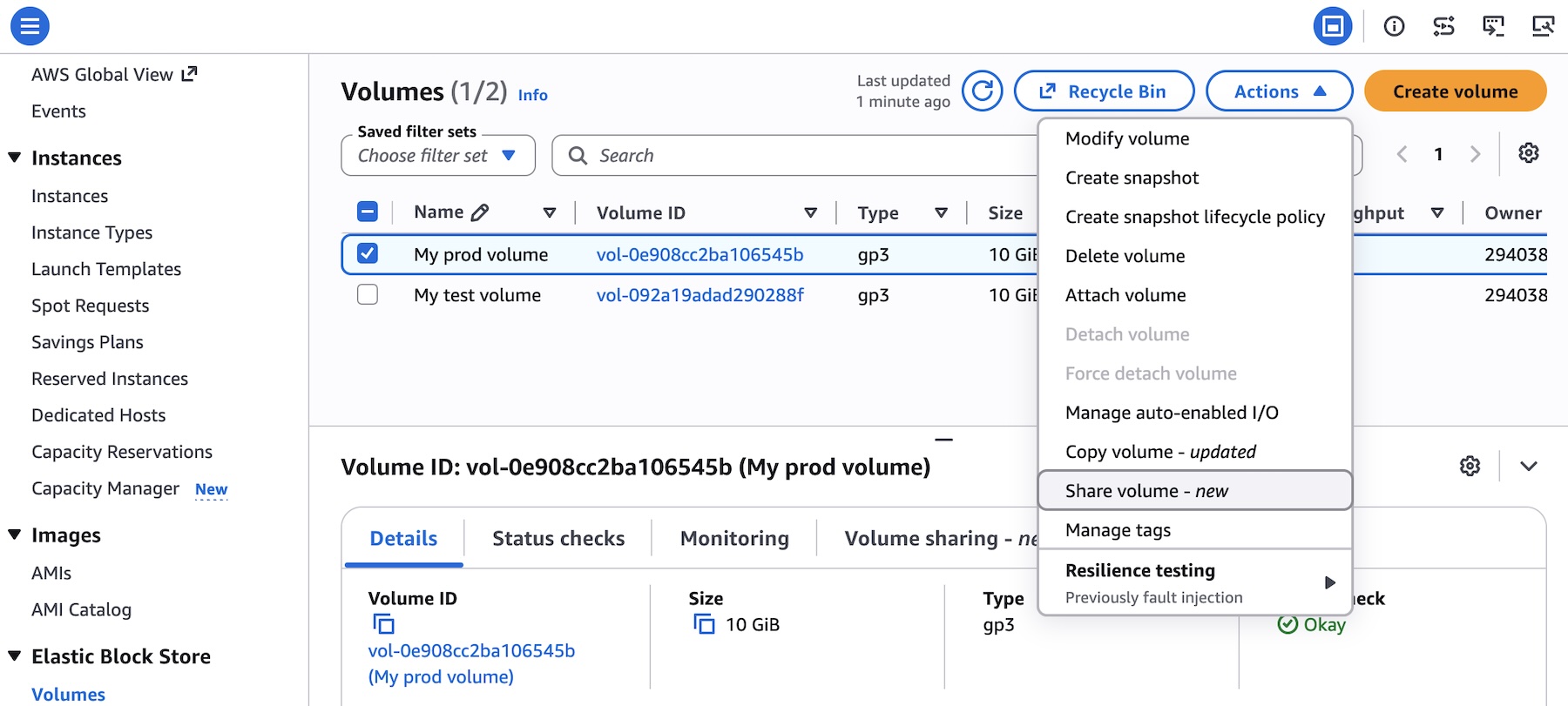
The owner of the source Amazon EBS volume navigates to the Amazon EBS console, selects the desired volume, and chooses the Share volume option.
Configuring Resource Shares (AWS RAM):
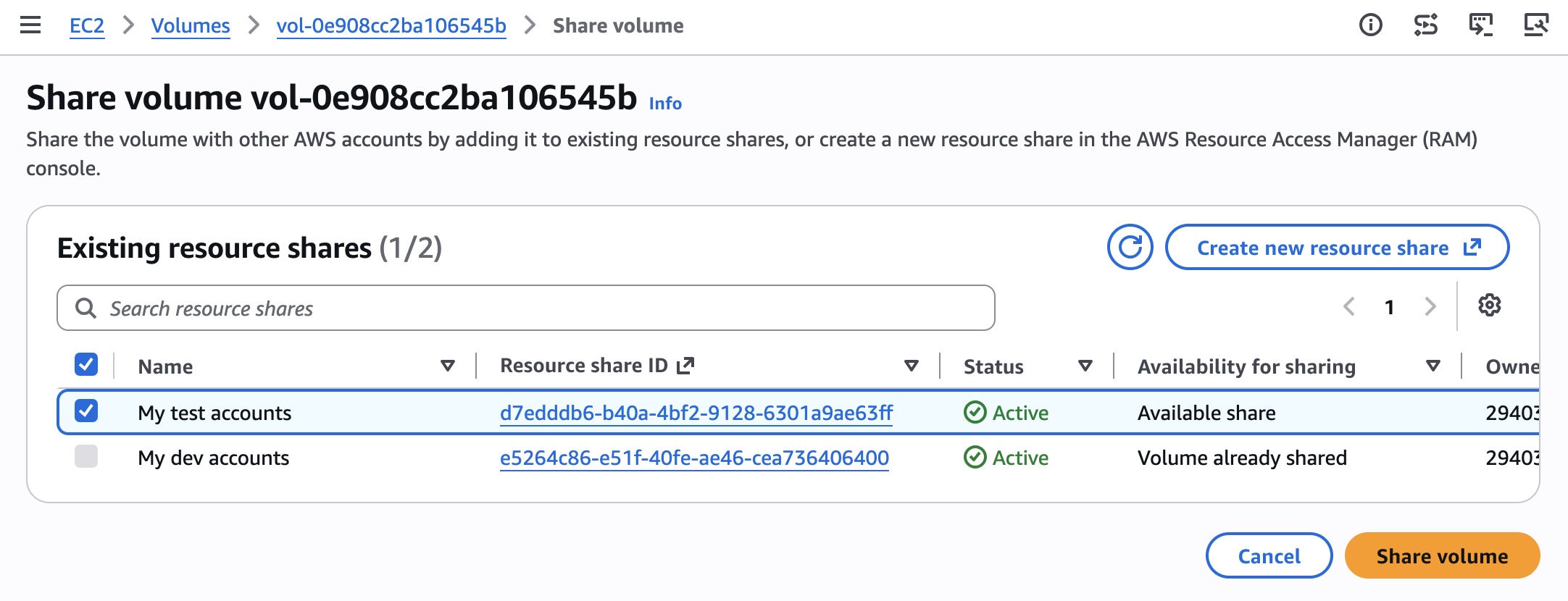
The user adds the volume to an existing resource share or creates a new resource share using the AWS RAM console. This step governs precisely which external AWS accounts or AWS Organization units are granted visibility into the block storage asset.
Validating the Share (Source Account Confirmation):
Once configured, the volume detail page displays confirmation under the Volume sharing tab, verifying that the asset has been successfully exposed to the target perimeter.
Acceptance (Target Account):
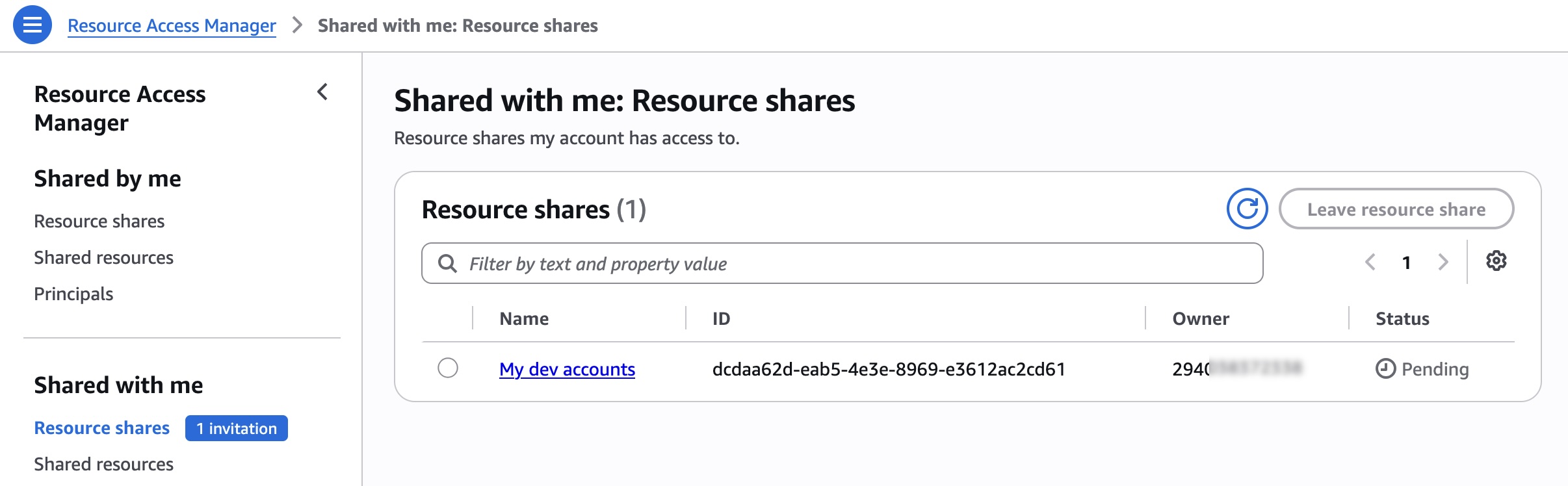
Administrators within the target AWS account must log into their respective AWS RAM console to explicitly accept the incoming resource share. This two-way handshake guarantees that no account can have data pushed into its environment without explicit administrative consent.
Executing the Copy and Re-encryption (Target Account):
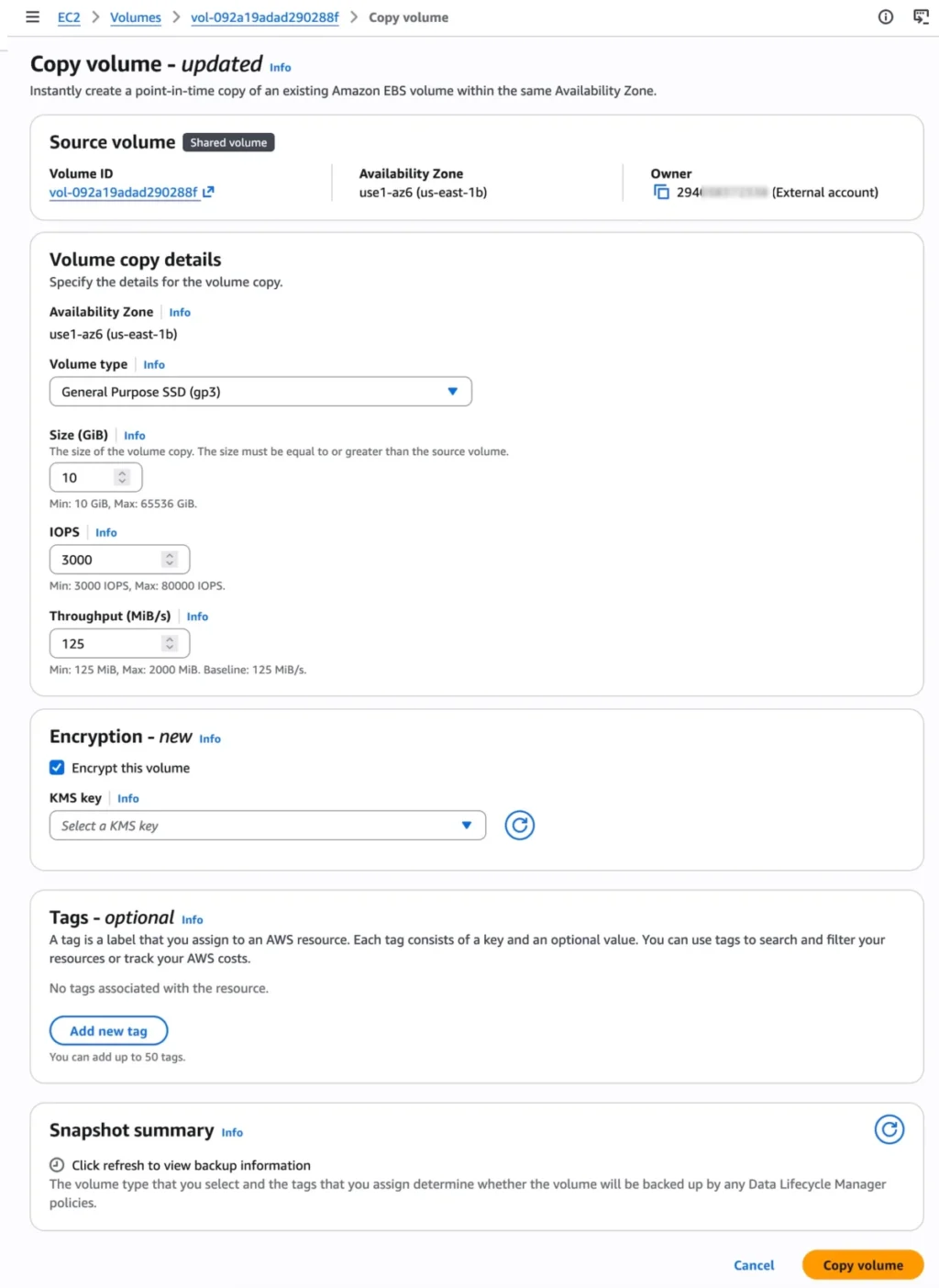
Once accepted, the shared volume appears natively within the EBS volume dashboard of the target account. The target user simply selects Copy volume, at which point they can assign a new encryption profile utilizing their local AWS KMS keys, isolating the data footprint entirely from the source account.
Programmatic Automation and AI Tooling Integration
For DevOps pipelines and automated infrastructure-as-code (IaC) workflows, managing cross-account shares manually is impractical. AWS has ensured full API support for these features. Furthermore, in a nod to modern engineering workflows, AWS highlights that teams can utilize the AWS MCP Server and associated plugins to manage, search documentation for, and execute cross-account EBS operations programmatically through advanced AI coding assistants.
Official Responses and Industry Perspectives
AWS representatives and cloud architecture experts have emphasized that this feature directly targets one of the most persistent bottlenecks in enterprise software delivery: data parity between environments.
"By extending Volume Clones with cross-account copy, we are giving development and QA teams the ability to harness the exact pulse of production data without compromising security or operational isolation," noted senior AWS engineering leadership in the release documentation. "Organizations no longer have to choose between maintaining strict multi-account security boundaries and empowering their developers with realistic, up-to-date testing datasets."
Industry analysts have similarly lauded the update, noting that data freshness is a primary driver of software quality. When developers test against stale or synthetically generated mock data, edge cases and race conditions frequently go undetected until code reaches production. By removing the friction from copying and re-encrypting live production volumes into sandbox accounts, AWS has lowered the barrier to rigorous pre-production testing.
Furthermore, compliance officers have welcomed the target-side AWS KMS re-encryption capability. In regulated industries such as finance and healthcare, data leakage across account boundaries represents a severe compliance risk. By ensuring that target accounts can immediately wrap cloned volumes in their own locally managed encryption keys, AWS maintains a strict audit trail and enforces the Principle of Least Privilege.
Implications for Enterprise Architecture and Security
The launch of cross-account Amazon EBS Volume Clones carries profound implications across multiple dimensions of cloud computing, touching financial operations, software development lifecycles (SDLC), and security postures.
In traditional enterprise environments, provisioning a staging or QA environment with a realistic dataset could take hours or even days, requiring database administrators to export data, upload it to Amazon S3, download it in the target account, and rehydrate it into block storage. Cross-account volume cloning cuts this down to minutes. Developers can automate their CI/CD pipelines to pull fresh data clones on a nightly or weekly basis, ensuring that automated regression tests run against data structures that mirror current production usage.
2. Enhanced Financial Optimization (FinOps)
While cloning storage volumes consumes underlying capacity, the redirect-on-write mechanics of EBS Volume Clones ensure that storage costs remain optimized. Enterprises can avoid the wasteful practice of over-provisioning redundant full backups across multiple accounts. Combined with AWS Cost Explorer and resource tagging, cloud financial management teams can accurately attribute storage costs associated with cross-account testing back to the respective business units or development projects.
3. Fortified Security and Blast-Radius Reduction
A core tenet of cloud security is the minimization of blast radius. In the past, teams attempting to debug production issues sometimes granted broad IAM permissions or shared live database credentials across accounts. Cross-account EBS cloning eliminates this risky practice. Production data is safely copied, re-encrypted with isolated KMS keys, and handed over to the development environment, leaving the production environment untouched and unexposed.
4. Regional Availability and Getting Started
Cross-account volume clones for Amazon EBS are generally available today across all AWS Regions that natively support Amazon EBS Volume Clones. Organizations looking to verify regional support can consult the official AWS Capabilities by Region documentation.
Cloud architects and DevOps engineers can begin experimenting with the feature immediately via the Amazon EC2 console. Feedback and technical inquiries can be channeled through the AWS re:Post for Amazon EBS community or standard enterprise AWS Support channels. As multi-account cloud strategies continue to dominate enterprise IT, tools like cross-account EBS volume cloning represent the vital infrastructure required to keep development fast, secure, and resilient.