Global WordPress Education Initiatives Empower Thousands of Students Through Hands-On Tech Workshops and Mentorships
GLOBAL — In an era where digital literacy is as fundamental as reading and writing, grassroots educational initiatives are breaking down barriers to technology access across continents. Driven by the global open-source community, programs like WordPress Campus Connect and WordPress Credits are reshaping how students interact with the web. By providing free, hands-on training, mentored internships, and real-world project experience, these programs have empowered thousands of learners—many of whom had never built a website before—to step confidently into the tech ecosystem.
Recent data highlights a surge in momentum. In July alone, students in Bangladesh constructed 108 websites in just two weeks, a workshop in eastern Uganda succeeded despite a total lack of electricity, and university students in Costa Rica authored a replicable guide after teaching high schoolers the fundamentals of web development.
Main Facts: Bridging the Digital Divide Through Open Source
The core of this educational movement lies in two complementary, zero-cost initiatives designed to foster technical skills and open-source contribution:
- WordPress Campus Connect: This program delivers free, hands-on WordPress workshops to schools, vocational institutes, and universities. Local volunteers utilize a shared, standardized curriculum to teach students the basics of web design, content management, and digital entrepreneurship. Upon completion, every participant receives a certificate.
- WordPress Credits: Taking education a step further, this initiative places students into structured, mentored internships. Participants contribute directly to the core WordPress software—which powers over 40 percent of the web—while earning academic credit. As of July, the program boasts 226 graduates (up from 199 in June) and collaborates with 38 partner institutions across 16 countries.
Crucially, these programs require no financial investment from participating students or schools. By leveraging local volunteer networks and open-source tools, Campus Connect and WordPress Credits are democratizing access to high-value tech skills, particularly in developing regions.
Chronology of Recent Milestones: July’s Global Wave of Innovation
The scale and adaptability of these educational initiatives were put on display during a busy month of global workshops and community-driven events.

Early July: Bangladesh’s Rapid Web Development Surge
In Kishoreganj, Bangladesh, organizer Muhibul Haque spearheaded a remarkable two-week campaign across two local campuses. At Kishoreganj University, students successfully launched 38 websites during their initial session. Shortly after, at the Kishoreganj Polytechnic Institute—where guest speaker Shipon Karmakar traveled more than 80 kilometers to attend—students built nearly 70 additional sites. To date, the regional initiative has engaged over 150 students, with workshops planned for two additional institutions.
Mid-July: AI and Vocational Training in Spain
Taking a different technological route, Josep Morán organized two intensive four-hour sessions for 100 vocational students at Escola Pia Sta. Anna in Mataró, Spain. Utilizing WordPress Playground and artificial intelligence tools, the students successfully built a working plugin designed to calculate optimal shore fishing times in the local area. Faculty and students alike emphasized the immediate practical value of the curriculum, noting how seamlessly the skills mapped onto existing regional job markets.
Late July: Overcoming Adversity in Eastern Uganda
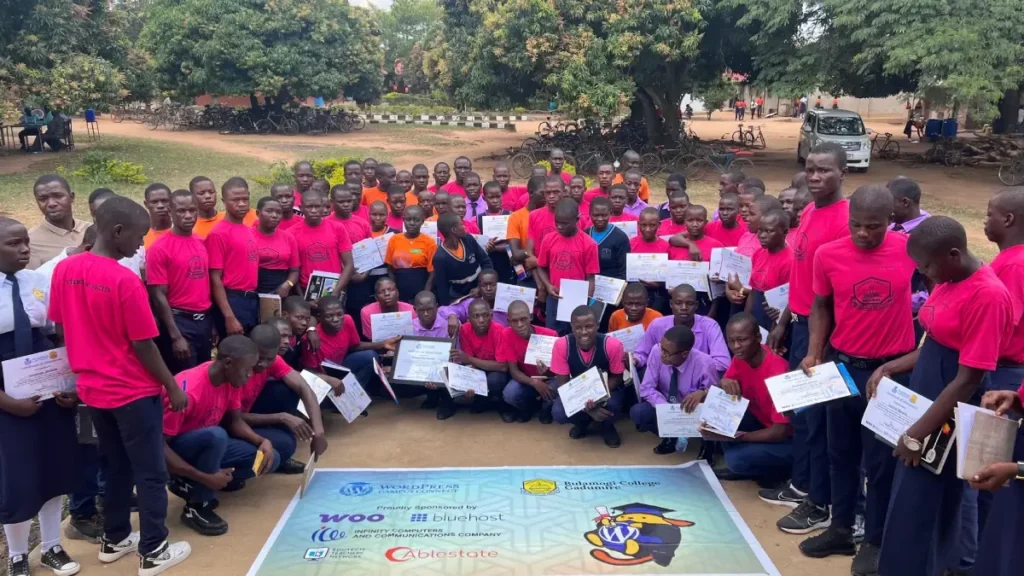
Perhaps one of the most remarkable stories of the month unfolded at Bulamogi College Gadumire in Kaliro, eastern Uganda. The event was made possible by Mariam Nairuba, a former student who requested the workshop after attending an event the previous December.
When the volunteer team—led by Moses Ssebunya—arrived on July 29 with laptops, extension cords, and a projector, they were met by more than 100 eager learners and a startling revelation from the Director of Studies: the school had no electricity.
Refusing to cancel, the organizers pivoted. They engaged the packed room with two fundamental questions: What do you already know about WordPress, and what would you like to know?

According to the organizers’ event recap, "The room exploded." Students fired off questions regarding web security, the cost of the platform, and pathways to becoming professional developers. First-time volunteer John Wayera meticulously recorded every question and answer on a blackboard. Before departing, the team presented the school with a Certificate of Appreciation, accepted by the Head Teacher in front of the governing body.
Late July into August: Peer-to-Peer Teaching in Costa Rica
Rita Robles Loaiza published two groundbreaking pilots in Costa Rica centered on a simple premise: students who have just mastered a skill are exceptionally well-equipped to teach it to others.
- STEM Empowerment for High Schoolers: Three students from the second WordPress Credits cohort at Universidad Fidélitas designed and delivered a bespoke workshop for 40 high school girls. Hosted at Patrones Hermosos—a science and engineering camp run by Tecnológico de Monterrey and MIT—every participant successfully built and presented their own website. Participant satisfaction reached a flawless 100 percent. The student instructors subsequently compiled their methods into a comprehensive, replicable guide for global use.
- Long-Term Community Service: Thirteen students at Liceo Experimental Bilingüe José Figueres Ferrer—marking the first high school in the Americas to join WordPress Credits—partnered with the Costa Rican Spanish Polyglots team. Fulfilling their community service requirements, these students are translating WordPress into the local es_CR dialect, ensuring future software installations feel distinctly native to Costa Rican users.
Supporting Data and Global Expansion
The momentum of WordPress education is quantitatively backed by steady institutional growth:
- 108 Websites Built: Achieved by students in Kishoreganj, Bangladesh, over a two-week period.
- 226 Graduates: The milestone reached by the WordPress Credits internship program in July.
- 38 Partner Institutions: Active educational collaborations spanning 16 countries.
- 100+ Learners: Engaged in single-session workshops, from Mataró, Spain, to Kaliro, Uganda.
Furthermore, the Monthly Education Buzz Report for July 2026 highlights ongoing activities that demonstrate grassroots sustainability. For instance, students at the Kyoto University of Advanced Science in Japan independently managed a Campus Connect run, while a newly formed Student Club in Dhaka, Bangladesh, has begun organizing its own localized campus events.
Official Responses and Perspectives
Educators, organizers, and students have universally praised the practical, community-oriented structure of the programs.

Organizers of the Uganda workshop noted the profound psychological impact of the unpowered session: "By stripping away the tech infrastructure and focusing purely on curiosity and dialogue, we discovered an immense, latent hunger for digital empowerment. The blackboard became our server, and the students’ questions drove the curriculum."
Academic institutions participating in the WordPress Credits program have similarly commended the bridge it builds between theoretical learning and professional reality. By contributing directly to open-source software utilized by millions, students graduate not only with a resume-boosting credential but with a tangible sense of global agency.
Implications: Building the Future of the Open Web
The implications of these educational initiatives extend far beyond learning how to write code or configure a content management system. By fostering digital literacy in underserved regions, programs like Campus Connect and WordPress Credits are laying the foundation for economic self-sufficiency.
- Local Workforce Development: Students acquire market-ready skills that enable them to freelance, build local business websites, or secure traditional tech employment without relocating.
- Diversity in Tech: Initiatives like the all-girls workshop at the MIT-backed camp in Costa Rica actively work to close the gender gap in STEM fields.
- Sustaining the Open Web: By introducing young learners to open-source contribution early, the WordPress ecosystem secures its next generation of maintainers, developers, and advocates from every corner of the globe.
As these programs continue to scale, they prove that with a shared curriculum, dedicated local volunteers, and an internet connection (or even just a blackboard), the barriers to entering the global tech economy can be successfully dismantled.