Ride-Hailing Turf War in Gujarat: Coercion, Controversy, and the Shadow of Bharat Taxi
Ahmedabad & Gandhinagar — Tensions have reached a boiling point across the urban corridors of Gujarat, where passengers and cab drivers report being targeted by vigilante groups demanding a forced migration from established platforms like Uber and Rapido to the government-backed newcomer, Bharat Taxi.
What began as localized rumblings of driver discontent over commissions has escalated into unsettling street-level confrontations. Accounts detailing vehicle blockades, forced ride cancellations, intimidation, and digital surveillance have raised serious alarms regarding passenger safety, driver livelihoods, and the fundamental freedom of consumer choice in India’s rapidly evolving gig economy.
Main Facts: The Ground Reality in Gujarat
The unfolding crisis in Ahmedabad and Gandhinagar exposes a volatile friction point between legacy ride-hailing giants and a state-supported cooperative initiative.
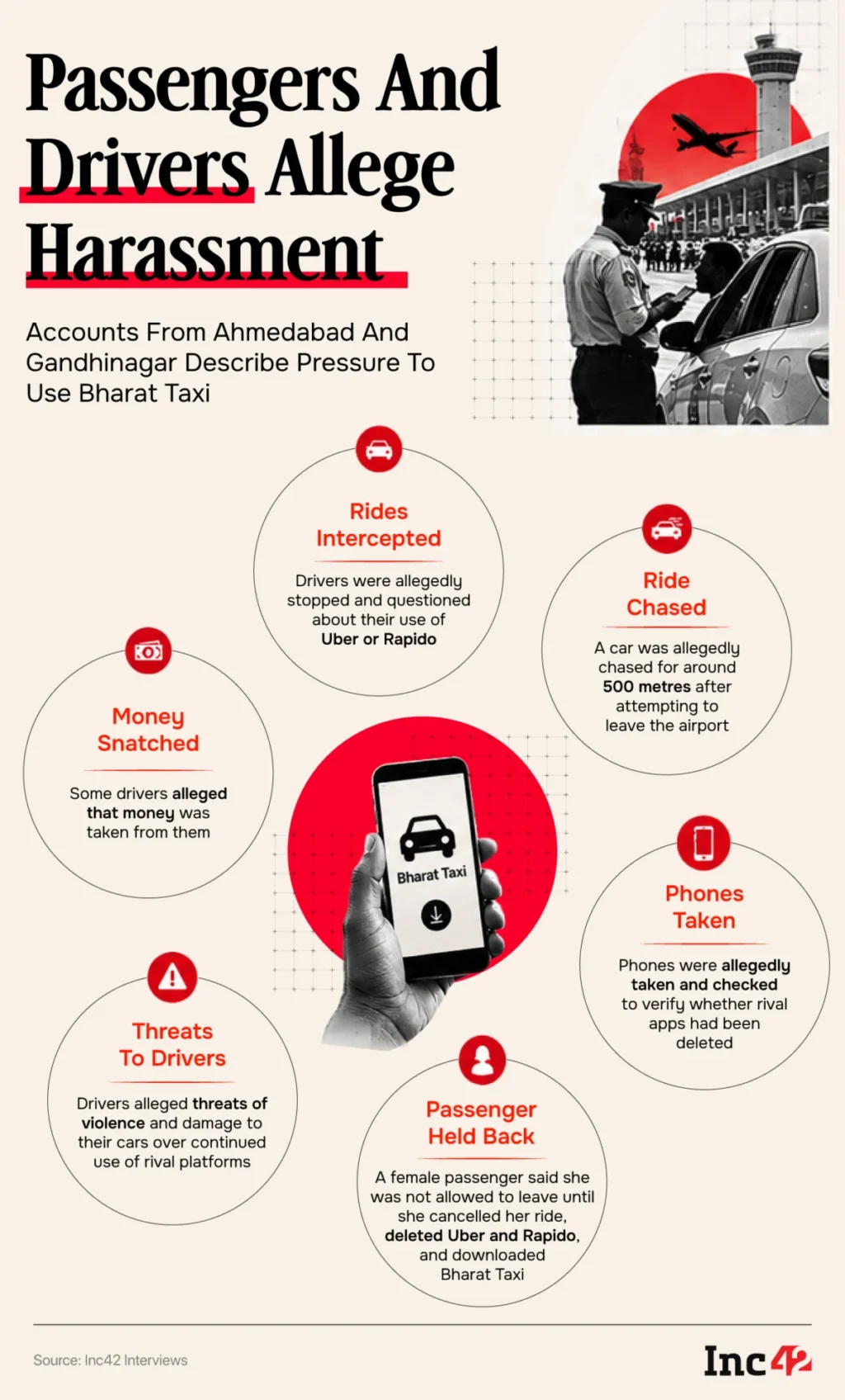
According to multiple testimonies gathered from travelers and commercial drivers, unidentified groups of 10 to 15 individuals have been actively intercepting cabs mid-trip. Passengers are interrogated about the application used to book their ride, while drivers face immense pressure to abandon current bookings and align exclusively with Bharat Taxi.
- Coerced Cancellations: Passengers have reported being forced to cancel ongoing rides, with vigilantes occasionally demanding access to their personal smartphones to verify the complete deletion of Uber and Rapido applications.
- Driver Vulnerability: Independent drivers, already squeezed by rising vehicle EMIs and operational costs, report being caught in the crossfire. Many claim that Bharat Taxi’s current order volume is insufficient to sustain their daily earnings, yet they are terrorized into dropping multi-app workflows.
- The Safety Crisis: Incidents of intimidation have reportedly ranged from verbal abuse and threats of vehicle vandalism to alleged thefts and "honeypot" setups, where miscreants book rides through private apps solely to target and threaten incoming drivers.
While Bharat Taxi was launched with the explicit promise that its cooperative model would not restrict drivers from working concurrently on competing platforms, the realities on the ground paint a starkly different picture.
Chronology of Events: From App-Based Boycotts to Street-Level Coercion
To understand the current crisis, one must trace the timeline of escalating friction within Gujarat’s transport sector:
- Early September: Reports of localized driver dissatisfaction begin circulating. Drivers across Ahmedabad and Gandhinagar voice growing concerns over shrinking profit margins, high platform commissions levied by private aggregators, and delayed payouts.
- Mid-September (Approx. 10–15 Days Prior to Reports): Street-level disruptions begin. Unidentified groups reportedly start staking out high-traffic zones, including airport terminals and railway stations, intercepting rides booked via Uber and Rapido.
- Monday, September: Cab and autorickshaw drivers in Ahmedabad officially launch an organized boycott against Uber and Rapido, openly urging commuters to switch to Bharat Taxi. However, passenger and driver accounts indicate that aggressive street-level coercion predates this formal union- or driver-led boycott.
- Mid-Week (Tuesday, September 22): Media outlets, including the Financial Express, document the wider driver strike over fare structures and platform charges. Simultaneously, individual accounts of passenger harassment surface on social media platforms.
- Late September: Contradictory digital media campaigns emerge. Viral videos surface featuring individuals in police uniforms both endorsing Bharat Taxi and warning vigilantes against taking the law into their own hands. Major platforms like Rapido begin coordinating with local authorities to secure emergency interventions.
Supporting Data and Background: What Is Bharat Taxi?
To contextualize the fervor surrounding Bharat Taxi, it is essential to examine its structural framework and unique value proposition.
Introduced as India’s first government-backed, cooperative-driven ride-hailing platform, Bharat Taxi was envisioned as a direct, equitable alternative to profit-driven tech monopolies. Operated under the aegis of Sahkar Taxi Cooperative Limited, the platform aims to empower drivers by cutting out corporate middlemen.
Key Structural Pillars of Bharat Taxi:
- Zero-Commission Model: Unlike Uber or Rapido, which typically deduct substantial percentages from every fare, Bharat Taxi operates on a zero-commission structure, allowing drivers to retain 100% of the trip earnings.
- Cooperative Ownership: Drivers are required to purchase a minimum of five shares (valued at ₹500), granting them co-ownership status, voting rights, and a direct share in corporate profits through annual dividends.
- Social Security Benefits: The cooperative model promises integrated welfare perks, including ₹5 Lakh in health/life insurance coverage and pension schemes.
- Localized Integration: The platform features localized support systems, including robust Gujarati-language interfaces to ease onboarding for regional drivers.
Despite these progressive features designed to uplift the driving community, the aggressive tactics employed by purported supporters threaten to overshadow the cooperative’s foundational ethos of voluntary empowerment.
Official Responses and Administrative Ambiguity
The response from civic and law enforcement authorities has been marked by mixed messaging, leaving both citizens and commercial operators bewildered.
The Social Media Paradox
Complicating the enforcement of law and order is a wave of conflicting digital content circulating across platforms like Instagram and X (formerly Twitter).

- The Endorsement Video: One widely shared video features an individual in a police uniform actively encouraging local drivers to download Bharat Taxi and advising citizens to exclusively utilize the platform. The video touts the app’s zero-commission rates, insurance benefits, and regional language support.
- The Warning Video: Shortly after public outcry regarding harassment intensified, a counter-video surfaced. Also featuring an official in a police uniform—allegedly filmed within Ahmedabad—this clip sternly warns agitators of strict legal repercussions for stopping ongoing rides, harassing commuters, or intimidating fellow drivers.
Silence and Action from Authorities
Formal inquiries dispatched by media outlets to high-ranking officials—including Anupam Singh Gahlaut, Commissioner of Ahmedabad Police, and Ravi Teja Vasamshetty, District Superintendent of Police, Gandhinagar—have thus far yielded no official statement regarding the authenticity of the viral videos or the specific measures being deployed to curb street-level vigilantism.
Conversely, corporate stakeholders have begun taking a firmer stance. In an official statement provided to media houses, ride-hailing major Rapido praised local authorities for intervening to protect transport workers and commuters alike:
“Every captain has the right to choose the platform they work with, and every commuter has the right to choose how they travel. Any form of intimidation or coercion undermines that choice and affects the people who depend on these services every day.”
Rapido confirmed that its local support teams and dedicated helplines remain active to assist drivers facing threats on the ground, though the company declined to quantify the exact volume of harassment complaints logged.
Implications: Safety, Livelihoods, and the Future of Gig Mobility
The unfolding situation in Gujarat serves as a cautionary tale for the integration of state-backed initiatives into competitive commercial markets. The long-term implications of these developments stretch across several vital domains:
1. Passenger Safety and Consumer Freedom
The cornerstone of modern urban transit is the ability of a consumer to safely and independently choose their mode and medium of travel. When passengers arriving at major transit hubs are subjected to midnight interrogations, forced application deletions, and digital monitoring by vigilantes, public trust in urban transit infrastructure plummets. Tourists and business travelers alike may hesitate to visit regions where transit choices are dictated by street-level intimidation.
2. The Fragility of Driver Livelihoods
While Bharat Taxi’s zero-commission promise is theoretically attractive, forcing drivers to cut ties with multi-app workflows strips them of financial resilience. In a volatile economic climate, drivers rely on dispatch algorithms across Uber, Rapido, and local networks to maintain consistent vehicle utilization and cover steep monthly EMIs. Restricting them through coercion rather than organic market preference ultimately hurts the very working-class individuals the cooperative seeks to protect.
3. Regulatory Accountability
The emergence of contradictory videos featuring individuals in police uniforms highlights an urgent need for institutional clarity. If law enforcement is perceived as partisan—or worse, actively endorsing extra-legal coercion—public faith in the legal system erodes. Prompt, transparent intervention by the Ahmedabad Police Commissionerate and Gandhinagar DSP is vital to re-establish the rule of law.
4. The Precedent for Cooperative Platforms
As India explores cooperative models to democratize the digital economy through initiatives like the Open Network for Digital Commerce (ONDC) and state-backed gig apps, the Ahmedabad incident offers a stark lesson. True market disruption must rely on superior service delivery, fair economics, and consumer adoption rather than coercive monopolization disguised as grassroots activism.
Conclusion
As investigations continue and pressure mounts on law enforcement to provide clarity, the transport ecosystem in Ahmedabad and Gandhinagar remains on edge. For Bharat Taxi to succeed as a legitimate, revolutionary alternative in India’s transit landscape, its proponents and affiliates must distance themselves unequivocally from intimidation tactics. Until civil authorities firmly stamp out street-level vigilantism and guarantee absolute freedom of choice for both drivers and passengers, the shadow of coercion will continue to loom large over Gujarat’s roads.