Riding the Driverless Wave: An In-Depth Review of Waymo’s Autonomous Taxis in San Francisco
By Sahana Venugopal
Introduction: The Shadow of KitKat and the Promise of Autonomy
On October 27, 2025, a sudden tragedy in San Francisco sparked an international debate that bridged continents. Oceans away, news outlets reported on the tragic killing of a nine-year-old cat named KitKat. The incident drew global attention not merely because of the loss of a beloved pet, but because of the culprit: a self-driving Waymo robotaxi, operated by Alphabet, the parent company of Google.
The incident reignited fierce debates regarding the safety, ethics, and rapid deployment of autonomous vehicles (AVs) on public streets. While local residents expressed outrage over algorithmic blind spots and erected a memorial for KitKat, industry proponents defended the technology. They argued that human-driven vehicles claim the lives of thousands of animals annually, and that autonomous fleets are programmed to iteratively learn, adapt, and ultimately minimize human error on the road.
Nearly a year after the incident, curiosity—and a heavy dose of skepticism—prompted me to book a Waymo ride in San Francisco. Traveling from a local hotel to a nearby metro station during the early morning hours when the streets were clear, I set out to evaluate what it truly feels like to surrender the steering wheel to a machine.
This independent, non-sponsored review explores the cost, design, interior ergonomics, safety measures, and broader implications of navigating the urban landscape inside a driverless Waymo.

Chronology of the Ride: From App to Curb
Booking a robotaxi via Waymo shares a familiar DNA with conventional ride-sharing services like Uber, Lyft, or even local transit apps. However, the operational nuances reveal a system heavily reliant on pre-programmed digital infrastructure.
1. Booking and App Interaction
To secure a ride, users download the Waymo application, establish a profile, input payment information, and designate pick-up and drop-off coordinates. Riders can request an immediate vehicle or schedule transit for a later time.
- App Performance: While functional and intuitive, the application suffered from slow loading times during initial launch phases. Beyond scheduling, the app functions as a digital key, allowing passengers to unlock the vehicle, customize interior climate settings, access customer support, or request fewer automated audio announcements.
- Payment Seamlessness: Transactions were processed smoothly, even when utilizing an international (Indian) credit card, culminating in an immediate e-receipt and promotional credit for subsequent rides.
2. The Pick-Up Adjustment
Upon requesting a vehicle from a pick-up point directly outside my hotel, the app executed an unexpected adjustment. It redirected me to walk across the road to an alternate pick-up location. The system’s geographic intelligence had recognized that the original coordinate placed the vehicle directly onto an active tram line—a subtle indicator of real-time route risk mitigation.
3. Arrival and Unlocking
Within two minutes of booking, a sleek Jaguar SUV bearing the Waymo sensor suite pulled up to the curb. The vehicle utilizes a secure boarding mechanism: passengers unlock the car via their mobile app, prompting the door handles to pop outward. This prevents unauthorized individuals from commandeering or mistakenly entering the ride. Once inside, the vehicle is programmed to wait up to five minutes for the passenger before canceling the fare.
Supporting Data: The Anatomy of a Robotaxi Trip
For analytical travelers, metrics dictate efficiency. Below is the data profile of a standard inner-city transit route via Waymo:

| Metric | Recorded Data |
|---|---|
| Waiting Time | Under 2 minutes |
| Ride Distance | ~3 kilometers |
| Ride Duration | 14 minutes |
| Fare Cost | $23.55 (USD) |
| Environmental Impact | 486 grams of CO2 saved |
Vehicle Design and Interiors: A Chauffeur Without a Face
The vehicle that arrived at the curb was a modified Jaguar I-PACE electric SUV, its roofline crowned by a spinning LiDAR sensor array mounted just above a tinted glass skylight.
Cabin Comfort and Ambiance
- Pristine Cleanliness: The cabin interior was dark, scent-free, and immaculately maintained, offering ample legroom and space to accommodate a large suitcase in the back seat alongside the passenger.
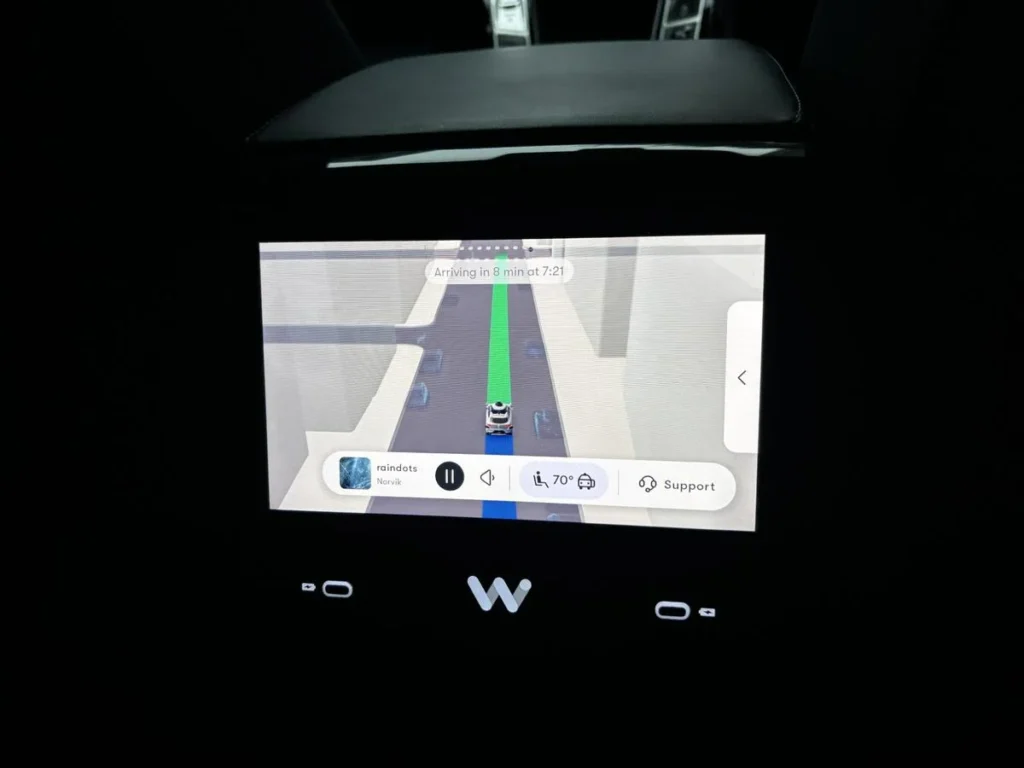
- Dual-Screen Layout: Two primary touchscreens dominated the interior: a narrow display at the front and a wider, interactive screen positioned for backseat passengers. These monitors tracked journey status, traffic navigation visuals, estimated arrival times, safety briefings, and media settings.
- Ambient Audio & Climate: Upon departure, the system initiated soothing, ambient music. Passengers embarking on longer journeys can sync their personal Spotify and YouTube playlists. The cabin temperature was maintained at a warm setting to counter the chilly morning air, though users retain manual control over climate dials.
- Mechanical Quirks: The steering wheel moved fluidly on its own, creating the eerie yet fascinating sensation of being chauffeured by an invisible driver. While the car retained physical brake and accelerator pedals, they remained stationary during transit. Unlike minimalist competitors like the Tesla Cybercab, Waymo retains conventional driving and media controls in the front cabin.
Safety Analysis: Between Caution and Confidence
Safety remains the ultimate litmus test for autonomous technology. Bearing in mind the fatal incident involving KitKat, alongside viral videos of Waymo vehicles occasionally running red lights or straying into emergency zones, my apprehension was palpable as I waited for the car.
Operational Performance on the Road
Once buckled up, an automated audio briefing reminded me of safety protocols and noted that the cabin could be monitored for security purposes, while assuring riders of sufficient privacy to sing or relax undisturbed. Blinking recording panels were mounted visibly on the ceiling.
- Pace and Precision: The vehicle operated at a conservative, measured speed. It handled San Francisco’s notorious steep, near-vertical slopes with impressive confidence, executing controlled braking maneuvers without any dangerous rollbacks.
- Traffic Compliance: Despite empty early-morning streets, the Waymo unfailingly adhered to speed limits, came to complete stops at every stop sign, and respected traffic signals with predictable, fluid turns.
- Obstacle Tracking: The backseat touchscreen displayed a real-time 3D visualization of the car’s path, highlighting nearby vehicles, pedestrians, and structural obstructions. Unexpected routing adjustments were handled with extreme caution.
- The Drop-Off Challenge: Upon reaching the destination, the car required an extra two minutes to locate a safe, legal pull-over spot amidst a corridor of parked vehicles. Disembarking required pulling the interior door handle twice—a safety redundancy ensuring passengers never exit hastily into moving traffic.
Official Responses and Regulatory Landscape
The rapid expansion of autonomous ride-hailing services has divided municipal authorities, regulators, and local communities.
- Local and Regulatory Concerns: The National Highway Traffic Safety Administration (NHTSA) and local governing bodies have repeatedly flagged incidents where autonomous vehicles have confused first responders, barged into restricted emergency zones, or fallen victim to human interference, such as bystanders placing traffic cones on vehicle hoods to disable them.
- Industry Defense: Conversely, technology advocates and corporate representatives maintain that human fatigue, inebriation, and distraction are responsible for the vast majority of global traffic fatalities. Autonomous systems, they argue, eliminate human error variables entirely, improving statistically with every cumulative mile driven. As Waymo eyes expansion into more complex suburban and rural roadways across the United States, scaling safety protocols across diverse environments remains a paramount corporate challenge.
Implications for Urban Mobility and Public Safety
Beyond the novelty of driverless engineering, experiencing a Waymo ride exposes a deeper psychological reality: the alleviation of urban commuting anxiety.

Conventional taxi and ride-sharing experiences often force passengers—particularly women and late-night commuters—to remain hyper-vigilant. Concerns regarding swapped license plates, aggressive or intoxicated drivers, sudden price surges, discriminatory ride cancellations, or the need to stage fake safety phone calls to loved ones are deeply woven into modern urban transit.
A robotaxi removes these vectors of human unpredictability. The passenger cabin functions as a secure, neutral sanctuary.
Limitations
Naturally, the technology is not without flaws. Issues regarding traffic obstruction, high cost relative to public transit, and vulnerability to localized vandalism or mischief must be addressed before mass-market ubiquity is achieved.
Conclusion: A Paradigm Shift in City Transit
While U.S. regulators and San Francisco residents continue to debate the ethical and operational boundaries of autonomous vehicles, a short ride through the city’s undulating streets offers a glimpse into the future of transportation.
Waymo is undeniably a game-changer for short, inner-city journeys where accessibility and personal safety are paramount. For travelers finding themselves in a supported municipality, stepping into an autonomous taxi is well worth the plunge—transforming an ordinary, high-stress commute into the serene highlight of the day.