Architecting AI: The Strategic Choice Between Tools and Subagents
As the field of artificial intelligence shifts from simple chatbots to autonomous agentic systems, developers are encountering a recurring architectural crossroads. When a system needs to perform a specific action—whether it is querying a database, parsing a legal document, or executing a complex financial calculation—the developer must decide: should this functionality be implemented as a tool or as a subagent?
This decision is not merely a matter of coding style; it is a fundamental architectural choice that dictates the latency, cost, reliability, and debuggability of the entire system. Misjudging this divide leads to either "bloated" agents that suffer from cognitive overload or unnecessarily complex multi-agent frameworks that introduce systemic fragility.
The Core Distinction: Execution vs. Reasoning
To understand the architecture, one must first define the operational boundaries of the two components.
What Are Tools?
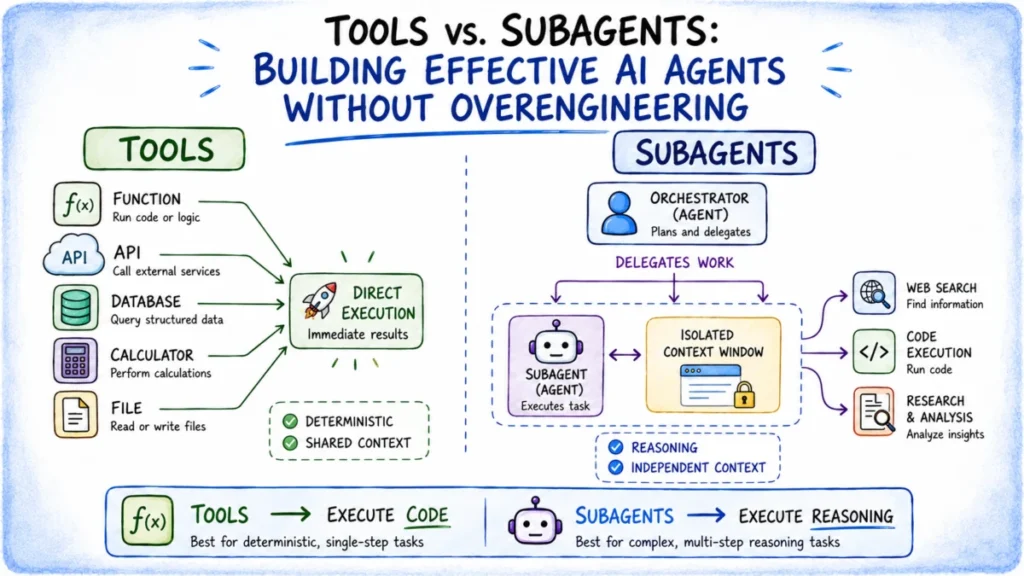
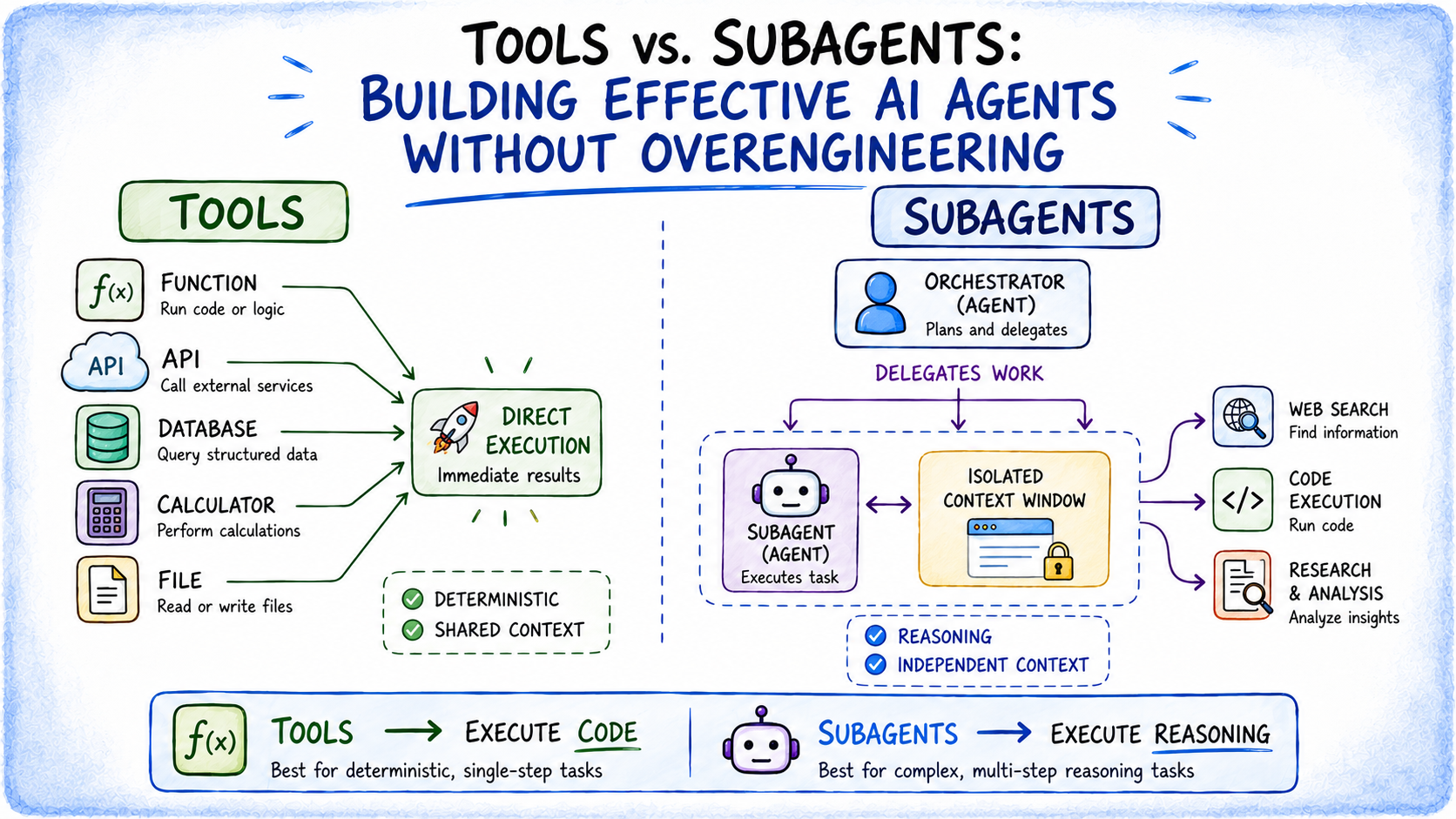
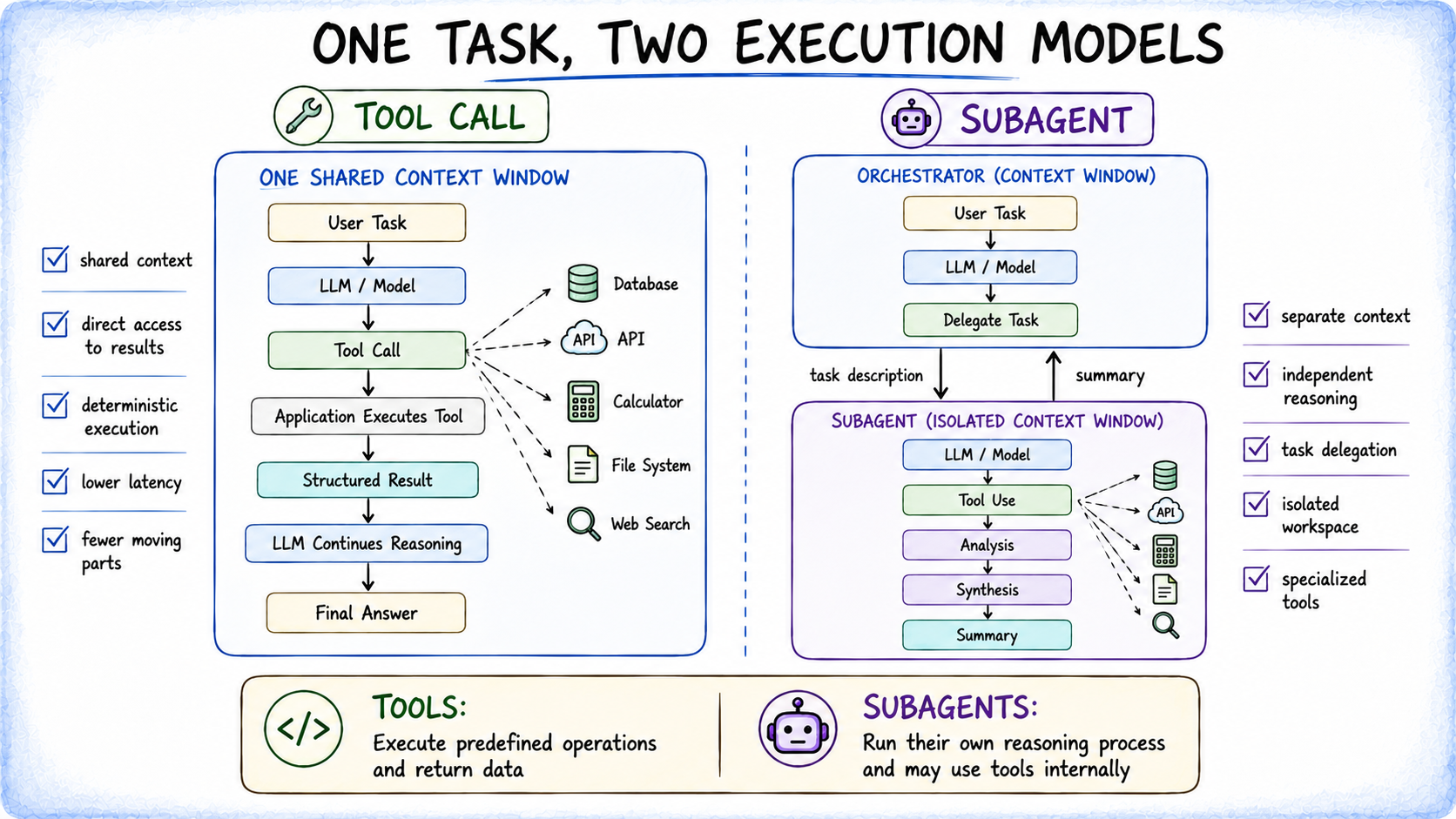
A tool is a deterministic extension of an AI model’s capabilities. In technical terms, it is a function, an API endpoint, or a script exposed to the model through a schema. When an agent calls a tool, it is essentially saying, "I have reached the limit of my linguistic processing; I now need to offload this specific operation to a piece of verified, executable code."
Tools are fast, predictable, and—crucially—they do not possess "intent." They execute a task and return a result. They are the workhorses of the AI world, handling data retrieval, mathematical operations, and system interactions without requiring the LLM to think twice about the underlying mechanics.
What Are Subagents?
A subagent is, for all intents and purposes, a recursive iteration of the agent itself. It is a distinct LLM instance equipped with its own system prompt, its own context window, and its own specialized set of tools. When an orchestrator delegates a task to a subagent, it is not merely asking for a calculation; it is asking for a thought process.
From the orchestrator’s perspective, the subagent is a black box. The orchestrator sends a directive and receives a summary. In between, the subagent may perform a multi-step reasoning loop, potentially calling several tools of its own to synthesize a final answer.
Chronology of the Decision-Making Process
For engineering teams, the implementation lifecycle typically follows a predictable trajectory.
Phase 1: The Monolithic Prototype
Most projects begin with a single, highly capable agent. Developers provide it with a large "toolbelt." At this stage, the agent is efficient. It maintains a coherent state and has a high degree of visibility into the problem space.
Phase 2: The Complexity Threshold
As the application requirements grow, the "toolbelt" becomes unmanageable. The agent begins to struggle with tool selection (the "lost in the middle" phenomenon) and the context window becomes cluttered with the results of intermediate tasks. Developers realize that a single agent cannot effectively manage both high-level strategy and low-level granular execution.
Phase 3: The Modular Shift
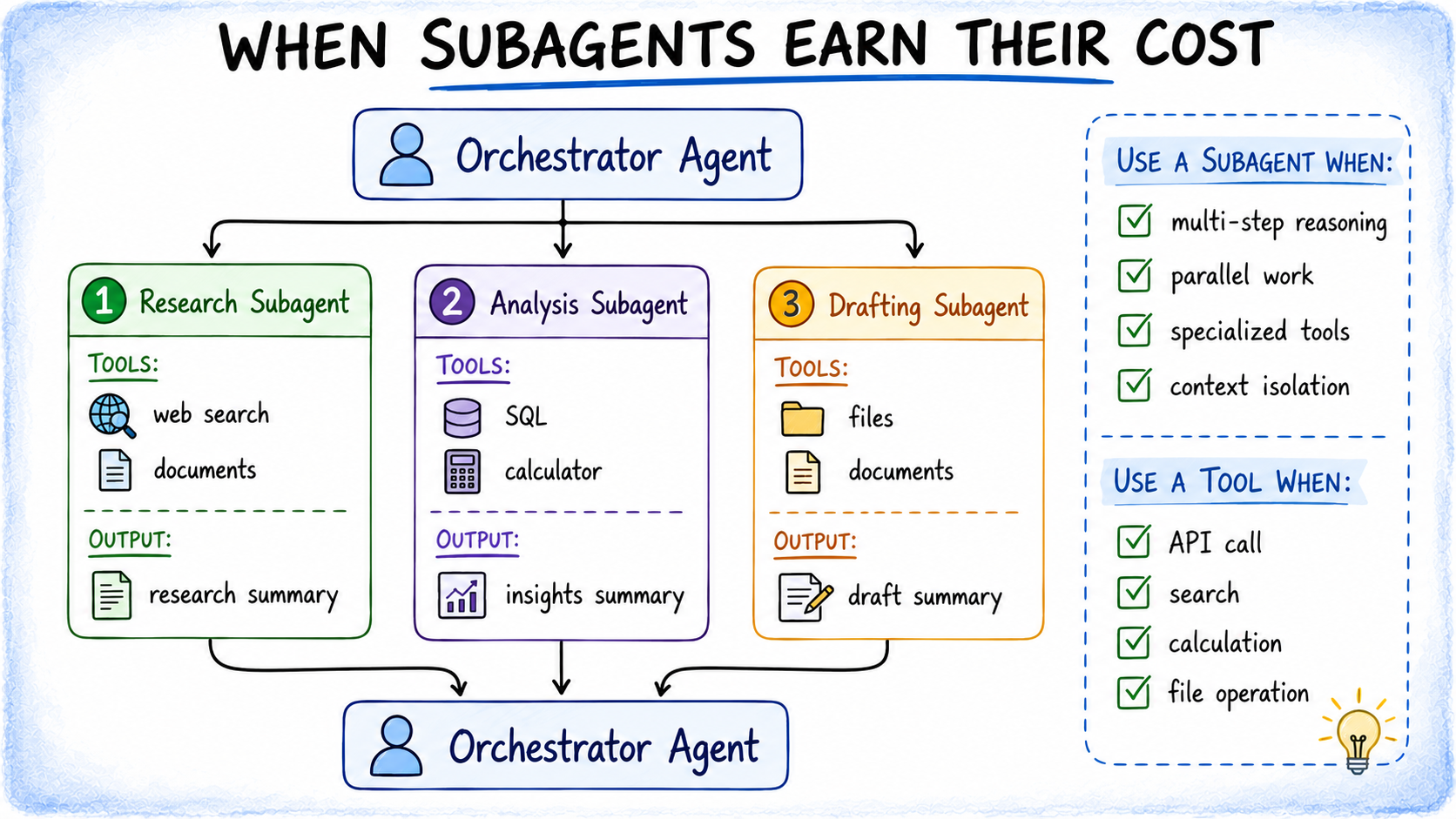
This is where the architecture splits. Developers begin to abstract complex, multi-step workflows into subagents. A "Research Agent" might be spun off to handle deep-web analysis, while a "Coding Agent" is tasked with generating and verifying syntax. The primary agent becomes an "Orchestrator," focusing on coordination rather than execution.
Supporting Data: When to Use Which
The following table provides a breakdown of the performance trade-offs associated with each approach:
| Metric | Tool | Subagent |
|---|---|---|
| Logic Type | Deterministic/Procedural | Heuristic/Reasoning |
| Latency | Low (Execution time) | High (Inference cycles) |
| Context | Shared with parent | Isolated |
| Failure Mode | API error / Syntax error | Hallucination / Goal drift |
| Overhead | Minimal | High (Orchestration cost) |
The Case for Tools
If you can express a task as a Python function—e.g., calculate_tax(amount) or get_weather(location)—it should be a tool. Tools provide:
- Reliability: You can unit test a function. You cannot easily "unit test" an LLM’s reasoning chain.
- Speed: Executing a SQL query is orders of magnitude faster than waiting for an LLM to generate a thought process about how to query a database.
- Cost: Tools cost pennies in compute; subagents consume significant token budgets.
The Case for Subagents
Subagents should be reserved for tasks that require subjective judgment or recursive discovery. If the task requires "Research," "Drafting," or "Strategy," it likely involves a series of decisions where the output of step one dictates the parameters of step two. Subagents excel here because they provide an isolated context, preventing the "noisy" intermediate steps of a large research project from polluting the primary agent’s workspace.
Implications of Overengineering
A common trap in modern AI development is the urge to "agentify" every interaction. This is often termed "architectural gold-plating." By introducing subagents prematurely, developers inadvertently create a "distributed system" problem.
- Debugging Nightmares: When a system consists of five interconnected agents, tracing a single hallucination becomes exponentially more difficult. If a subagent provides a bad result, is it because the instruction was unclear, or because the subagent’s internal prompt was misaligned?
- Context Fragmentation: When subagents operate in silos, they lose the "global" perspective of the main task. If not managed with precise interface contracts, the system can suffer from "semantic drift," where the subagent solves the problem correctly but in a way that is incompatible with the orchestrator’s needs.
- Latency Accumulation: In an agentic chain, every handoff adds seconds of latency. A user waiting for an answer to a simple question does not want to watch three different agents "think" in sequence.
Official Guidelines for Agent Design
Leading industry frameworks, including those utilized by major research labs, suggest a "Default to Tools" policy.
- Start with a "Fat" Agent: Begin with one agent and a set of robust tools. Do not segment until the context window explicitly fails to handle the complexity or the tool list exceeds the model’s capacity to choose accurately.
- The "Clear Handoff" Protocol: If you must use a subagent, ensure the interface is strict. Pass only the necessary input data and expect only a concise summary. Avoid passing "full context" to subagents, as this often leads to context-window bloat and higher token costs.
- Observe the "Contract": Treat subagents like microservices. A subagent should have a defined contract: Input -> Process -> Output. If the subagent needs to talk back to the orchestrator mid-process, your architecture is likely too tightly coupled.
Conclusion: The Path Forward
The goal of agentic architecture is not to build the most complex system, but to build the most resilient one. Tools represent the bridge between the AI’s "brain" and the reality of external data and systems. Subagents represent the delegation of cognitive load.
By defaulting to tools for execution and reserving subagents for genuine reasoning, developers can avoid the pitfalls of overengineering. The most effective agents are those that keep the "thinking" centralized and the "doing" distributed. As the ecosystem matures, the ability to discern when to call a function versus when to spawn an agent will define the difference between a high-performing production system and a fragile, experimental prototype.
In the final analysis, remember the golden rule of agentic design: Pass tasks down, pass conclusions back up. If you follow this simple hierarchy, your architecture will remain scalable, debuggable, and performant, no matter how complex the underlying task becomes.