Breaking Language Barriers: Building a Unified Multilingual Text Classification Pipeline
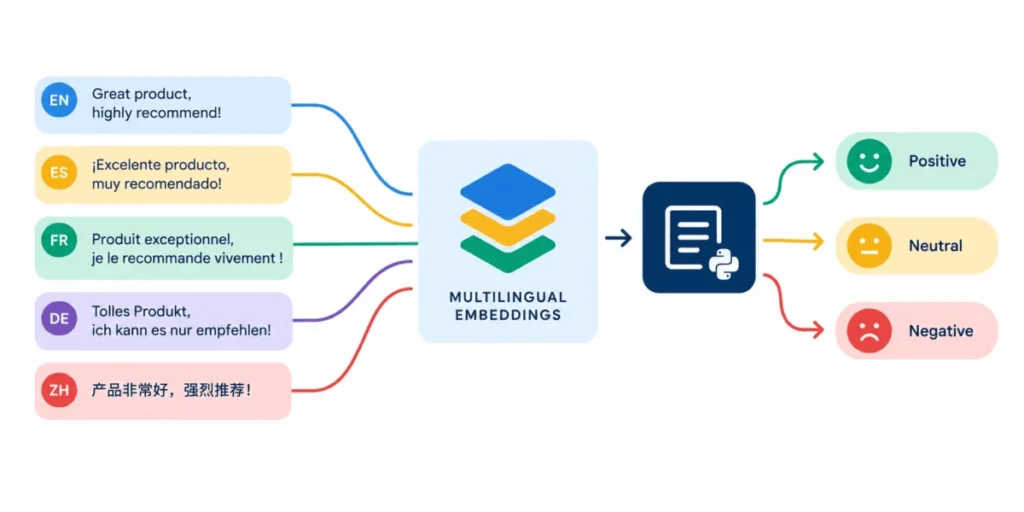
In the rapidly evolving landscape of Natural Language Processing (NLP), the ability to process and classify information across linguistic boundaries is no longer a luxury—it is a business necessity. Traditionally, building a global classification system meant maintaining a fractured architecture: a separate model for English, another for Spanish, a third for French, and so on. This "siloed" approach was not only an operational nightmare in terms of maintenance and compute resources, but it also ignored the underlying semantic commonalities shared across human languages.
Today, we are witnessing a paradigm shift. Thanks to the advent of Multilingual Large Language Model (LLM) embeddings and integration libraries like Scikit-LLM, developers can now build a single, unified pipeline that treats language as a feature rather than a barrier. This article explores how to architect such a system, leveraging the power of local inference with Ollama and the flexibility of Scikit-learn.
The Core Concept: Semantic Vector Spaces
At the heart of this innovation lies the concept of the Shared Embedding Space. When a state-of-the-art multilingual model—such as the BGE-M3 model—processes a sentence, it does not merely look at the vocabulary. Instead, it converts the input into a high-dimensional vector.
Crucially, because these models have been pre-trained on massive datasets spanning over 100 languages, they learn to map semantically equivalent concepts to the same location in the vector space. Consequently, the English phrase "This product is fantastic!" and the Spanish equivalent "¡Este producto es fantástico!" end up as nearly identical numerical vectors. By training a lightweight classifier (like Logistic Regression) on these vectors, the model learns to identify "sentiment" or "intent" regardless of the underlying syntax or grammar.
Chronology of Development: A Step-by-Step Implementation
Building this pipeline requires a clean, reproducible environment. By avoiding proprietary APIs like OpenAI, we ensure that our solution is cost-effective, private, and portable.
Phase 1: Environment Setup
The initial stage focuses on preparing the infrastructure. We must install the necessary Python ecosystem, including scikit-llm for LLM integration and datasets for data handling. Furthermore, we deploy the Ollama distribution to run our embedding model locally.
# Installing core dependencies
pip install scikit-llm "datasets==2.19.1" -q

# Ensure system requirements for local LLM orchestration
apt-get update -qq && apt-get install -y -qq zstd

# Initialize the local inference engine
curl -fsSL https://ollama.com/install.sh | sh
Phase 2: Orchestrating the Local Server
Once the environment is ready, we treat the local machine as an API endpoint. Using Python’s subprocess module, we spin up the Ollama server and pull the BGE-M3 model—a powerhouse in multilingual retrieval and embedding generation.
import subprocess
import time

# Launching the server in the background
subprocess.Popen(["ollama", "serve"])
time.sleep(5)

# Downloading the embedding model
subprocess.run(["ollama", "pull", "bge-m3"])
Phase 3: Configuring the Scikit-LLM Bridge
Scikit-LLM acts as the connective tissue between the Scikit-learn API and our local LLM. We point the library to the local server URL (http://localhost:11434/v1/). Even though Ollama doesn’t require a paid subscription, the internal client expects an API key, allowing us to pass a "dummy" key to satisfy the configuration requirement.
Data Acquisition and Preprocessing
For this implementation, we utilize the Amazon Multi-language Reviews dataset. This dataset is a gold standard for classification tasks, as it contains user-generated content across various languages, tagged with 1-to-5-star ratings.
To ensure our pipeline is robust, we perform a balanced sampling:
- Selection: We draw 1,000 samples each from English and Spanish subsets.
- Shuffling: Randomizing the data is critical to prevent the model from learning patterns based on the order of samples rather than the content of the reviews.
- Verification: We confirm that our target variable (the 5-star scale, labeled 0–4) is well-distributed.
This phase is the "reality check" for the model. By combining the data into a single Pandas DataFrame, we effectively train our downstream classifier on a mixed-language dataset, forcing the model to generalize across linguistic differences.
The Pipeline Architecture
The magic of this approach is captured in a single Scikit-learn Pipeline object. The pipeline consists of two stages:
- The Vectorizer: The
GPTVectorizer(usingbge-m3) processes raw text and returns numerical embeddings. - The Classifier: A
LogisticRegressionmodel takes these embeddings and maps them to the specific rating labels.
from skllm.models.gpt.vectorization import GPTVectorizer
from sklearn.pipeline import Pipeline
from sklearn.linear_model import LogisticRegression

pipeline = Pipeline([
    ("vectorizer", GPTVectorizer(model="bge-m3", batch_size=32)),
    ("classifier", LogisticRegression(max_iter=1000))
])

# Training
pipeline.fit(X_train, y_train)
By the time the data hits the LogisticRegression layer, the "language" of the input is irrelevant. The classifier is only looking at the dense vector representations, which have already been normalized into a common, language-agnostic space.
Implications of Multilingual Embeddings
The implications of this technology are far-reaching, particularly for global enterprises and developers working on resource-constrained projects.
1. Reducing Operational Complexity
Previously, maintaining ten models for ten languages was a significant overhead. Updates to one model could cause performance drift in another. A unified pipeline allows developers to manage a single codebase and a single training cycle. If you need to add support for a new language, you don’t need a new model; you simply feed the new language into the existing pipeline.
2. Improved Performance on Low-Resource Languages
By training on a combined dataset, the model benefits from "transfer learning." The nuances learned from high-resource languages (like English) help the model understand sentiment patterns that can then be applied to lower-resource languages. The model isn’t just learning to classify English; it is learning to classify the concept of sentiment.
3. Handling Nuance and Context
Traditional translation services often strip away cultural nuance or slang, which are essential for accurate sentiment analysis. By using embedding models, we avoid the "translation step" entirely. The model analyzes the text in its native form, capturing the specific linguistic markers that indicate satisfaction or frustration.
Analyzing the Results: Where Do We Go From Here?
As demonstrated in our classification report, the initial model achieves moderate success. We observe a clear pattern: extreme ratings (1-star and 5-star) are classified with higher precision than intermediate ratings (2, 3, and 4 stars).
Why does this happen?
- Subjectivity: Extreme reviews often contain highly polarized, emotionally charged words (e.g., "terrible," "amazing," "broken"). Intermediate reviews are inherently more ambiguous, as they often contain a mix of positive and negative sentiments, making the classification task more difficult for any machine learning model.
- Data Imbalance: While we balanced the languages, the distribution of sentiment within the reviews may vary. If a dataset has fewer 2-star reviews, the model will naturally struggle to identify the specific characteristics of that rating.
Future Refinements:
To improve these results, one might consider:
- Fine-tuning the Embedding Model: While
BGE-M3is excellent out-of-the-box, fine-tuning it on specific domain data can drastically improve performance. - Hyperparameter Tuning: Adjusting the regularization strength of the
LogisticRegressionmodel or switching to a more complex classifier, like an XGBoost model, could capture non-linear relationships in the embedding space. - Expanding the Dataset: A larger sample size would allow the classifier to better distinguish between the nuanced middle-ground ratings.
Conclusion
The era of training isolated, language-specific models is drawing to a close. By leveraging multilingual LLM embeddings, we have unlocked a future where the language of the input is secondary to the intelligence of the output. This approach is not only more efficient and maintainable but also more equitable, allowing developers to build robust, high-quality applications that serve a global user base with equal proficiency. Whether you are building a customer support bot, a review sentiment analyzer, or a global content moderation tool, the path forward is clear: integrate, vectorize, and unify.