Reclaiming Your Digital Sovereignty: Building a Zero-Cost Agentic AI Workflow with Hermes and Ollama
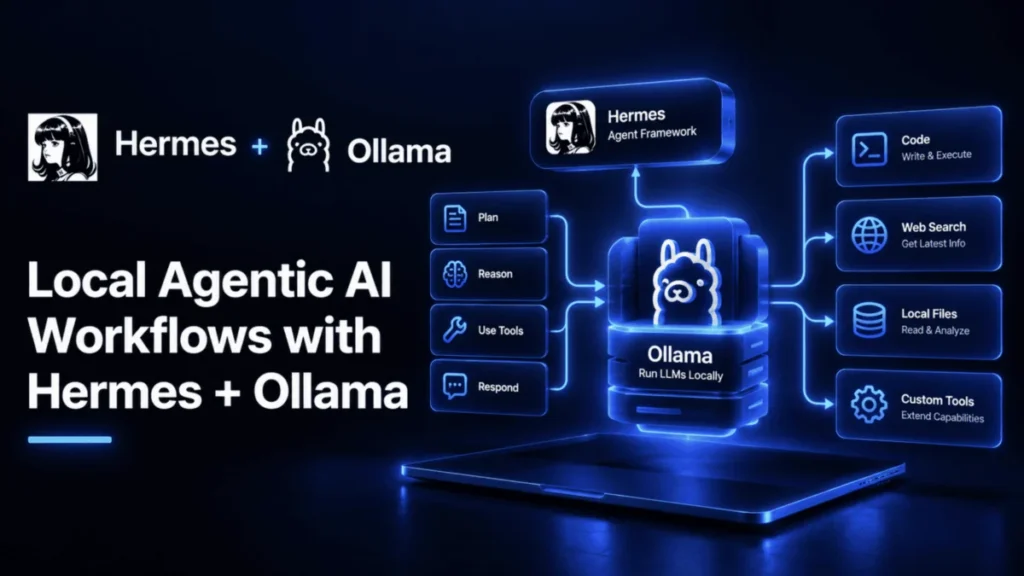
In an era where artificial intelligence is increasingly synonymous with massive, opaque cloud-based data centers, a quiet revolution is taking place at the edge. Developers, privacy advocates, and power users are moving away from the "pay-per-token" model in favor of local-first architectures. By pairing Hermes Agent with Ollama, it is now possible to orchestrate a fully functional, agentic AI workflow that performs complex tasks—file management, web searching, and terminal operations—without a single byte of your proprietary code or private data ever crossing your hardware boundary.
This article explores the technical landscape of local agentic workflows, the economic necessity of local model serving, and the precise, step-by-step methodology for constructing an AI assistant that lives entirely on your machine.
The Economics of Privacy: Why Local Matters
For the average developer or automation enthusiast, relying on cloud-based Large Language Models (LLMs) like OpenAI’s GPT-4o or Anthropic’s Claude 3.5 Sonnet is a costly endeavor. According to recent cost breakdowns provided by Nous Research, a consistent workload of agentic tasks—which involve multiple reasoning steps, recursive tool calls, and lengthy context windows—can result in monthly bills ranging from $5 to $20 for light users, and significantly more for power users.
Beyond the financial drain, there is the "oversight cost." Every file uploaded for analysis, every debugging session, and every creative draft is transmitted to third-party servers. For companies handling sensitive intellectual property or individuals working with private data, this creates an unavoidable security risk. The architecture presented here—a local-first stack—eliminates these costs and risks entirely. By using your own hardware as the compute engine, you transform AI from a rented service into a persistent, private utility.
Decoding the Architecture: Hermes and Ollama
To achieve this, we rely on a two-part stack. At the foundation is Ollama, the industry-standard tool for downloading and serving open-weight models locally. It acts as the "brain," providing an OpenAI-compatible API endpoint (/v1/chat/completions) that allows other software to interact with a model as if it were a cloud service.
Sitting atop Ollama is Hermes Agent. Released by Nous Research under the MIT license, Hermes is a sophisticated orchestration layer. Unlike a basic chatbot, Hermes is an agent. It possesses "tool-calling" capabilities, meaning it can decide when to invoke system-level functions:
- File System Operations: It can read, write, and organize local directories.
- Terminal Execution: It can run shell commands to compile code or query system data.
- Sandboxing: It isolates execution environments via Docker, SSH, or local backends, ensuring that the AI’s actions do not compromise the integrity of your host OS.
- Persistent Memory: It learns from past interactions, allowing it to refine its performance over time.
Chronology of Setup: From Zero to Agentic Assistant
Building this system requires a systematic approach. We start by provisioning the local inference engine before configuring the agentic controller.
Phase 1: Provisioning the Inference Engine
First, ensure your hardware meets the baseline requirements. While 8GB of RAM can handle smaller 3B parameter models, a production-ready agentic setup—capable of reliable tool use—ideally requires 32GB of RAM and a dedicated NVIDIA GPU with at least 8GB of VRAM.
- Install Ollama: Execute the official installation script:
curl -fsSL https://ollama.com/install.sh | sh. - Verify Connectivity: Run
ollama --versionto confirm installation, then query the local API:curl http://localhost:11434/api/tags. An empty"models":[]response indicates a healthy, empty server. - Pull the Model: Choose your model wisely. For agentic tasks, the "Tool Calling" capability is non-negotiable. Currently, models like
gemma4:31bprovide the reasoning depth required to handle complex tool-use logic.
Phase 2: Wiring the Agent
Once the model is active, configure Hermes to communicate with Ollama. In the ~/.hermes/config.yaml file, define the provider as custom:
model:
  default: "gemma4:31b"
  provider: "custom"
  base_url: "http://localhost:11434/v1"
This configuration instructs Hermes to route all logic requests to your local localhost port rather than an external cloud provider.
Supporting Data: Selecting the Right Model
Not all models are built for agentic work. As shown in the performance matrix below, the choice of model dictates the success of your automation:
| Model | Size | RAM Needed | Tool Use? | Best For |
|---|---|---|---|---|
| gemma4:31b | ~20GB | 24GB+ | Yes | Heavy reasoning, coding, agents |
| gemma2:9b | ~5GB | 8GB+ | No | Conversational tasks |
| llama3.2:3b | ~2GB | 4GB+ | No | Ultra-fast simple Q&A |
For users on constrained hardware, a critical tip is to leverage GPU offloading. Ollama will automatically utilize NVIDIA CUDA cores if available. Even if only 40 layers of a 31B model fit on your VRAM, the speedup compared to pure CPU inference is exponential, often moving from 2 tokens-per-second to 15-20.
Optimization: The 64k Context Window
A common pitfall in local agentic workflows is the default context window. Standard models often default to 2,048 tokens, which is insufficient for an agent that needs to "read" an entire project repository. You can extend this by creating a custom Modelfile:
FROM gemma4:31b
PARAMETER num_ctx 64000
By running ollama create gemma4-64k -f /tmp/Modelfile, you create a new model variant capable of "remembering" significantly more file data, which is essential for complex coding tasks.
Implications: The Future of Hybrid AI
The true power of this setup lies in its extensibility. Once the local agent is functional, you can attach a Messaging Gateway. By adding your Telegram bot token to the Hermes configuration, you effectively carry your AI assistant in your pocket. Because the agent is running on your machine, your phone simply acts as a remote control for your local server.
Furthermore, we must address the "Hard Question" dilemma. Local models are powerful, but they are not omniscient. Hermes allows for the configuration of fallback_providers. This enables a hybrid workflow: 90% of your daily operations—organizing files, drafting emails, summarizing notes—happen for free on your machine. Only when the local model determines a query is beyond its current capability does it route to a paid API like Claude or OpenAI. This is the ultimate "best of both worlds" scenario: total privacy for the mundane, and premium power for the exceptional.
Conclusion: A New Standard for Workflow
Building a local, agentic AI workflow is no longer an academic exercise reserved for machine learning engineers. With tools like Hermes Agent and Ollama, it has become a pragmatic solution for anyone looking to increase their productivity without compromising their privacy or budget.
By taking control of your AI stack, you ensure that your digital workspace remains your own. You are no longer just a user of a service; you are the owner of an intelligent system that grows with your projects, learns from your habits, and respects the sanctity of your local files. As local hardware continues to improve, the gap between cloud-based and local-first AI will continue to shrink, making this transition not just a temporary trend, but the inevitable future of personal computing.