Architectural Intelligence: The Evolution of AI Agent Action Primitives
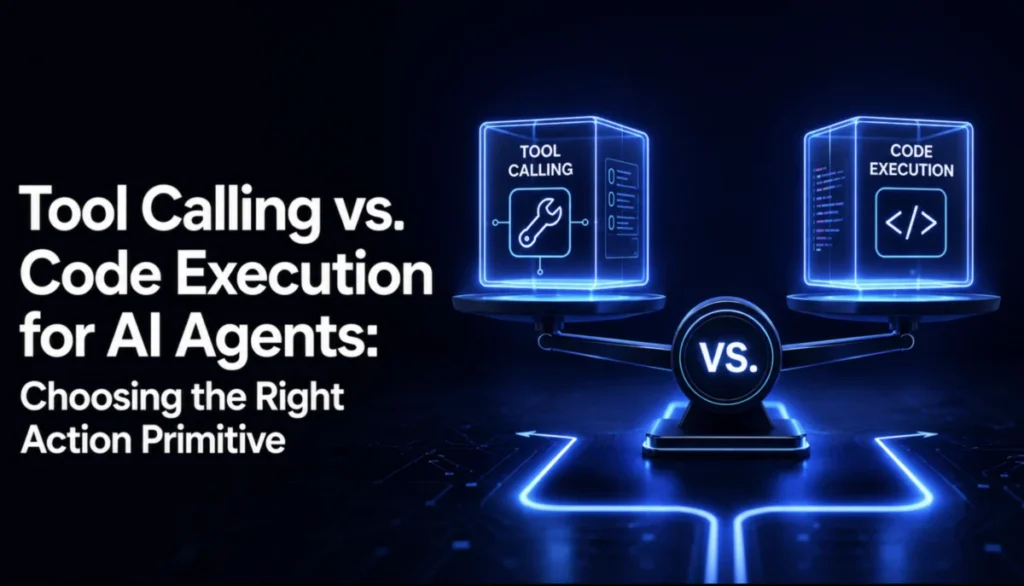
In the rapidly maturing landscape of artificial intelligence, the focus is shifting from simple text generation to the development of sophisticated autonomous agents. These agents are tasked with performing complex, real-world workflows—from auditing financial records to synthesizing multi-source research. However, a critical design hurdle persists: how do these systems actually "act" in the digital world?
At the core of every agent framework lies an "action primitive," the foundational mechanism that allows a language model to translate a cognitive decision into a tangible result, such as a database write, an API request, or a file manipulation. While early agent development relied almost exclusively on standard tool calling, the industry is increasingly adopting code execution as a more robust, scalable alternative. Understanding the functional, economic, and technical differences between these two primitives is no longer a niche concern; it is an architectural requirement for any developer aiming to build production-grade AI systems.
The Problem of Context Bloat: A Case Study in Inefficiency
To understand the necessity of this evolution, consider a common enterprise task: identifying which of twenty employees exceeded their Q3 travel budget. To solve this, an agent must retrieve expense line items, flight logs, hotel receipts, and meal records for each individual, then cross-reference these against variable budget limits.
If designed using traditional, sequential tool calling, the agent would initiate twenty separate tool requests. Each return, containing dozens of line items, would be fed directly into the model’s context window. The result? Over 2,000 line items and more than 50KB of raw data—the vast majority of which the model never needs to read. The model doesn’t need to "see" every coffee receipt; it only needs the final sum. This is the "hidden tax" of inefficient design, resulting in unnecessary latency, inflated token costs, and a higher probability of model hallucination due to context window overcrowding.
Defining the Action Primitives
Tool Calling: The Traditional Sequential Loop
Tool calling is the established standard. In this paradigm, the model is trained to identify when an external function is required. It outputs a specific, structured JSON payload that the host application intercepts. The application then executes the function and feeds the result back into the model’s context, effectively treating the output as if it were the next piece of user input.
This approach offers significant advantages in terms of auditability and simplicity. Because every interaction is a discrete, logged event, it is straightforward to monitor and debug. The model is forced to "reason" through every piece of data it receives, which is ideal for tasks requiring human-in-the-loop oversight or nuanced interpretation of intermediate results.
Code Execution: The Programmatic Paradigm
Code execution represents a fundamental departure. Instead of requesting a single action, the model is empowered to write a complete script—typically in Python or TypeScript—that resides within a sandboxed, secure environment. This environment, often leveraging patterns like Anthropic’s Model Context Protocol (MCP), allows the agent to perform multiple actions in parallel or in complex sequences.
The key innovation here is "Programmatic Tool Calling." By utilizing an allowed_callers parameter, developers can grant the model permission to call specific tools directly from within the sandbox. The model writes the logic (loops, conditionals, error handling), executes the tasks, and only returns the final, synthesized output to the primary conversational thread. This effectively hides the "noise" of intermediate data from the model’s context.
Chronology: From Simple Tools to Advanced Orchestration
The trajectory of this technology reflects the broader maturation of LLM capabilities.
- 2023 – Early 2024: The "Tool Calling" era. Developers treated models as simple API routers. Frameworks like LangChain and early agentic libraries standardized the JSON-based tool-use pattern.
- Late 2024: The emergence of "CodeAct" research. Papers began documenting that models perform significantly better on complex, multi-step logic tasks when they write code rather than just requesting tool outputs.
- November 2025: The shift to "Programmatic Tool Calling." With the release of advanced features by major labs like Anthropic, the distinction between "tool-calling" and "coding" began to blur, allowing for a hybrid approach where models can choose their execution method based on the complexity of the task at hand.
Supporting Data: The Case for Efficiency
The transition to code execution is not merely a matter of developer preference; it is supported by significant performance gains.
According to internal benchmarks shared by developers and AI research labs, the move from sequential tool calling to code execution can reduce token usage by as much as 37% on complex research tasks. Even more compelling are the accuracy metrics: in the GAIA benchmark, agents utilizing programmatic code execution saw accuracy rise from 46.5% to 51.2%.
Furthermore, the "CodeAct" paper (Wang et al., 2024) demonstrated that agents capable of writing their own code to solve problems exhibit a 20% increase in success rates for multi-step tasks. These figures suggest that when a model is forced to manage intermediate state through its own code, rather than through natural language, it effectively reduces the "reasoning tax" that leads to logical errors and calculation mistakes.
Implications for Development and Infrastructure
For software architects and developers, the choice between these primitives has profound implications for system design.
When to Stick with Tool Calling
Tool calling remains the superior choice for:
- Single-Step Tasks: If an agent only needs to perform one lookup (e.g., "What is the current weather in London?"), the overhead of initializing a sandboxed code environment is counterproductive and increases latency.
- High-Touch Reasoning: If the model must perform qualitative analysis on raw data—such as analyzing the sentiment of a specific paragraph within a document—the data must be present in the context window.
- Simplicity and Auditability: If your organization lacks secure sandboxing infrastructure, or if every single intermediate step must be logged for regulatory compliance, standard tool calling is the safer, more transparent path.
When to Pivot to Code Execution
Code execution becomes the clear winner when:
- Fan-Out and Aggregation: If you need to perform actions on a list of items (e.g., "Summarize these 50 reports"), the model should loop through them in a script, not in the conversational stream.
- Large Payloads: If the data being processed is large or contains sensitive information (PII) that should not be repeatedly passed through the LLM, keeping that data inside the execution sandbox is a critical security and cost optimization.
- Complex Multi-Step Logic: Whenever a task requires conditional branching or mathematical aggregation, the model will be more accurate if it offloads that logic to a Python interpreter.
Official Guidance and Best Practices
Industry leaders, including Anthropic, now advocate for a hybrid approach. Their current guidance suggests that developers should not view these primitives as mutually exclusive. Instead, sophisticated agents should be designed to dynamically choose the right tool for the job.
This is often achieved by providing the model with a "toolbox" that includes both standard API-linked tools and a "code execution" tool. If the model determines that a request requires data aggregation or iterative processing, it invokes the code execution tool. For simpler, one-off inquiries, it defaults to direct tool usage. This adaptive strategy allows for a "best-of-both-worlds" architecture: the reliability and transparency of tool calling paired with the power and efficiency of programmatic execution.
Conclusion: The Future of Agentic Workflows
The evolution of action primitives marks a shift from "AI as a chatbot" to "AI as a worker." By moving beyond the limitations of simple, linear tool-calling loops, developers are enabling agents to handle tasks that require genuine, reliable computation.
Ultimately, the goal of an agentic architecture is to ensure that the language model is doing what it does best—reasoning, planning, and language synthesis—while delegating calculation, data handling, and multi-step orchestration to robust, verifiable code. As these patterns continue to refine, the distinction between the model and the application will grow increasingly thin, leading to agents that are not only more capable but also more cost-effective and accurate than the rigid systems of the past. For the modern developer, mastering the interplay between these primitives is the first step toward building the next generation of autonomous digital intelligence.