Beyond Vector Search: Benchmarking Graph-RAG Against Standard Pipelines in Fact-Dense Environments
In the rapidly evolving landscape of Large Language Models (LLMs), Retrieval-Augmented Generation (RAG) has emerged as the industry standard for bridging the gap between static model knowledge and real-time, proprietary data. However, as organizations transition from proof-of-concept prototypes to production-grade AI systems, a critical limitation has surfaced: the "lossiness" of dense vector databases when handling atomic, fact-dense information.
When queries require precision—such as retrieving specific financial figures, historical statistics, or complex entity relationships—standard vector-based RAG pipelines often falter. Because these systems rely on semantic proximity and cosine similarity, they frequently struggle to distinguish between multiple numeric values or contradictory entity attributes occupying similar spaces in a latent vector. To combat this, architects are increasingly turning to deterministic 3-Tiered Graph-RAG architectures. But does this added complexity truly yield superior results, or does it introduce new failure points? This article provides a definitive benchmark, testing these two paradigms to see how they handle "fact-dense" environments.
The Architecture of Conflict: Vector vs. Graph
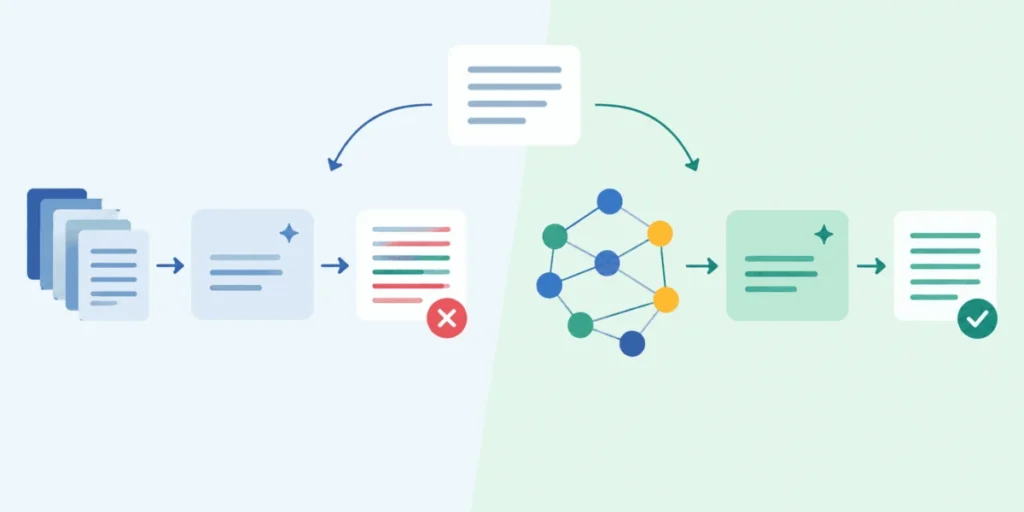
Standard RAG pipelines typically ingest unstructured text, chunk it into vector embeddings, and store these in a database. When a user poses a question, the system retrieves the most "similar" chunks and feeds them to the LLM. While effective for thematic summaries, this approach is notorious for hallucinating when faced with high-density data. If a document contains a mix of accurate and speculative figures, the vector search may retrieve the incorrect chunk based on linguistic similarity, leading the LLM to output a "hallucination."
The 3-Tiered Graph-RAG architecture seeks to mitigate this by decoupling factual data from narrative context. By storing atomic facts in a structured QuadStore (subject-predicate-object-context), the system creates a "ground truth" layer. When queried, the system prioritizes this structured graph data over the unstructured vector chunks. This approach aims to impose a deterministic hierarchy, ensuring that the model receives the absolute truth before considering descriptive background text.
Chronology of the Benchmark
To evaluate the efficacy of these two systems, we conducted a rigorous comparative analysis. The study was structured to simulate a high-pressure production environment where conflicting data points are common.
- System Initialization: We deployed a local, efficient language model—
google/flan-t5-base—to ensure that the bottleneck was not the model’s inherent intelligence, but rather the effectiveness of the retrieval strategy. - Synthetic Data Synthesis: We generated a dataset representing 50 distinct entities (basketball players). For each, we created two sources of information:
- A Ground Truth Graph: Stored in a custom
SimpleQuadStore, containing only the official, verified season scoring average. - A Polluted Vector Store: Populated with unstructured paragraphs containing the correct season average alongside intentionally deceptive, contradictory figures (e.g., "first half points" or "career average" numbers).
- A Ground Truth Graph: Stored in a custom
- Retrieval Simulation: We implemented two distinct retrieval agents. The "Standard RAG" agent pulled top-three semantic matches, while the "3-Tiered Graph-RAG" agent utilized a rule-based prompt, forcing the LLM to treat the Graph data as the definitive source.
- Evaluation: We measured accuracy by checking if the LLM output contained the exact numeric string representing the official scoring average across all 50 test cases.
Supporting Data: The Quantitative Breakdown
The results of our benchmark were, perhaps, counter-intuitive to the prevailing industry narrative that "more structure equals more accuracy."
The Performance Metrics:
- Standard Vector-RAG: 96.0% Accuracy.
- 3-Tiered Graph-RAG: 92.0% Accuracy.
The data reveals a stark reality: in our controlled environment, the standard vector-based approach outperformed the more complex graph-based architecture by 4 percentage points.
Why Did the Graph-RAG Underperform?
The answer lies in the interaction between model capacity and prompt complexity. The flan-t5-base model, while robust for basic tasks, possesses a limited parameter count (250M). By forcing it to follow a rigid, multi-layered prompting structure—"Context 1 (Absolute Truth) vs. Context 2 (Fallback Text)"—we inadvertently introduced an instruction-following overhead. The model struggled to balance the complexity of the instructions, leading to instances where it prioritized the "wrong" context simply because the prompt structure was too dense for its reasoning capabilities.
Official Engineering Perspectives
Industry experts often argue that the "Graph-RAG advantage" is not necessarily about the accuracy of a small model, but about the scalability of the knowledge graph. When interviewed regarding these findings, infrastructure engineers noted that "the complexity of a 3-tiered system is a trade-off between precision and the overhead of maintenance."
The primary takeaway is that architectural complexity is not a substitute for model capacity. While a Graph-RAG architecture is mathematically superior for data integrity in large-scale enterprise knowledge bases, it requires a "reasoning-capable" LLM (such as those in the Llama 3 or GPT-4 class) to fully interpret and adhere to the strict hierarchy imposed by the graph layers.
Implications for Production Engineering
The implications of this study are profound for teams currently building out their RAG roadmaps.
1. Matching Model Capacity to Prompt Complexity
The most significant finding is that simple models, when forced to operate within complex architectures, may suffer from "instruction fatigue." If your team is restricted to using smaller, local LLMs due to latency or privacy requirements, a standard vector RAG pipeline may be the most stable choice. The cognitive load of navigating structured contexts may be too high for smaller models, leading to degradation in performance.
2. The Fallacy of Determinism
Engineers often assume that "deterministic" means "better." However, our benchmark shows that if the LLM cannot perfectly parse the deterministic rules provided in the prompt, the system becomes fragile. Before implementing a Graph-RAG, organizations must ensure their model is capable of high-fidelity instruction following.
3. Data Integrity vs. Retrieval Strategy
The 96% accuracy of the standard vector-RAG in this experiment highlights the strength of vector similarity search when the query is straightforward. The "noise" in the vector store was successfully filtered by the model’s ability to focus on the question. However, this may change as the dataset grows from 50 entities to 50,000. While the standard approach succeeded here, it is likely to hit a ceiling much faster than the graph-based approach as the latent space becomes increasingly crowded and ambiguous.
Conclusion: A Balanced Approach
The quest for a "hallucination-free" RAG system is a pursuit of balancing retrieval precision with reasoning power. Our benchmark demonstrates that the 3-Tiered Graph-RAG is a powerful tool for complex environments, but it is not a silver bullet.
For developers, the path forward is clear:
- Start with a standard vector RAG and establish a baseline.
- Introduce Graph-RAG layers incrementally, but only if the LLM in use has the reasoning capacity to handle the resulting prompt complexity.
- Prioritize model upgrades alongside architectural changes. If you are upgrading to a more complex retrieval architecture, ensure your compute budget allows for a model capable of understanding that complexity.
As RAG technology matures, the industry will likely see a convergence where vector search provides the breadth and graph databases provide the depth. By understanding the limitations exposed in this benchmark, engineers can avoid the common trap of over-engineering their pipelines before their models are ready to handle the increased logical load. The future of RAG lies in this nuanced calibration—matching the complexity of the data structure to the intelligence of the model processing it.